Saint-Romain-en-Gal Archaeological Park: A Gallo-Roman Urban Quarter


Site at a Glance
- Rating
- 4.6
- Popularity
- Medium
- Country
- France
- Primary era
- Classical
- External website
- Open
- Eras represented
- Classical
- Civilizations
- Roman
- Site type
- City
On this page12 sections
History
Saint-Romain-en-Gal Archaeological Park in France preserves a Gallo-Roman residential and commercial quarter of Vienna, a major Roman city in Gaul and the political centre of the Allobroges, a Celtic people incorporated into the Roman world. The quarter occupied the Rhône valley opposite Vienne and extended southward into Sainte-Colombe. Its occupation began in the late first century BC, while an important phase of urban development at the beginning of the Roman era established the street grid.
Urban development and production
After the urban layout was established, wealthy merchants built large private houses with peristyles, open courtyards surrounded by columns. These residences stood among warehouses, shops, craftsmen’s premises, and workshops, creating a densely used urban quarter rather than a separate Roman city.
Pottery production formed part of the quarter’s early economic life. A workshop northeast of the site belonged to the earliest occupation phase. Another, found about 80 metres north of the archaeological park in 1977 and 1978, operated from the mid-first century and made vessels from calcareous clay, including jugs, mortars, two-handled pots, and bowls.
A third pottery workshop left a pit in the House of the Ocean Gods. It produced Aco beakers, Roman drinking vessels associated with the name Aco, from about 20 BC, as well as beakers covered with lead glaze. Its products and moulds show that moulds moved between Vienne and Lyon, although the direction of transfer remains uncertain. The workshop may have operated for only a short period.
Excavation and preservation
Excavations began in 1967 during development connected with the construction of a secondary school. They revealed the extent and richness of the ancient quarter. The Rhône department acquired the site in 1970, and a permanent archaeological team was established in 1981.
Saint-Romain-en-Gal has been protected as a historic monument since 1983 and has undergone substantial restoration. A museum was planned in 1988, with the architectural work entrusted to Philippe Chaix and Jean-Paul Morel. The museum opened in 1996. Together, the archaeological park and museum occupy about seven hectares and preserve nearly 4,000 objects and works, including around 1,160 mosaics, wall paintings, sculptures, and other ancient materials on display.
A mosaic from Saint-Romain-en-Gal entered the Louvre in 1892 and was transferred to the Museum of National Antiquities in 1935. After major restoration in 2022 and 2023, it was presented again at the museum of Saint-Romain-en-Gal in an exhibition scheduled to remain in place until 2027. A mosaic-conservation and painted-plaster restoration workshop has operated at the Gallo-Roman museum since 1981.
In 2025, archaeologists searching for the private house that contained the Seasons Mosaic discovered a mausoleum dating to about AD 50. Its occupant was probably a member of the aristocratic elite with an important political role connected to imperial power, adding evidence of high-status activity within the wider quarter.
Remains
The urban quarter
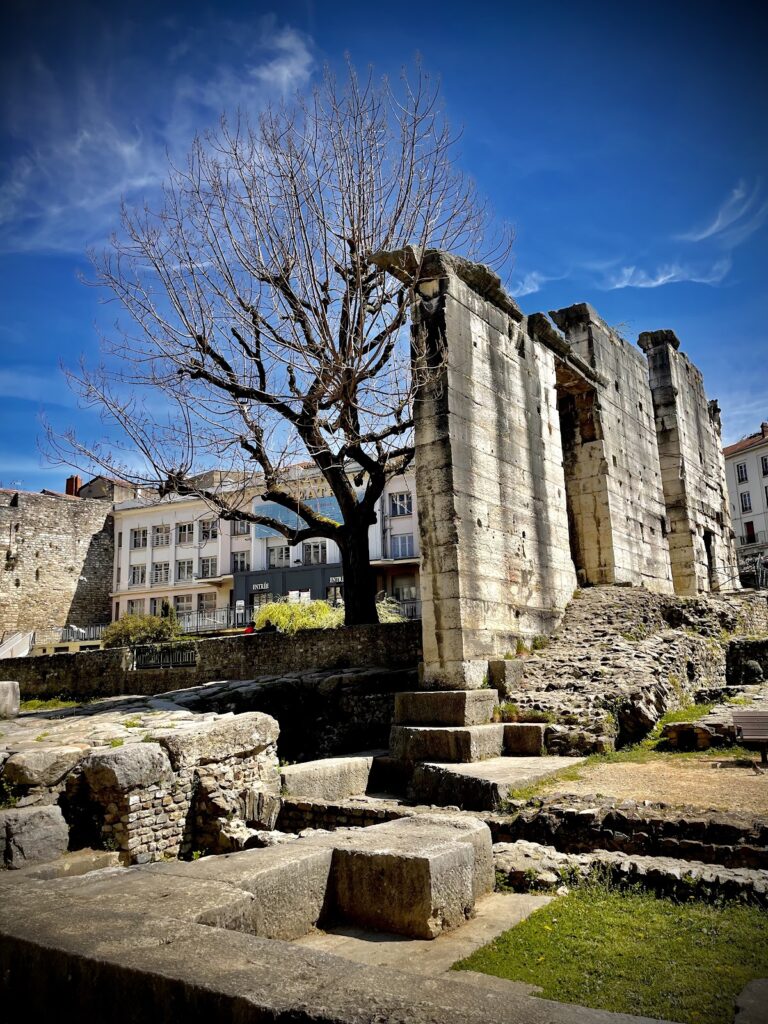
The archaeological park is laid out around the remains of a Roman urban district containing residential buildings, large courtyard houses, thermal baths, workshops, warehouses, shops, and artisans’ premises. The buildings preserve evidence of hypocaust heating, an underfloor system in which hot air from a furnace circulated beneath a raised floor and sometimes through wall ducts. Mosaics, painted walls, sculptures, everyday objects, and scale models help present the organization of the quarter and the former appearance of its buildings.
House of the Ocean Gods
The House of the Ocean Gods combines the remains of a major private residence with evidence of pottery production. A pit associated with the building belonged to a workshop that made Aco beakers and lead-glazed beakers. The site also identifies a House of Sucellus, while other large residences preserve the architectural setting of wealthy urban households.
Baths and thermal buildings
The quarter includes the Baths of the Wrestlers and the probable thermal complex known as the Palais du Miroir. These buildings form part of the district’s bath and heating installations, alongside the hypocaust systems preserved in other structures.
The Seasons Mosaic
The Seasons Mosaic was made from limestone, stone, and glass tesserae, the small pieces assembled to form a mosaic. Dated from the beginning of the second to the beginning of the third century AD, it measures approximately 4.48 by 8.86 metres. Twenty-seven surviving panels belong to a pavement that originally contained forty. Each square panel measures 59 centimetres and is bordered by a braid of multicoloured tesserae, while the outer border is formed mainly by a vine scroll with acanthus leaves.
Seasonal figures
The four central panels personify the seasons. Spring appears as a nude child, an ancient Roman Cupid figure, riding a bull. Summer shows the same figure riding a lion, and autumn shows it riding a tiger. Winter is represented by a woman wrapped in blue, riding sidesaddle on a boar and holding a long reed.
Agricultural and religious scenes
The surrounding panels depict work connected with the agricultural year, including ploughing, sowing, gathering, milling, tree grafting, collecting cuttings, and fruit picking. Viticulture appears through vineyard work, grape-treading, grape-pressing, and the coating of wine jars with pitch to make them watertight.
Four panels show religious observances associated with this seasonal cycle. They represent a sacrifice to Jupiter-Taranis, a combined Roman and Celtic divine association, ritual sowing, offerings at a temple, and the Parentalia, a February family festival commemorating the dead through offerings and a commemorative meal.
Architectural setting
The mosaic’s original architectural context remains only partly understood. A threshold lay to its north and another room to its west. Marble, fragments of capitals and columns, and heated-air ducts called tubuli indicate a luxurious building. The earlier interpretation of a public structure has been replaced by the view that the mosaic decorated a reception room in a large private residence near the Palais du Miroir.
The mausoleum
The mausoleum discovered in 2025 has an internal diameter of 15 metres and dates to about AD 50. Its scale and its probable association with an aristocratic occupant connected to imperial power provide evidence for an elite presence in the quarter during the early Roman period.