Kościół św. Mikołaja w Wierzchlesie: Gothic and Baroque Parish Church in Poland
Site at a Glance
- Rating
- 4.6
- Popularity
- Very Low
- Country
- Poland
- Primary era
- Medieval
- External website
- Open
- Eras represented
- Medieval, Early Modern
- Civilizations
- Kingdom of Poland, Polish–Lithuanian Commonwealth
- Site type
- Religious
- Remains
- Church
On this page7 sections
History
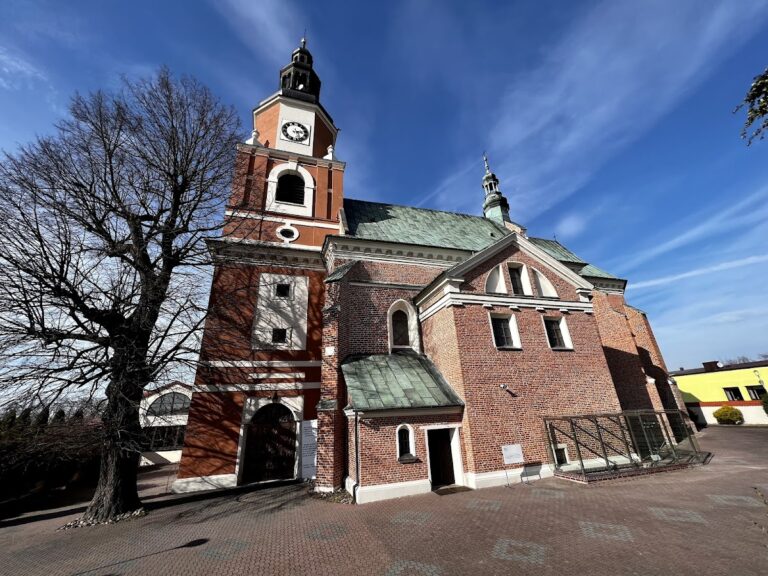
Kościół św. Mikołaja w Wierzchlesie is a Roman Catholic parish church in Wierzchlas, Poland, dedicated to Saint Nicholas the Bishop and Confessor. Probably built in the fifteenth century in the Gothic style, it belongs to the Wieluń–Saint Adalbert Deanery of the Archdiocese of Częstochowa, and its patronal feast is celebrated on 6 December. A fourteenth-century completion date has also been recorded, so the church’s precise early chronology remains uncertain.
Medieval Origins and Reconstruction
The church was repeatedly altered during its history. Fire destroyed it in 1603, but rebuilding followed soon afterward. A much more extensive reconstruction took place in 1760 with the support of Felicjan Wierzchleyski of the Berszten coat of arms. He was the local landowner and district judge, and later became a member of the Great Sejm, the national parliamentary assembly of the Polish–Lithuanian Commonwealth in the late eighteenth century. This rebuilding gave the church its Baroque character, created an octagonal room beside the nave, and included the demolition of the tower.
Nineteenth and Twentieth-Century Changes
The interior decoration was expanded in 1873, followed by major renovation in 1914. The work was supported by Father Wawrzyniec Głogowski, who later served for many years as parish priest. He was murdered at Dachau, a Nazi concentration camp in Germany, in 1942. During the German occupation from 1939 to 1945, the church was used as a grain store, and valuable objects were looted from the interior.
After the Second World War, the roof was replaced, the plaster renewed, and the interior repainted. Electrical installations were added, while new bells and a wooden floor were installed. The sacristy was renovated in 1997. Conservation work at the end of the twentieth century included the pulpit, baptismal font, and high altar. The church is listed in the historic-monument register under number 975, with the entry dated 30 December 1967.
Marian Devotion
A Marian cult at the church is associated with the image known as Our Lady of Wierzchlas. Probably dating from the eighteenth century, it is regarded by art historians as a replacement for an older copy of the Częstochowa icon that had already been venerated at Wierzchlas as miraculous. Episcopal visitation records from 1668 mention an image of Our Lady of Częstochowa in the high altar, together with two gilded silver crowns and nineteen votive offerings. The image and its cult were mentioned again in records from 1730 and 1746. The church has since been established as a diocesan sanctuary, a church formally recognized as a place of particular religious devotion.
Remains
Exterior Form and Layout
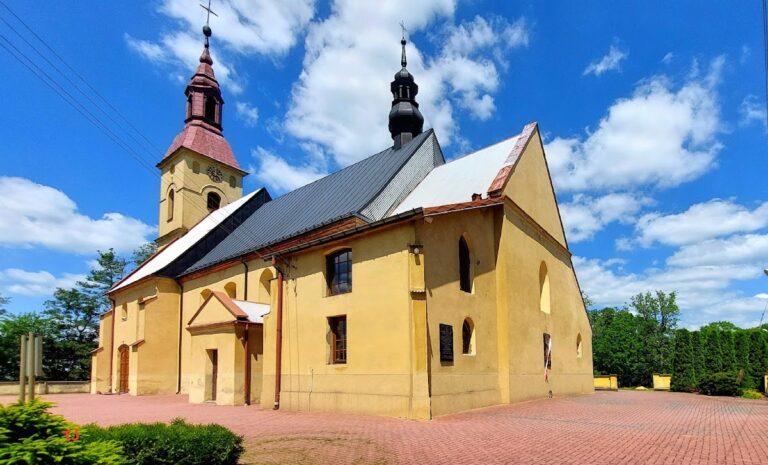
The church is an orientated brick building with a single nave and a shorter, narrower rectangular chancel. A sacristy is attached on the south side, an octagonal room on the north, and a porch on the west. The octagonal room probably dates from the eighteenth century and belongs to the 1760 reconstruction. The former tower was demolished during that work, but its surviving lower section now serves as the porch. Pointed-arch windows and buttresses are especially visible along the north and south elevations. A gabled roof covers the building and is topped by a Baroque bell turret.
Interior Furnishings and Memorials
Three altars stand inside the church. The high altar contains a copy of the Częstochowa Madonna, which becomes visible when the image of Saint Roch is raised. The image of Our Lady of Wierzchlas is protected by a silver covering funded in 1886 by Father Klemens Brzozowski. The furnishings bring together several periods of art, including a late-Gothic baptismal font, Rococo altars made in the second half of the eighteenth century, and an eighteenth-century Baroque pulpit.
A tomb slab commemorating Albert and Katarzyna Gaszyński bears the Berszten and Poraj coats of arms. These heraldic emblems identify the noble lineages associated with the memorial. Above, the vault carries a painting of the Assumption of the Blessed Virgin Mary.