Saint Sophia Church, Drama: A Tenth-Century Byzantine Church in Greece


Site at a Glance
- Rating
- 4.7
- Popularity
- Very Low
- Country
- Greece
- Primary era
- Medieval
- External website
- Open
- Eras represented
- Classical, Medieval, Early Modern, Modern
- Civilizations
- Byzantine, Ottoman
- Site type
- Religious
- Remains
- Church
On this page12 sections
History
Saint Sophia Church is a tenth-century Byzantine church in Drama, Greece, built during the period of prosperity under the Macedonian dynasty. It is the oldest surviving building in the city and remains associated with Eastern Orthodox worship within the Diocese of Drama, an ecclesiastical district governed by a bishop or metropolitan, under the Ecumenical Patriarchate of Constantinople.
Byzantine foundation
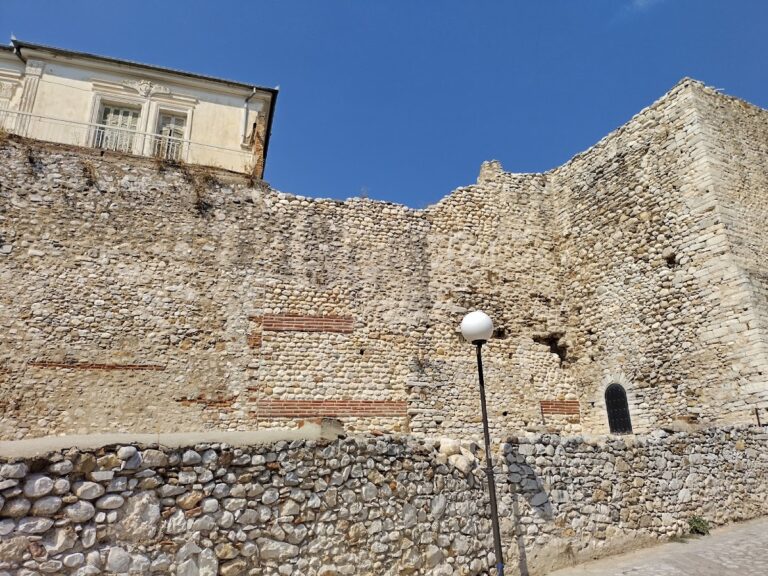
The church was erected on Drama’s highest point together with the city walls, using the same stones in their construction. Its precise date and circumstances are unknown, but its architecture belongs to the Byzantine period extending from the reign of Leo VI the Wise to that of Basil II. The Macedonian dynasty ruled the Byzantine Empire during a major period of political and cultural expansion.
The building probably began as a church dedicated to the Theotokos, the Christian title for Mary, the mother of Jesus. Records of the Drama Metropolitanate identify its original dedication more specifically as the Dormition of the Theotokos, referring to the Orthodox belief in Mary’s death and assumption into heaven. It was built over the remains of a larger three-aisled Early Christian basilica, whose surviving traces were uncovered during work in the courtyard. A nearby votive inscription dedicated to Dionysus, the ancient Greek god associated with wine, vegetation, ritual ecstasy, and theatrical performance, provides evidence of an earlier religious presence in the area.
Ottoman conversion and preservation of antiquities
During the Ottoman period, the church was converted into a mosque. One tradition places the conversion in 1430, while another connects it with the reign of Sultan Murad I, between 1359 and 1389. The building was then known as Bey Mosque, Hisar Mosque, or Kale Mosque, and a Muslim cemetery occupied the open ground to the north.
While the building served as a mosque, Themistoklis Chatzistavrou, then Archdeacon and Protosyncellus of the Diocese of Drama, excavated behind the sanctuary apse with permission from the local Muslim cleric. A Protosyncellus was the senior clerical deputy of a bishop or metropolitan. Chatzistavrou recovered chalices, censers, vigil lamps, and other sacred vessels, which he placed with the Diocese of Drama.
Chatzistavrou also found a partly damaged marble inscription in the courtyard and published it in a Thessaloniki newspaper. Metropolitan Chrysostom of Drama, later the martyred Metropolitan of Smyrna, worked with him to collect, preserve, and publish inscriptions and other antiquities threatened with theft or destruction.
Return to Orthodox worship
On 1 November 1912, during the First Balkan War, the church came under Greek control. During the first Bulgarian occupation, the Bulgarian administration planned to turn it into an archaeological museum, a proposal that met strong opposition from Metropolitan Agathangelos of Drama. After the city returned to Greek rule, the building was restored to Orthodox Christian worship.
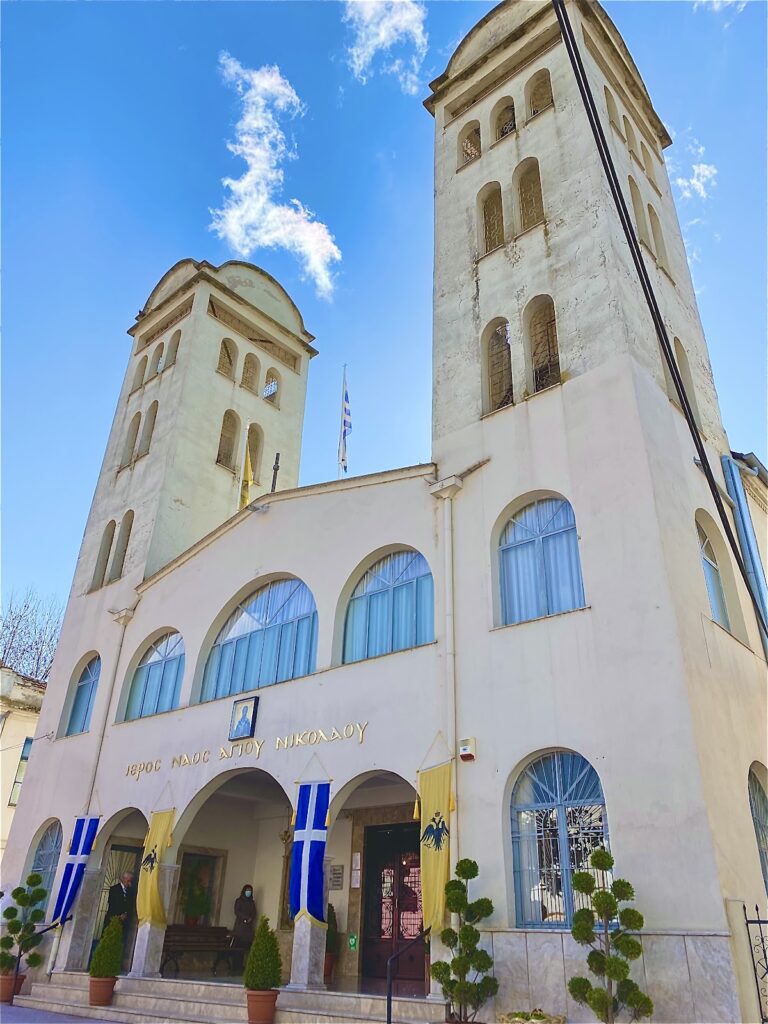
In 1922, Greek refugees from Asia Minor and Eastern Thrace who had settled in Drama rededicated the church to the Holy Wisdom of God, giving it the name Saint Sophia Church. The building had survived the earthquake of 1829, which levelled Drama. Its partly buried position is considered a possible reason for that survival. The church is recognized as a cultural monument and protected historic building, and it is also treated as an archaeological site.
Remains
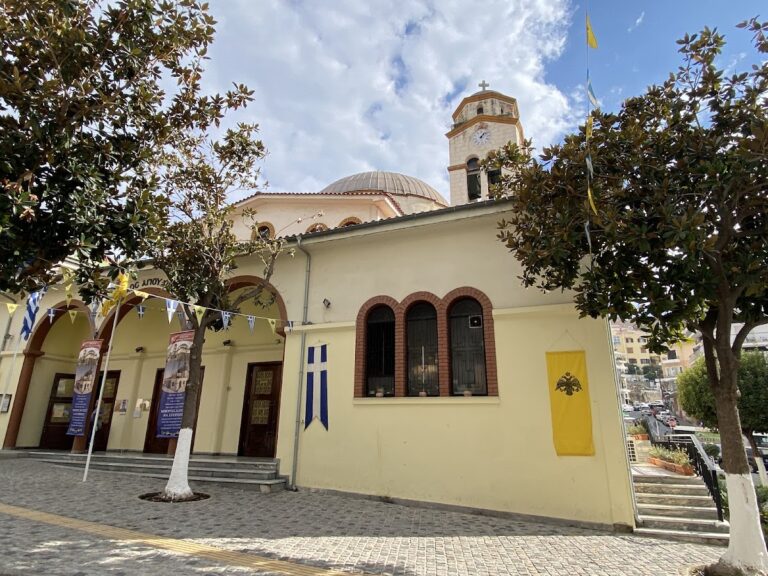
Saint Sophia Church is a two-storey building formed through successive phases that extend back to the Byzantine period. Its almost square interior measures 13.40 metres from east to west and 10.46 metres across. The structure is a transitional-type domed basilica, combining features associated with different Byzantine architectural phases, with a passage or gallery running around the central part of the church. Its design has similarities to Hagia Sophia in Thessaloniki and to the Church of the Dormition of the Theotokos at Nicaea in Bithynia, an important ancient and Byzantine city in northwestern Asia Minor.
Byzantine core and later entrance
Eastern Byzantine section
The older eastern part of the church is sunk into the ground. It contains a tall octagonal dome set on a square base, while the original masonry incorporates ancient architectural elements and decorative bands of brick. On the upper exterior of the eastern wall, an ancient Greek inscription was reused upside down. It includes the name of a sculptor, John, together with part of a Latin inscription.
Western entrance and bell tower
The western entrance section was added during the Ottoman period and rises approximately two metres above the Byzantine church. This porch also formed part of the mosque. A bell tower now stands on the south side, occupying the site of the former Ottoman minaret, preserving the physical memory of the building’s conversion and later return to Christian use.
Interior decoration and earlier remains
Sanctuary paintings and historic floor
The sanctuary, the eastern liturgical area surrounding the altar, preserves the church’s original wall painting of the Dormition of the Theotokos. The image was painted when the church was built, covered with plaster during the Ottoman period, and remains visible. The original floor was laid with patterned slabs of coloured marble until the beginning of the twentieth century. Later constructions now cover the historic floor beneath it.
Narthex fresco
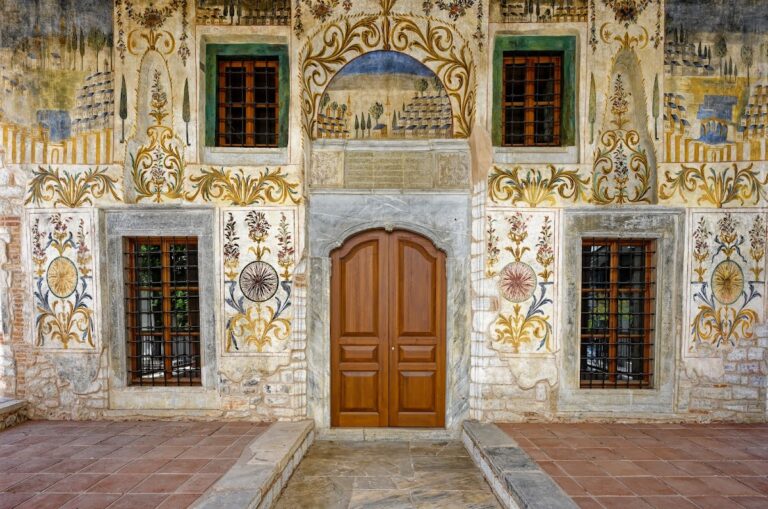
The narthex, the entrance or vestibule area of a church, contains a large fresco dated 1917. This wall painting, executed on plaster, depicts scenes of the Second Coming.
Early Christian basilica
Remains of the earlier three-aisled Early Christian basilica lie beneath or around the present church. Courtyard works revealed these remains, establishing the earlier ecclesiastical layer on which the Byzantine building was constructed.
Nearby sites