St. Michael’s Parish Church in Brixen: A Late Gothic Church
Site at a Glance
- Popularity
- Medium
- Country
- Italy
- Primary era
- Early Modern
- Eras represented
- Medieval, Early Modern, Modern
- Civilizations
- Holy Roman Empire, Italian
- Site type
- Religious
- Remains
- Church
On this page14 sections
History
St. Michael’s Parish Church is a Roman Catholic church in Brixen, Italy, dedicated to the Archangel Michael and traditionally serving the town’s burghers. It is the church of the Brixen parish and deanery, an administrative grouping of parishes, within the Diocese of Bolzano-Brixen. An Ottonian predecessor, from the Central European cultural period associated with the Ottonian rulers, stood here in the 11th century. Bishop Hartwig consecrated it in 1038. The church was later rebuilt in late Gothic form around 1500 and consecrated in 1503.
Medieval church and memorial
In 1408, before leaving on a pilgrimage to Palestine, the Tyrolean knight, poet, and composer Oswald von Wolkenstein commissioned a memorial stone for himself. It was first installed in a chapel of Brixen Cathedral. Its image presents him as a crusader rather than a pilgrim, interpreted both as a public expression of a vow and as a tombstone prepared in case he did not return.
Baroque changes and the Old Cemetery
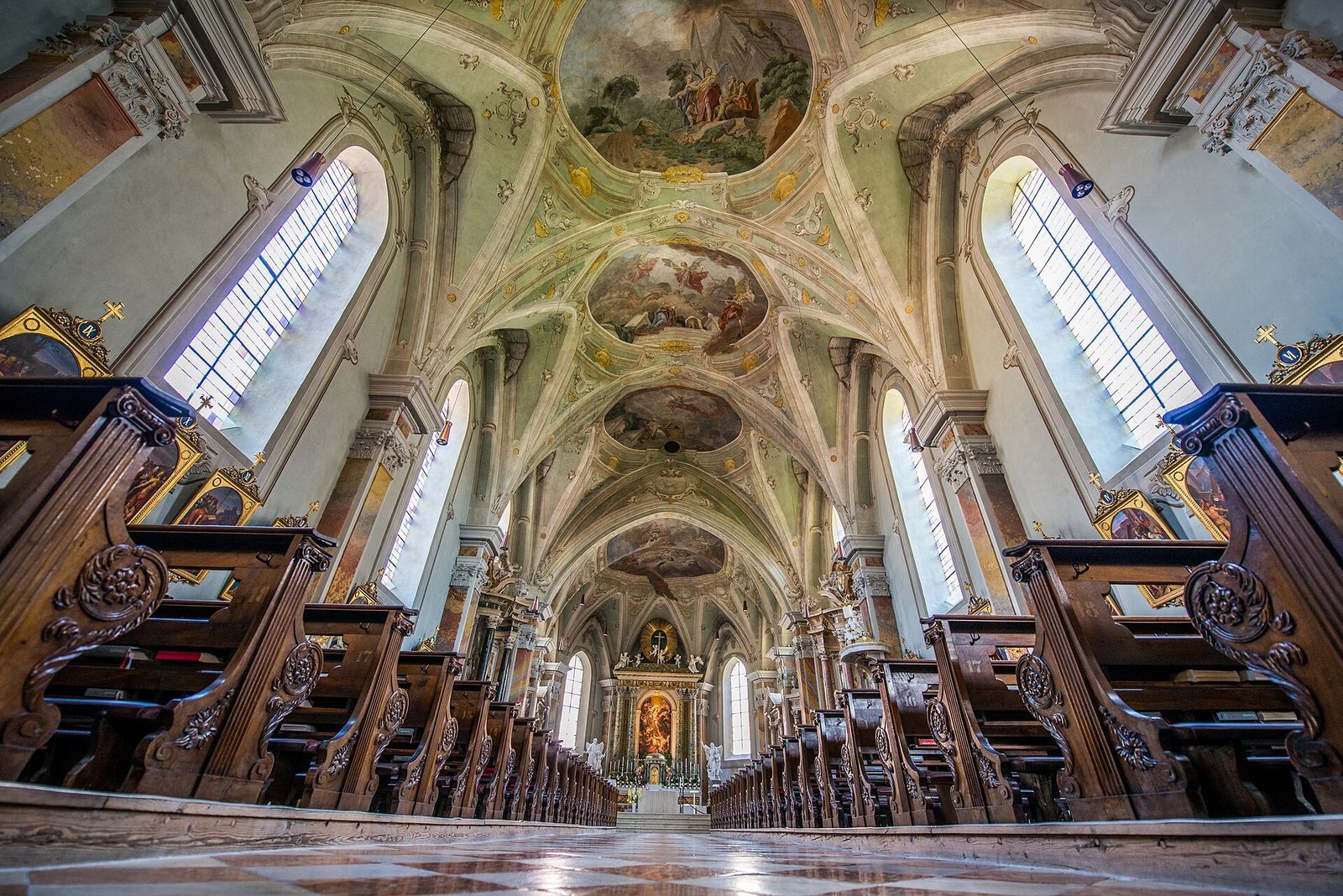
Around 1750, the church interior received a Baroque treatment, an ornate European artistic style, and it was redecorated in 1757. The adjoining Old Cemetery served as Brixen’s municipal burial ground until 30 December 1793.
Modern memorials and protection
A war memorial honoring those killed in the First and Second World Wars was erected in the cemetery’s western arcade in 1960. The church has been under monument protection since 1984.
Remains
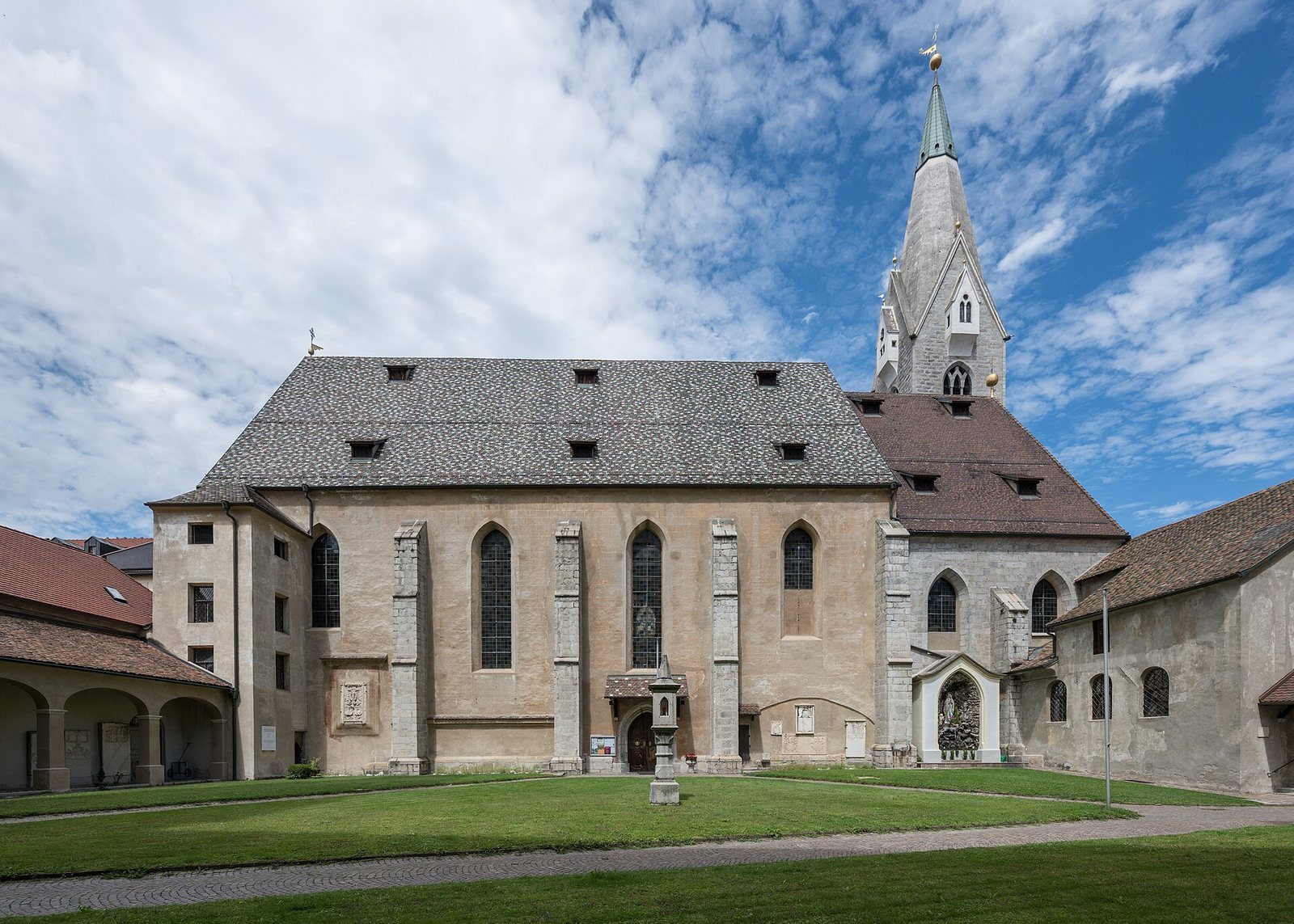
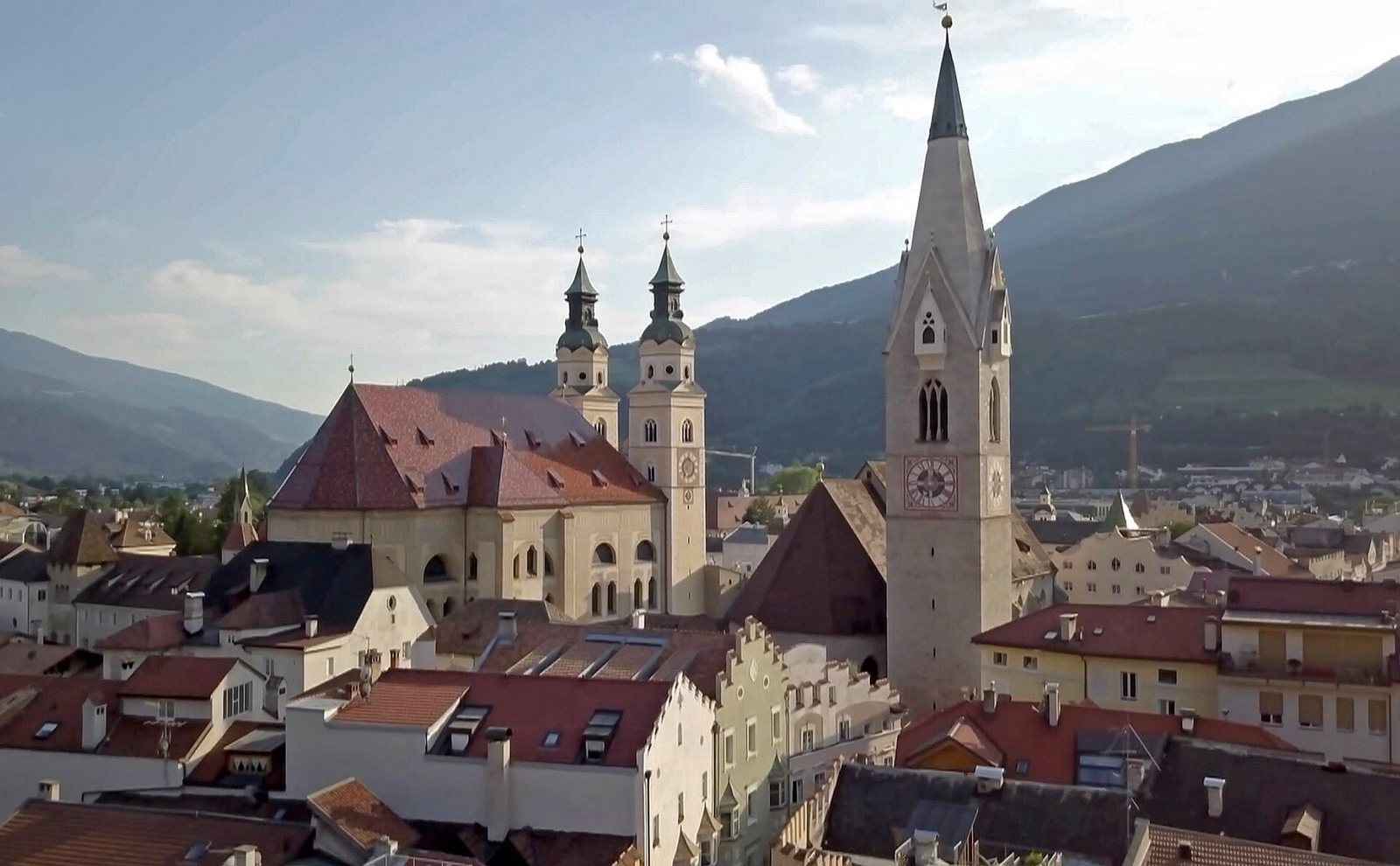
The church stands on Pfarrplatz, north of Brixen Cathedral, between Domplatz, Weißenturmgasse, and Albuingasse. The Old Cemetery lies to the south, between the church and cathedral. Entrances are set on three sides. Seen from Domplatz and Albuingasse, the church forms a religious ensemble with the cathedral buildings.
Church and tower
Church building
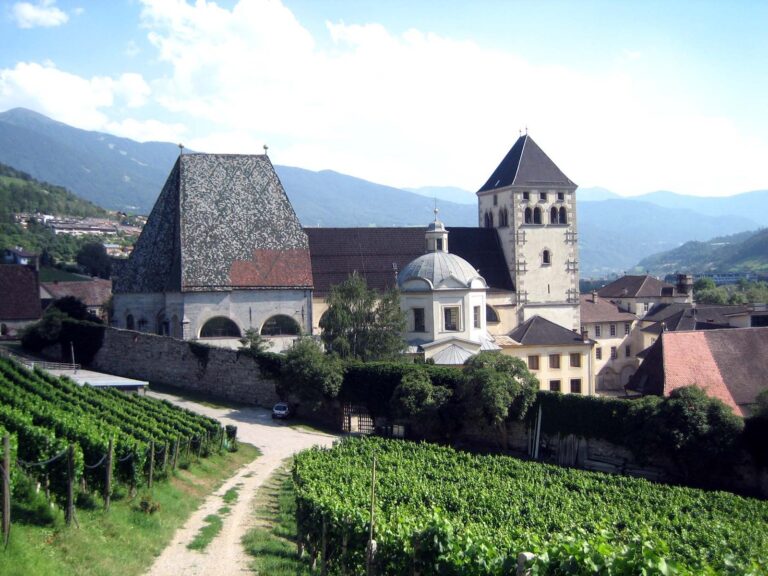
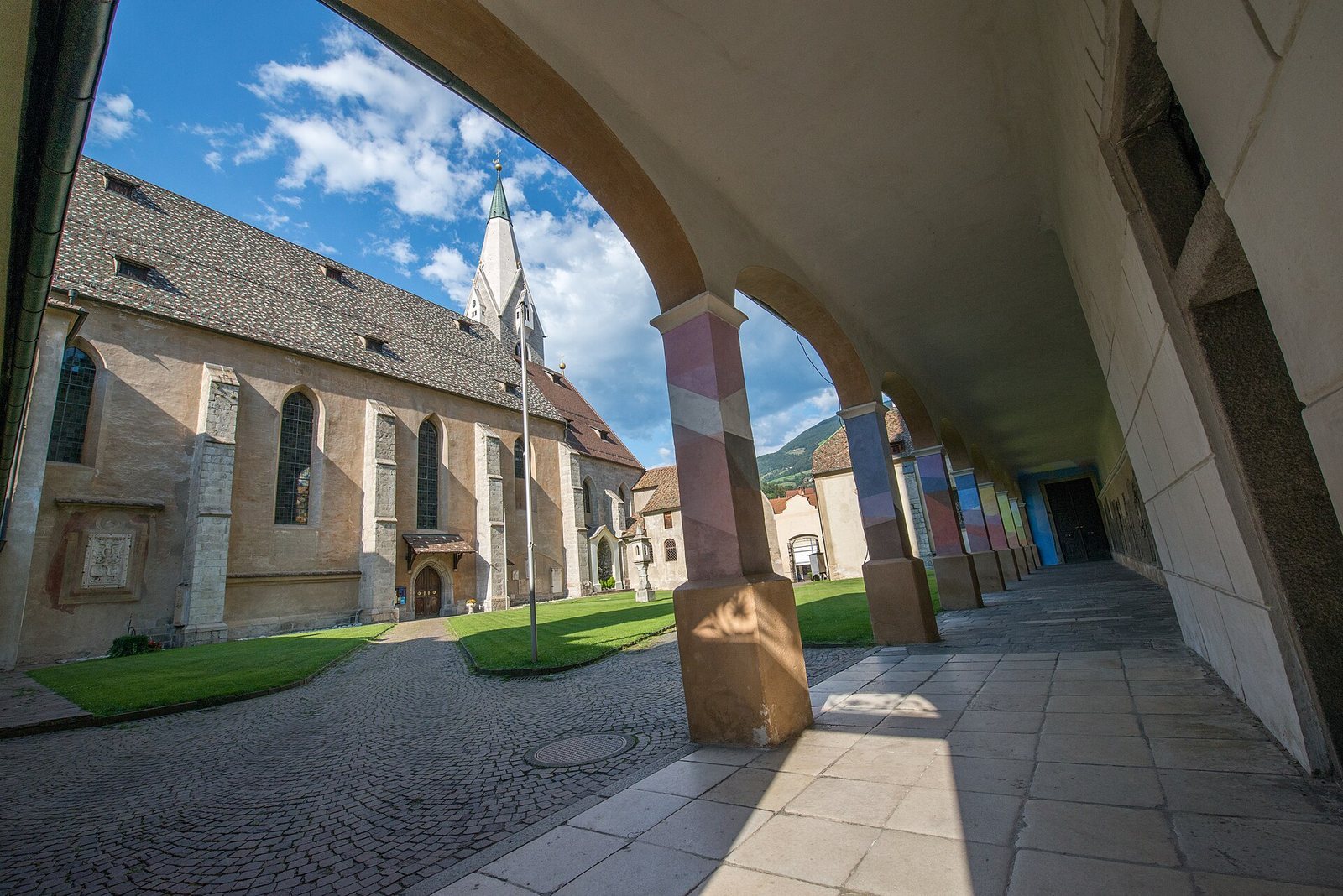
The present church is a late Gothic hall church, with a broad interior in which the nave and side aisles are of similar height. Its eastern choir, the area reserved for clergy and services, ends in a polygonal form. The earlier cemetery chapel had a rectangular plan and an apse, a rounded or curved end to the building.
White Tower
The square White Tower rises 72 metres from the church’s northeastern corner, beside the choir. Its lower part dates to around 1300, while the upper part was added in 1459. The upper stage has small projections, pointed-arch openings for bells, and a pointed spire.
Interior and furnishings
Josef Hauzinger, a pupil of Baroque painter Paul Troger, created the paintings on the ceilings and vaults. Andrea Pozzo painted the high-altar scene of Michael fighting Lucifer, who is commonly associated with Satan, the adversary of God. Johann Perger made the flanking angel sculptures. The high and side altars and other furnishings include ornate Baroque work, forms inspired by classical antiquity, and later Romantic pieces. A wooden sculpture showing Christ carrying the cross with Simon of Cyrene dates to the 15th century.
Old Cemetery
Burial ground and arcades
The former burial ground is now grass-covered. Its 18th-century arcades contain historically valuable grave slabs belonging to cathedral clergy and noble families.
Oswald von Wolkenstein memorial stone
Among the stones set into the arcades is the memorial to Oswald von Wolkenstein. Its life-size figure wears armor, a battle tunic, a knight’s belt, and a long sword. He holds a crusader’s banner in his right hand and a horned helmet decorated with peacock feathers in his left. The carving also shows his curled moustache, wavy hair, chin beard, shoes covered with small metal plates, and rowel spurs. The figure stands above the coats of arms of the Villanders and Wolkenstein families. Space along the stone’s right edge was left for dates to be added.
Funerary lantern
A Gothic funerary lantern, a cemetery monument associated with keeping a light for the dead, stands at the cemetery’s centre. It dates to 1483.
War memorial and cemetery plaque
The western arcade’s war memorial includes a figure of a falling soldier by South Tyrolean sculptor Othmar Winkler. A plaque installed in 2001 recalls the cemetery’s former use.