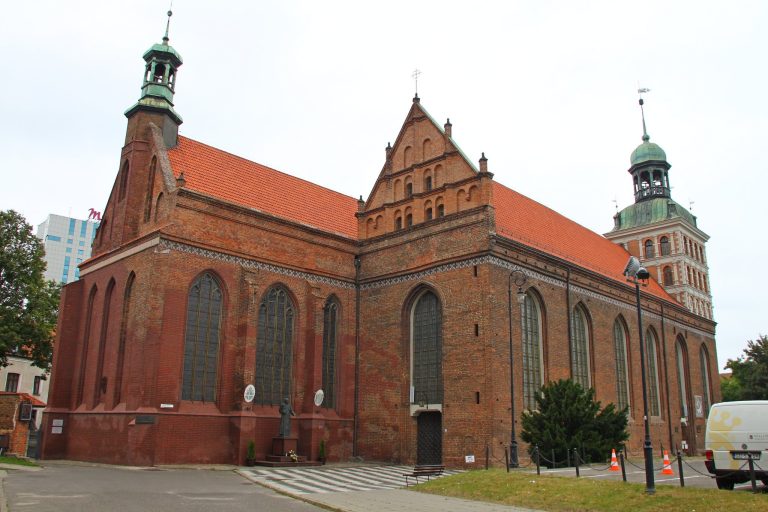
Saint Michael Archangel Church in Gdynia: A Historic Parish Church


Site at a Glance
- Rating
- 4.7
- Popularity
- Low
- Country
- Poland
- Primary era
- Medieval
- External website
- Open
- Eras represented
- Medieval, Early Modern, Modern
- Civilizations
- Polish–Lithuanian Commonwealth
- Site type
- Religious
- Remains
- Church
On this page9 sections
History
Saint Michael Archangel Church in Gdynia, Poland, is a Roman Catholic parish church whose history is traced to 1224, when it was founded by Świętopełk II, Duke of Gdańsk. A parish was established here in 1253 by Wolimir, Bishop of Kuyavia–Pomerania, a medieval diocese in northern Poland. Its territory covered Kępa Oksywska and almost the entire administrative area of present-day Gdynia. The church is described as the oldest building in Gdynia and the Tricity area.
Medieval parish and later destruction
The church belongs to the Gdynia Oksywie deanery and the Archdiocese of Gdańsk. It continues to function as a parish church, with the liturgical feast of Saint Michael the Archangel celebrated on 29 September. During the Swedish wars, the building was destroyed and stripped of its furnishings. Reconstruction followed in 1687, when the church also received a wooden tower crowned with a Baroque cupola.
Restoration took place between 1925 and 1927, with particular attention given to the north wall of the main nave. The building suffered partial destruction twice during the Second World War and was rebuilt soon afterwards. It became a protected historic monument and was entered in the heritage register under number A-1605 on 16 August 1996.
Cemetery and naval commemoration
The parish cemetery beside Arciszewskich Street is described as Gdynia’s oldest burial place. It occupies the slope of a small rise beside Puck Bay, with the church at the summit and the naval port at the foot. Among the graves connected with the history of the region is that of Antoni Abraham, a Kashubian activist and public figure. The cemetery’s oldest military grave is that of Father Antoni Muchowski, who died in 1915. He had taken part in the 1863 uprising, a major Polish insurrection against the Russian Empire, and had been exiled to Siberia before escaping.
A nearby military cemetery on Antoni Muchowski Street forms part of the area’s commemorative setting. The Small Navy Pantheon honours Polish naval personnel and vessels lost during the 1939 defence of the coast and in combat on foreign seas during the Second World War. Its memorials also include a 1984 plaque for naval officers murdered during the Stalinist period, the post-war system of political repression associated with Joseph Stalin and his sphere of influence, and a 1988 plaque for sailors of the Pinsk and Vistula flotillas, Polish riverine naval formations. Devotional associations with the church include relics of Blessed Dorota of Montau and Saint Padre Pio.
Remains
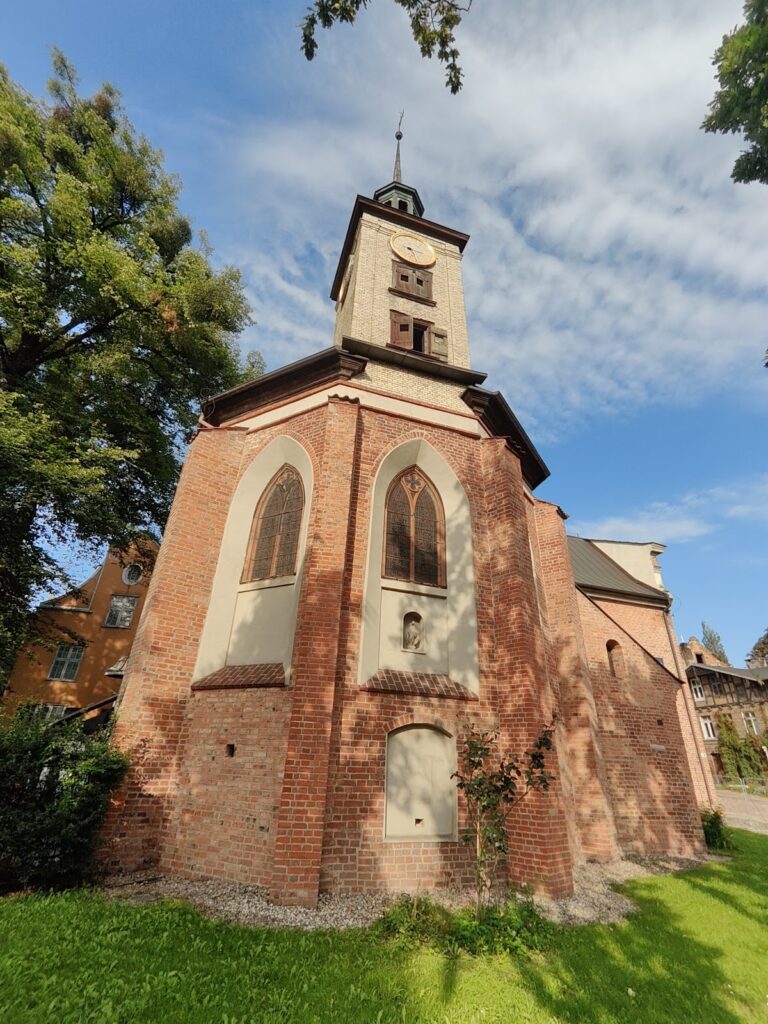
The surviving church stands on the summit of the rise above the parish cemetery. Its internal arrangement follows the rural parish-church style widespread in Gdańsk Pomerania during the thirteenth and fourteenth centuries. The building has two aisles and three altars, while the surrounding cemetery slopes towards Puck Bay and the naval port below.
Church structure
Medieval fabric and expansion
Only the west wall survives from the original medieval church. During the fourteenth century, the building was enlarged with a polygonal chancel and a north aisle. These surviving elements form part of the church’s layered structure, which also reflects the rebuilding undertaken after the Swedish wars and the Second World War.
Tower and interior
The wooden tower erected in 1687 is crowned by a Baroque cupola. A listed building-data entry gives its height as 1 metre. The church’s three bells, cast in 1957, are named Piotr, weighing 600 kilograms, Queen of Poland, weighing 420 kilograms, and Michał, weighing 200 kilograms. Inside, the neo-Baroque high altar dates from 1930. Memorial plaques commemorate Blessed Father Władysław Miegoń, a Polish Catholic priest, Admiral Józef Unrug, and Vice Admiral Jerzy Świrski.
Parish cemetery
The cemetery beside Arciszewskich Street occupies the rise below the church and contains graves linked to the regional past. Its position beside Puck Bay and beneath the church gives the burial ground a direct physical relationship with the parish building and the naval landscape at the foot of the slope.
Small Navy Pantheon
The Small Navy Pantheon consists of bronze plaques commemorating naval personnel and sunken vessels. The memorials include sailors of the Pinsk and Vistula flotillas killed in 1919–1920, personnel killed during the 1939 defence of the coast, and vessels sunk in combat between 1939 and 1945. Individual plaques honour the Polish Navy ships ORP Dragon, Jastrząb, Grom, Orzeł, Kujawiak, and Orkan. ORP is the standard Polish Navy prefix for a commissioned warship.