Kirche Hohen Thekla: A Medieval Fortified Church in Leipzig


Site at a Glance
- Rating
- 4.2
- Popularity
- Very Low
- Country
- Germany
- Primary era
- Medieval
- External website
- Open
- Eras represented
- Medieval
- Civilizations
- Holy Roman Empire
- Site type
- Religious
- Remains
- Fortified Church
On this page8 sections
History
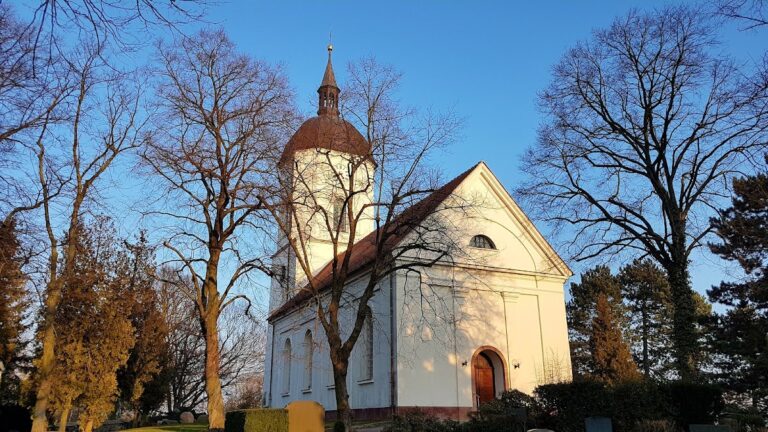
Kirche Hohen Thekla is a medieval Romanesque church in Leipzig, Germany, whose construction is generally placed between the tenth and twelfth centuries, possibly around the middle of the twelfth century. It served as both a parish church and a fortified church for the three Parthen villages of Neutzsch, Cleuden, and Plösen.
Medieval origins and the Parthen villages
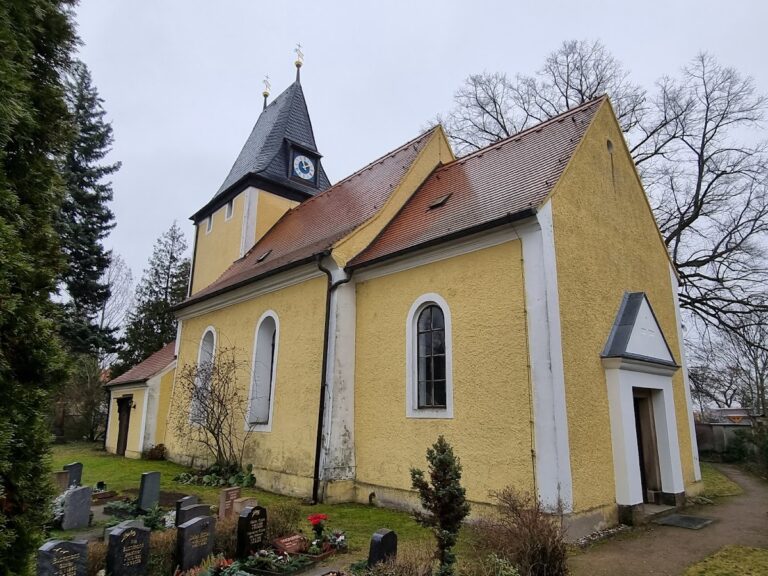
The church and its cemetery occupy the centrally situated Kirchberg in Thekla, a 17-metre-high terminal moraine. This glacial ridge rises above the otherwise flat Parthenaue and gave the site a prominent position in the surrounding landscape. The hill was historically known as Hohentichel, Hohentiegel, and Hohentechla. Together with the Bergkirche in Beucha and the church in Panitzsch, it is popularly counted among the “Three High Priests” of the Leipzig region because of its elevated setting.
The church continued to serve the three Parthen villages, which united in 1889 and named their new settlement Thekla after the church. The name St. Thekla Church became common after the Thirty Years’ War, the major European conflict of 1618 to 1648 involving religious and political struggles across the Holy Roman Empire and neighboring regions. The name arose through a misunderstanding and is documented in writing from 1663, while Kirche Hohen Thekla is the correct name.
War damage and rebuilding
Kirche Hohen Thekla was damaged during the Thirty Years’ War and burned out in 1637. Rebuilding was completed by 1660, according to the date on the southern entrance door, while another dating places the work around 1650. In 1670, the interior received a painted, panelled wooden ceiling and galleries with painted balustrades.
The church also became connected with the Battle of Leipzig, fought in October 1813 when a coalition including Sweden and other allied powers defeated Napoleon’s forces. From 16 to 19 October, Swedish Crown Prince Karl Johann used the Kirchberg as a camp and observation post while commanding the allied Army of the North. Karl Johann, born Jean-Baptiste Bernadotte, had previously been a marshal of France and later became King Charles XIV John of Sweden. Three French cannonballs embedded in the tower plaster commemorate the battle.
A prominent wedding took place in the church on 29 April 1840, when the German democratic politician and later revolutionary Robert Blum married Eugenie Günther. Architect Julius Zeißig directed a restoration in 1898, when a portal was created through the west side of the tower.
Fire, reconstruction, and present affiliation
Arson caused a fire on 30 January 1959 that completely destroyed the interior furnishings. Fritz Ziel and Lilo Häring directed the rebuilding from 1959 to 1962. The reconstructed church, with modern furnishings, was rededicated on 7 October 1962.
Today, Kirche Hohen Thekla belongs with Kirche Schönefeld and Stephanuskirche Mockau to Matthäus parish Leipzig Northeast in the Leipzig church district of the Evangelical-Lutheran Church of Saxony. The church district is an administrative subdivision of the regional Lutheran church body, while the parish is the local ecclesiastical unit.
Remains
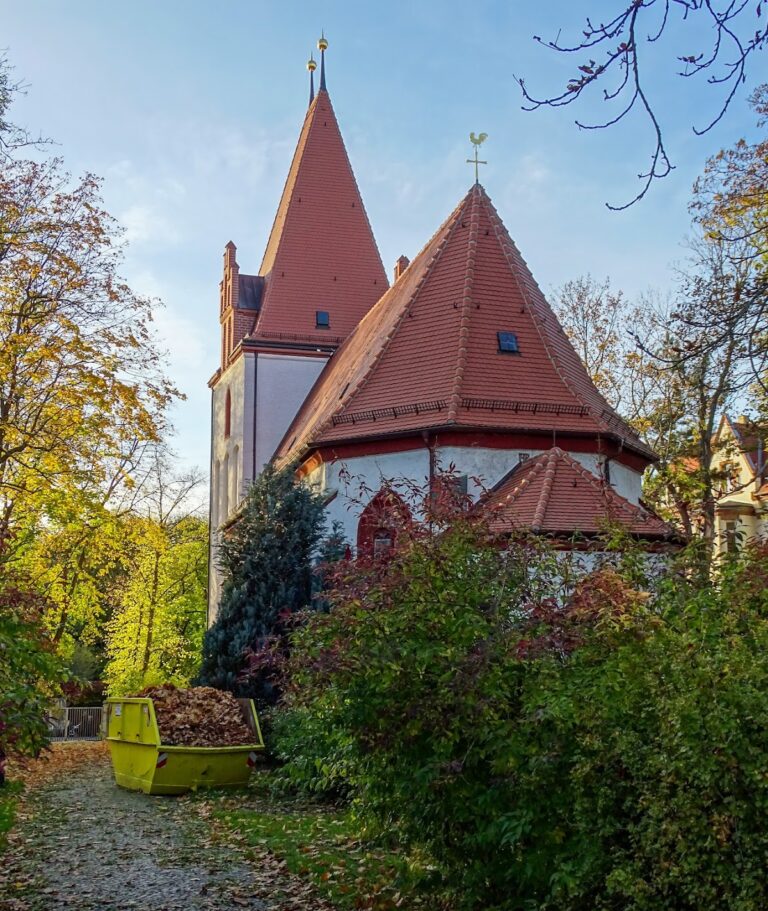
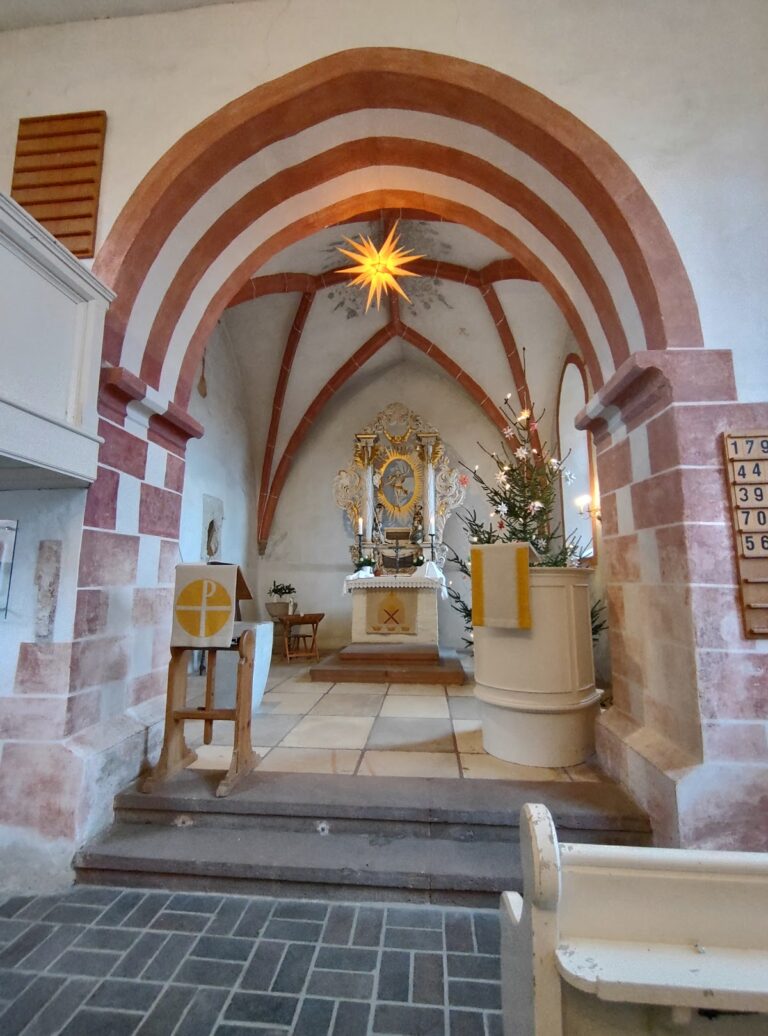
Kirche Hohen Thekla is a Romanesque hall church, meaning that its principal interior areas are approximately equal in height. It has a straight-ended chancel, which closes with a flat wall, and a transverse west tower. The church stands on the elevated Kirchberg, and its position places the building above the surrounding flat landscape. Rubble masonry, chiefly made from large fieldstones, forms walls up to two metres thick. The church has a gabled roof, while the tower is covered by a hipped roof. Inside, a triumphal arch opens toward the chancel.
Church building and interior
The interior combines white-plastered wall surfaces with the brown tones of the wooden-beam ceiling and gallery. These furnishings belong to the reconstruction after the 1959 fire and reflect the artistic style of the 1960s. Werner Hempel of Dresden made the baptismal font, pulpit, and lectern used in the rebuilt interior. The three French cannonballs associated with the Battle of Leipzig remain embedded in the plaster of the church tower.
Organ and bells
The present organ was made by Hermann Eule of Bautzen in 1966. It has two manuals, or keyboards, a pedal, the foot-operated keyboard, and 15 stops that control different ranks and tonal colors of pipes. The instrument was renovated in 2018 and 2019.
The church’s earlier organ history began with an instrument made in 1776 as a gift from a merchant from Zittau. Albert Hermann Wolfram of Taucha made a replacement in 1851 with two manuals, a pedal, and 13 stops. Alfred Schmeisser of Rochlitz later altered it, and zinc façade pipes were added in 1930. The instrument was destroyed in the 1959 fire.
Several bell installations have served the church. A three-bell bronze peal, a group of bells designed to sound together, was installed in 1908, surrendered as a metal donation during the First World War, returned afterward, and later confiscated for armaments production during the Second World War. A steel peal installed in 1951 was destroyed in the January 1959 fire. The oldest bell, cast around 1300, bears the inscription sit tempestatum per me genus omne fugatum, meaning “May every kind of storm be driven away by me,” together with a small relief of a bishop wearing a mitre. It is held in the depot of the Leipzig Museum of City History.
A new steel peal made by the German bell foundry Schilling & Lattermann was consecrated on 14 May 1960 during the topping-out ceremony for the rebuilding. It matches the 1951 peal in size, weight, tuning, and inscription. All the bells also carry the words “In the year of the church fire 1959, Kirche Hohen Thekla Leipzig.”
Cemetery
The cemetery surrounding the church retains Baroque and Neoclassical gravestones, adding later layers of material history to the medieval churchyard on the Kirchberg.