Former Cistercian Abbey in Oliwa: A Monastic and Cathedral Complex in Poland

Site at a Glance
- Rating
- 5
- Popularity
- Very Low
- Country
- Poland
- Primary era
- Medieval
- External website
- Open
- Eras represented
- Medieval, Early Modern
- Civilizations
- Kingdom of Prussia, Polish–Lithuanian Commonwealth, Teutonic Order
- Site type
- Religious
- Remains
- Monastery
On this page19 sections
History
The Former Cistercian Abbey in Oliwa in Gdansk, Poland, is a former male Cistercian monastery founded in the late twelfth century. It became the oldest continuously existing monastic establishment in Gdansk Pomerania and remained active from its foundation until its dissolution in 1831. The Cistercians were a Catholic monastic order that emphasized communal discipline, agricultural work, and self-sufficient religious communities. At Oliwa, their activities extended across worship, landholding, water management, education, craft production, and administration.
Foundation and medieval development
The foundation is dated either to 1186 or to the formal signing of the foundation charter in Gdansk on 18 March 1188. Tradition attributed the initiative to Duke Sobieslaw I, but the recorded founder was his son, Duke Sambor I of Pomerania. Sambor brought twelve monks from Kolbacz, a daughter house of Esrum in Denmark. The first abbot, Bernard Dithard, was a Dane, and the early community was probably predominantly Danish. The abbey’s mother house was Lubiaz until 1831, while its priory came under Szczyrzyc Abbey after 1945. From 1487, Oliwa belonged to the Baltic Cistercian province.
Around 1195, the first monks were removed and replaced by others from Kolbacz, probably because of disciplinary difficulties. By the end of the thirteenth century, princely gifts had made Oliwa a substantial landholder. Its possessions included fifty villages, a fishing station on Zaspa Lake with forty boats, exclusive rights on the Strzyza Stream, mills, and income from tithes on customs and Gdansk taverns.
The monastery suffered repeated attacks during the thirteenth century. Pagan Prussians plundered and burned it in 1226, killing the monks. New Cistercians arrived from Kolbacz and began rebuilding, but the Prussians returned in 1236, destroyed the buildings, and killed six monks and thirty-four servants. Pope Honorius III then exempted the Oliwa community from tithes. The Teutonic Knights burned the monastery in 1246 and plundered it in 1247 and 1252 during campaigns against the lands of Duke Swietopelk II. The Teutonic Order was a medieval Catholic military order that established a territorial state in the eastern Baltic, and its rule brought Oliwa into continuing disputes over property, taxation, jurisdiction, and allegiance.
Duke Mestwin II protected the abbey and prohibited outsiders from cutting timber in its forests in 1274. He was buried in the monastery church in 1294, and Duke Przemysl II attended his funeral. The Brandenburg occupation of nearby Gdansk in 1308 caused extensive damage. Margrave Waldemar compensated the monastery in 1310, while Grand Master Karl von Trier confirmed its possessions in 1312. Pope John XXII confirmed them in 1320, and the bishops of Warmia and Pomesania confirmed the indivisibility of the abbey’s property in 1323. After Gdansk Pomerania came under Teutonic rule, Abbot Rudiger acknowledged the new political order, although disputes continued until Grand Master Ludolf Konig von Wattzau recognized the Cistercians’ claims in 1342.
A fire on 25 March 1350 destroyed the church and monastery, probably after a kitchen chimney was being cleaned. The church was rebuilt in Gothic form within five years, and the abbey then entered a more stable and prosperous period. Its Gothic rebuilding also created the basic form of the church that survives today.
War, royal authority, and the Reformation
During the early fifteenth century, Oliwa faced financial pressure, high taxes imposed by the Teutonic Knights between 1401 and 1403, epidemics in 1416 and 1427, and the Hussite invasion of 1433. Hussite forces led by Jan Capek of Sany seriously damaged the monastery and its estates, forcing the monks to take refuge in Gdansk.
In the Thirteen Years’ War, the abbey supported the Prussian Confederation and King Casimir IV Jagiellon. Royal troops occupying Gdansk used Oliwa as a defensive position, surrounding it with fortifications and placing 600 soldiers under Gotard of Radlin there. The Second Peace of Thorn in 1466 returned Gdansk Pomerania to Poland as Royal Prussia, the part of Prussia then under the Polish Crown. From 1466 to 1772, the abbey consistently supported Polish political authority, including the Polish-Lithuanian Commonwealth after 1569, in disputes with Gdansk.
Abbot Mikolaj Muskendorf repaired and enlarged the monastery between 1474 and 1488. The abbey hosted Albert of Prussia, then Grand Master of the Teutonic Order, in 1516. After the Reformation intensified in 1525, royal authorities repeatedly intervened in conflicts over the monastery’s property, administration, and Catholic character. King Sigismund I the Old placed Oliwa under the protection of Voivode Jerzy Bazynski, while attempts were made to transfer its estates to the diocesan bishop. By this period, Oliwa and Pelplin were the only surviving Cistercian abbeys in the Pomeranian province.
Lambert Schlieff, who favored Protestantism, became abbot in 1549 through pressure from the Loitz family. He was removed in 1557, restored through the influence of his supporters, and died in 1559 while traveling to Oliwa. His successor, Mikolaj Locka, contested the abbacy with Kasper Geschkau. Geschkau became coadjutor, an assistant normally entitled to succeed the officeholder, in 1568 and abbot in 1569. As a royal representative in disputes with Gdansk, he became associated with the Commonwealth’s political position.
In February 1577, Protestant citizens of Gdansk attacked, looted, and burned the abbey. Two monks were killed and several were wounded. Royal troops led by Starost Ernest Weiher relieved the monastery, and Gdansk later paid 20,000 guilders in compensation. Reconstruction began immediately, and the church resumed functioning in 1583. The church and conventual buildings were restored in their earlier forms, while a baptismal chapel and Baroque decoration were added. The old abbatial palace was also rebuilt before Geschkau’s death in 1584.
Expansion and the Swedish wars
Abbot Jan Kostka held office from 1584 to 1588. King Sigismund III Vasa visited Oliwa in 1587 and swore the pacta conventa, formal commitments made by an elected Polish monarch before taking the throne. In 1603, Sigismund obtained from Pope Clement VIII the right for Oliwa’s abbots to wear the mitre and carry the crozier.
Under Abbot Dawid Konarski and his successors, the church was renovated, the priory was enlarged, and the monastery walls were rebuilt in 1605 and 1608 because of the Swedish threat. The archive and treasury were moved to Gdansk for protection. Swedish forces under Admiral Carl Gyllenhielm plundered the monastery in 1626 and carried its Renaissance pulpit and pipe organs to Skokloster Castle in Sweden.
During the Swedish Deluge of 1655 to 1660, many monks left, while the treasury and library were transferred to Gdansk. Swedish troops plundered Oliwa in 1656. Gdansk soldiers expelled them but then looted and damaged the monastery themselves. Peace negotiations held at the abbey ended with the Treaty of Oliwa on 3 May 1660. The royal court was based in Gdansk, Swedish forces were stationed in Sopot, and French mediators resided in the monastery during the negotiations.
Baroque renewal and eighteenth-century crises
A monastery hospital was built in 1665, and a printing press was established in 1676. Abbot Michal Antoni Hacki, appointed by King John III Sobieski in 1683, promoted the abbey’s development and financed much of its Baroque church furnishings, including the main altar completed in 1688.
During the Great Northern War, Saxon troops wintered at Oliwa in 1702, and the abbey endured requisitions and financial contributions. In 1709, a major epidemic killed nine Cistercian pastoral ministers in succession in the Gate House, which thereafter became known as the House of Pestilence. In 1733, during the War of the Polish Succession, Oliwa supported the Wettin claimant while Gdansk supported Stanislaw Leszczynski. Russian Field Marshal Burkhard Christoph von Munnich occupied the abbatial palace during the siege of Gdansk in 1734. His presence helped spare Oliwa from destruction, although other monastic properties suffered.
A local cult of Saint Oliwa was introduced in the 1730s. Ceremonies held from 5 to 6 June 1739 included the transfer of the saint’s relics from the Church of St. James to the monastery church. In the same year, Abbot Iwo Roweder helped establish a philosophical and theological academy that operated until 1783. Abbot Jacek Rybinski later renovated the Church of St. James and the former St. Lazarus Hospice, built a new Rococo abbatial palace between 1754 and 1756, commissioned a new pulpit, and sponsored new pipe organs.
Prussian rule and dissolution
The First Partition of Poland in 1772 transferred the area around Oliwa to Prussia. This marked the beginning of direct Prussian control and the eventual dissolution of the abbey. The Prussian state seized the monastery’s estates outside Gdansk, granted the abbot an annual pension of 4,000 guilders, and provided financial compensation. The impoverished community began selling church furnishings and silver objects.
After the Napoleonic and Polish capture of Gdansk in 1807, a French military hospital was established in Oliwa. The monastery lost its Prussian subsidies when the Free City of Danzig was created and sold additional silver furnishings. Following the Russian siege and fall of Gdansk in 1813, Oliwa was definitively incorporated into Prussia.
Prussian authorities prohibited the admission of novices in 1820. The papal constitution De salute animarum ended Oliwa’s status as a territorial abbey in 1821. A territorial abbey was a monastery whose abbot exercised authority over a defined territory in a manner comparable to a diocesan bishop. The Prussian government ordered the monastery’s liquidation in 1829, and dissolution took place on 1 October 1831. Its properties were divided between Gdansk and the Prussian king. The last abbot, Joseph Hohenzollern-Hechingen, died in 1836.
After the monastery
After the dissolution, a Catholic parish was established in the former monastery church and an Evangelical parish in the Church of St. James. Most of the abbey’s industrial facilities eventually disappeared, although the Water Forge survived. The former abbey church became the cathedral of Gdansk in 1925 and was designated a minor basilica in 1976. An orangery and botanical garden were added to the park during the interwar period.
Cistercians returned to Oliwa in 1945 but could not regain the former abbey because its church was already the cathedral. They took over the former Evangelical church on Lesna Street and a building at 131 Polanki Street, which they converted into a convent. Their priory came under Szczyrzyc Abbey, and a separate parish was established there in 1988. The former Cistercian and cathedral complex was designated a Historic Monument of Poland by presidential regulation in December 2017.
Remains
The surviving complex combines a long Gothic church, monastic buildings, the former Church of St. James, an abbatial palace, remains of industrial waterworks, and a landscaped park. The church and cloister survived the fighting around Oliwa in 1945, while the abbatial palace was damaged. The novitiate and infirmary were destroyed after the dissolution, and other conventual buildings were adapted for parish use.
The abbey church
Medieval structure
The first community built a Romanesque oratory and wooden residential buildings. The oratory was later adapted as the chancel. During the first half of the thirteenth century, elongated chapels, a transept, the main body of the church, and the first brick monastic buildings were added. The early church was partly modeled on the Cistercian church at Fontenay, and its first main body occupied four bays of the present nave.
The Gothic rebuilding after the fire of 1350 extended the chancel eastward, replaced the earlier chapels with an ambulatory and an adjoining Holy Cross abbatial chapel, and lengthened the nave by four bays. An ambulatory is a passage around the sanctuary or choir, while a transept is the crosswise part of a church that intersects the nave. A large refectory and a lavabo were also constructed. The refectory served as the community dining hall, and the lavabo was used for washing, especially before meals.
Dimensions and interior
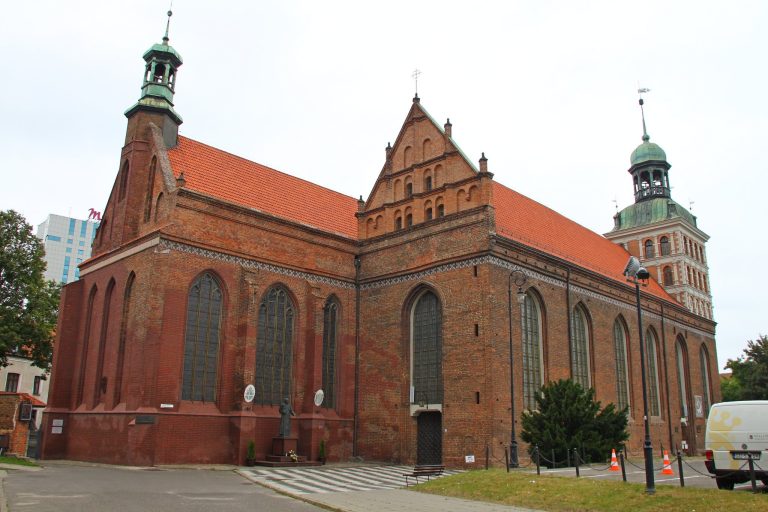
The church is approximately 107 metres long externally and 97.6 metres internally. Its central nave is about 8.5 metres wide, while the full width including both aisles is about 19 metres. The principal vault rises approximately 17.7 metres. The building has a ten-bay nave, a single-bay transept, and a choir surrounded by an ambulatory, giving it an unusually long, narrow, and relatively low form.
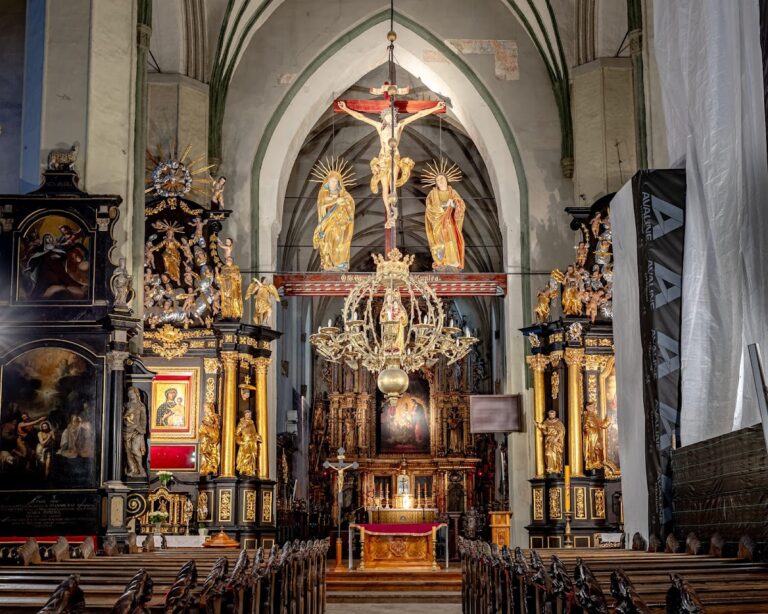
The church received its first pipe organ in 1603 and a pulpit in 1605. The Renaissance pulpit and organs were removed to Skokloster during the Swedish occupation of 1626. Later abbots commissioned a new Baroque interior. The monumental Baroque main altar was completed in 1688 and fills the wall space and vault of the eastern chancel termination. It is probably the work of the Gdansk architect and sculptor Andreas Schluter. A painting made in the workshop of Andrzej Stech shows Abbot Hacki and monks praying to the Holy Trinity, the Virgin Mary, and Saint Bernard.
Organs and eastern termination
A small organ was installed in the transept before Abbot Rybinski commissioned a larger instrument for the nave. Rybinski sent the organ builder Father Johann Wulff to study with European masters. Wulff, a Cistercian monk of Oliwa, built the Rococo gallery organ between 1763 and 1788. Its horseshoe-shaped case contains 7,876 pipes and movable elements that could be adjusted during performance.
The eastern termination contains a Rococo main altar, a richly decorated zone around a circular apse window, angel heads, a representation of Christ in Glory, and Moses carrying the Tablets of the Law. These elements belong to the later decorative renewal of the church rather than to its medieval construction.
Monastic buildings and associated churches
Conventual buildings and treasury
The monastery’s buildings were reconstructed after the destruction of 1577 in their earlier forms and style, with Baroque elements added to the church. The old treasury was rebuilt to accommodate an apothecary, the abbatial court, apartments for priests and church servants, and a printing press that operated from 1673 to 1744. The separate monastery hospital was erected in 1665. The former Gate House, later called the House of Pestilence, became associated with the deaths of nine Cistercian pastoral ministers during the epidemic of 1709.
Church of St. James
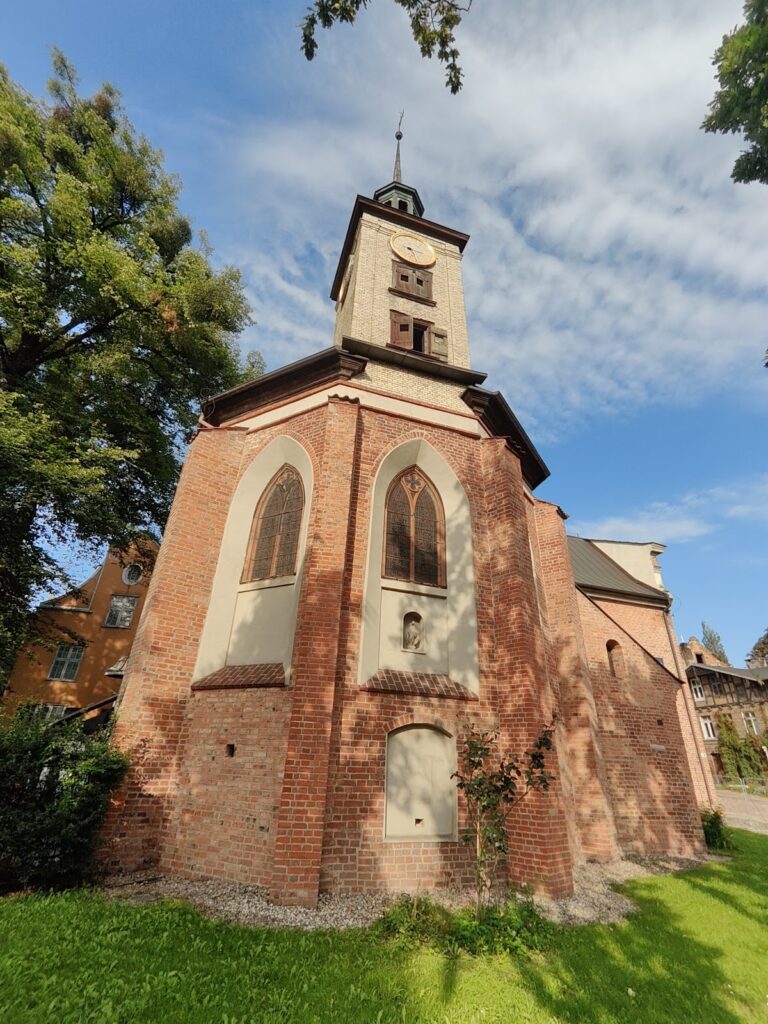
The Church of St. James was built around 1300 as a parish church for the local population. It was rebuilt and reconsecrated in 1604, its tower was rebuilt in 1709, and a new dome was added during an eighteenth-century renovation. After the abbey’s dissolution, it became an Evangelical parish church. The former St. Lazarus Hospice was also renovated under Abbot Rybinski.
Abbatial palace
The abbatial palace was rebuilt before 1584. A new Rococo palace was constructed between 1754 and 1756. During the siege of Gdansk in 1734, it housed Russian Field Marshal Burkhard Christoph von Munnich. The palace suffered wartime damage in 1945, unlike the surviving church and cloister.
Waterworks, park, and landscape
Water Forge and mills
More than twenty water-powered mills operated along the Oliwa Stream and its tributaries. They were numbered upstream from Mill I in Jelitkowo to Mill XXIV in the Krzaczasty Mill Valley. The Water Forge was the largest and survived the disappearance of most of the abbey’s industrial facilities. In the mid-eighteenth century, its tenant owed the abbey 140 florins each year and had to supply approximately 485 kilograms of iron annually. In 1830, the forge produced almost 200 tons of metal products.
Park and viewpoints
The former abbey park included French-style gardens associated with Abbot Jacek Rybinski and later English-style landscaping with pergolas, small bridges, and a constructed waterfall. Exotic plants were introduced afterward, and an orangery and botanical garden were added during the interwar period. A scenic belvedere was built on Pachołek Hill in 1793 and later replaced by a stone observation tower. One nearby hill became known as Louise’s Mountain after Queen Louise of Mecklenburg-Strelitz.