Saint Lawrence Church in Chorzów: A Relocated Wooden Parish Church


Site at a Glance
- Rating
- 4.7
- Popularity
- Low
- Country
- Poland
- Primary era
- Early Modern
- External website
- Open
- Eras represented
- Early Modern
- Civilizations
- Holy Roman Empire
- Site type
- Religious
- Remains
- Church
On this page8 sections
History
Saint Lawrence Church in Chorzów is a wooden church in Poland, built in Knurów in 1599 and transferred to Chorzów during the 1930s. Dedicated to Saint Lawrence, a third-century Christian deacon of Rome traditionally believed to have been martyred during the persecution of Emperor Valerian, it preserves the history of a rural parish church that was relocated and given a new ecclesiastical role.
From Knurów to relocation
The church served the parish in Knurów until the growing congregation required a larger building. After plans were made for a new church, the wooden building was closed in 1926. It then deteriorated for approximately a decade.
Dr. Tadeusz Dobrowolski, a Polish art historian and monument-conservation official serving as the voivodeship heritage conservator, initiated the church’s dismantling and preservation through relocation. Between 1935 and 1938, the structure was transferred to Chorzów. Reassembly began in 1936 on Wyzwolenia Hill, also called Reden Hill. The City of Chorzów financed the work, while Polskie Kopalnie Skarbowe supplied a plot measuring 2,825 square metres. The transfer cost 40,000 contemporary złoty, not including the interior furnishings.
Reassembly and parish use
Architect and engineer Witold Czeczott Danielewicz directed the construction work on behalf of the Chorzów municipal authorities. Bishop Stanisław Adamski of the Diocese of Katowice consecrated the reassembled church on 16 October 1938.
At first, the church functioned as a filial church, meaning a dependent church served by a larger parish, under the Parish of Saint Anthony. Since 1968, it has served as the parish church of Saint Lawrence Parish in Chorzów, within the Chorzów deanery, an administrative district grouping several parishes, of the Katowice Archdiocese.
Saint Lawrence Church is protected as a Polish cultural monument under registration numbers 1199/72, dated 20 December 1972, and A/922/2021, dated 16 December 2021. It also forms part of the Wooden Architecture Trail of Silesian Voivodeship.
Remains
Layout and timber construction
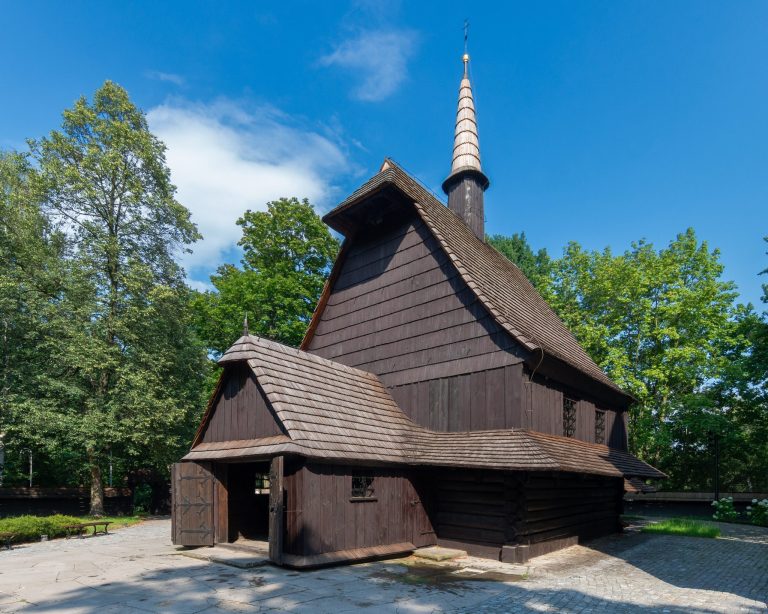
The church is an oriented, single-nave wooden building with a nearly square nave and a chancel closed on three sides. A sacristy adjoins the chancel on the north-west side, while a porch is attached to the south-east side. The nave contains a choir loft. The main body is built in logs, and the structure is enclosed by a stone fence.
Tower and roof forms
A tower stands at the front of the church. Its lower level is built of logs, while the upper part uses a post-frame structure. The tower walls taper inward, are covered with shingles, and are partly boarded in their upper sections. Carved rosette-shaped windows illuminate the bell stage. A shingled pyramidal roof rises above the tower and ends in a finial with a two-armed cross. The cross has been interpreted either as a reference to the Order of the Holy Sepulchre in Miechowice or as an allusion to the period when the ninth-century Byzantine missionaries Cyril and Methodius spread Christianity around Knurów. Its meaning remains unresolved.
The church has a shingled gabled roof. A six-sided bell turret with an onion-shaped cupola rises above the nave. Extended eaves create shingled lean-to coverings around the building, and the wall surfaces above these coverings are also clad in shingles.
Interior decoration and furnishings
The ceiling polychromy, or multicolored painted decoration, was made by the artist Stefan Kątski and follows older stencil-pattern decoration associated with wooden churches. Most of the interior furnishings are Baroque, also described as folk Baroque, and the principal pieces date mainly from the first half of the eighteenth century.
The main altar has a marble mensa, the altar table, supporting a polychromed and gilded wooden retable, the decorated structure behind an altar. Its central image shows Saint Lawrence and dates from the seventeenth century. The left side altar contains an image of Our Lady of the Rosary, while the right altar is dedicated to Saint Barbara and contains her image. Both paintings date from the nineteenth century, with the image of Our Lady of the Rosary assigned more specifically to the second half of that century. The Saint Barbara altar has an antependium, a decorated frontal panel, showing the martyrdom of Saint Lawrence. The side altars are taller, wider, and more richly decorated than the main altar.
The baptismal font and ambo, a lectern or preaching stand, belong to the early eighteenth-century furnishings. Five oil paintings loaned by the Katowice curia, the administrative office of the Catholic archdiocese, are also kept in the church. They include seventeenth-century paintings of the Madonna and Child and Saint Agnes, together with eighteenth-century depictions of the Presentation of the Rosary to Saint Dominic, Saint Martin, and the Pietà.
A stone holy-water stoup, a basin for blessed water, stands in the vestibule. It probably dates from the fifteenth century. The baptismal font and ambo were reconstructed in 2016, and both side altars were repaired in 2017.
Historic bells
Two bells hang in the tower. They were cast in Lorraine, France, in 1655 by the bell-founder Benedikt Brychta. The Goszczycki family donated them in the same year, when the family became the owners of Knurów.