Church of Saint James the Greater in Chylice: A Baroque Parish Church in Czechia


Site at a Glance
- Rating
- 4.6
- Popularity
- Very Low
- Country
- Czechia
- Primary era
- Early Modern
- Eras represented
- Medieval, Early Modern, Modern
- Civilizations
- Holy Roman Empire, Kingdom of Bohemia
- Site type
- Religious
- Remains
- Church
On this page7 sections
History
The Church of Saint James the Greater in Chylice is a Roman Catholic church in Czechia, near Mirošov and Hrádek. Its origins are traditionally associated with the medieval settlement of Chylice and the twelfth-century colonization of the Brdy region, although its foundation date is unknown. The church belongs to the Czech ecclesiastical province, the Diocese of Plzeň, and the Rokycany vicariate and parish.
Medieval Chylice
The first written reference to the church dates from 1295, when it paid a papal tax of eight groschen. Chylice ceased to exist as a settlement at the end of the sixteenth century and was described as deserted in 1616. The church probably fell out of use with the settlement, leaving its earlier fabric to be incorporated into a later building.
The Baroque parish church
In 1675, the surviving remains of the earlier church were incorporated into a new Baroque parish church serving Mirošov. The church and its tower were repaired in 1773 and again in 1882. During the latter repair, four tomb slabs were installed inside the building. The church has been protected as a cultural monument since 1958.
Remains
Church building and interior
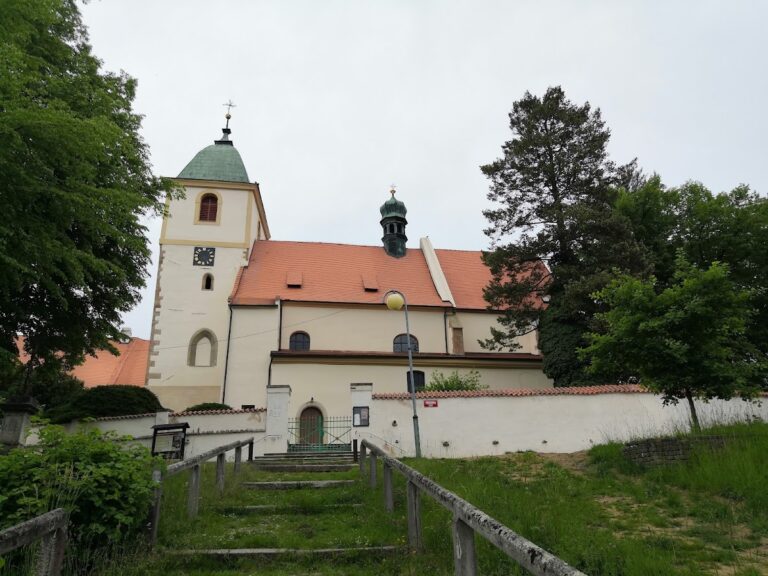
The surviving church is a masonry Baroque building with a single nave, a rectangular plan, and a flat ceiling. Two windows on the south side have rectangular openings with semicircular upper ends. A prismatic tower with a domed roof is incorporated into the southwestern corner. The main entrance is on the west. A sandstone slab above it carries two coats of arms, while a niche above the slab contains a statue of Saint James the Greater, the apostle traditionally identified as the son of Zebedee and brother of John.
The eastern presbytery, the part of the church surrounding the main altar, has a rectangular plan and a ribless cross vault. Its triumphal arch is segmental. The richly decorated Baroque altar dates from the second half of the seventeenth century. Its altarpiece shows Saint James appearing to King Ramiro and urging him to fight the Saracens, the Muslim forces opposed by the Iberian Christian king in this traditional narrative.
A second entrance is located on the south side and is reached through a Baroque gateway in the cemetery wall. The sacristy, an adjoining room for liturgical preparation and storage, occupies the northeastern part of the building and has its own entrance. Above the western entrance stands a choir loft, an elevated gallery for singers or an organ, supported by three pillars. A stone baptismal font is positioned beneath it near the entrance.
The Baroque pulpit has a hexagonal preaching platform carried by a twisted column. Twisted columns decorate its corners, and images of the holy Evangelists appear on the side panels. Its flat, hexagonal canopy is also richly decorated.
Tomb slabs
The four tomb slabs inserted in 1882 are set in two locations. Two occupy the pillars beneath the choir loft, while two are placed in the wall beside the south entrance. One slab beneath the loft shows a small girl holding three flowers in stone relief. The other is a cast-iron slab for Zikmund Ondřej Samuel Emerich, the young son of a shift foreman at the Mirošov ironworks, who died on 29 September 1704. Though the youngest of the four, it has an archaic appearance because its design follows older Renaissance tomb monuments.
The first slab beside the south entrance dates from 1657. It is made of stone and bears a carved six-petalled rosette, together with a cast-iron plaque carrying an inscription. The second dates from 1677 and is also stone, although its inscription has weathered and is difficult to read.
Cemetery of Chylice
The church stands within the cemetery of the extinct medieval settlement of Chylice, at a rural site beside the road between Mirošov and Hrádek. The extensive cemetery serves burials from Mirošov, Hrádek, Myť, and Veselá, and formerly also served Dobřív. Those buried there include Otakar Quadrat (1886–1963), a professor of chemical metallurgy and metallography and rector of the Czech Technical University in Prague, and Antonín Uxa (1847–1894), a miner, journalist, and labor-rights activist.