Szczyrzyc Abbey: A Cistercian Monastery and Marian Shrine in Poland


Site at a Glance
- Rating
- 4.7
- Popularity
- Low
- Country
- Poland
- Primary era
- Early Modern
- External website
- Open
- Eras represented
- Early Modern, Modern
- Civilizations
- Habsburg, Polish–Lithuanian Commonwealth
- Site type
- Religious
- Remains
- Monastery
On this page15 sections
History
Szczyrzyc Abbey is an active Roman Catholic Cistercian monastery in Szczyrzyc, Poland, established in the thirteenth century and centered on a church that combines Gothic elements with Baroque treatment. Dedicated to the Assumption of the Virgin Mary and Saint Stanislaus Bishop, it is also regarded as one of Poland’s Marian shrines, places of devotion centered on the Virgin Mary and an associated image or reported miracle.
Foundation and relocation
In 1234, Teodor Gryfita, the voivode of Kraków, donated land to monks from Jędrzejów so that they could establish a Cistercian settlement near Ludźmierz. The Cistercians were a Catholic monastic order founded in the late eleventh century as a reform movement emphasizing communal prayer, disciplined observance, and agricultural self-sufficiency. The community founded its monastery at Ludźmierz, but probably moved its seat to Szczyrzyc around 1243. The harsh climate, infertile soil, and danger from Mongol or Tatar raids contributed to the relocation.
Devotion to the Virgin Mary began at Ludźmierz and continued at Szczyrzyc, where it became associated with the image known as Our Lady of Szczyrzyc. The monks also helped develop the surrounding region. Their activities included the foundation of Nowy Targ, construction of a fortified castle at Szaflary, cultivation of land, regulation of rivers, and the building of bridges and mills. They established orchards and apiaries and provided practical instruction in crafts connected especially with agriculture.
Medieval growth
The abbey was plundered in 1260 during the Second Mongol Invasion of Poland. By the fourteenth century, its possessions included 33 villages and the estates of Ludźmierz and Szczyrzyc. King Casimir III of Poland ratified these privileges in Kraków on 13 June 1368, confirming the institutional and economic position the monastery had acquired.
Baroque rebuilding and wartime damage
The monastic complex underwent major Baroque renovation between 1620 and 1644, while elements of the earlier Gothic fabric were retained. The Cistercians established a brewery at the abbey in 1628. The church was built in 1620 and later remodeled during the eighteenth and nineteenth centuries, reflecting the complex’s mixture of earlier and later architectural forms.
Swedish troops took the reputedly miraculous Marian image during the Great Northern War in 1705, a conflict involving Sweden and several European powers in the struggle for dominance around the Baltic region. A fire severely damaged the abbey, particularly its church, in 1765. The Marian image was later stolen again by Austrian authorities from 1794, adding another disruption to the history of the shrine.
Habsburg rule and the return of abbey privileges
After the First Partition of Poland in 1772, Szczyrzyc became part of the Habsburg territories. The abbey was incorporated into the Austro-Hungarian Cistercian Congregation. From 1794, the authorities prevented the monks from electing their abbot, confiscated most of the abbey’s land, and barred admission to the novitiate, the period of preparation for monastic vows.
The monks were nevertheless allowed to establish a four-grade elementary school for village children. Władysław Orkan, a Polish writer and poet of the late nineteenth and early twentieth centuries, was among its pupils. The restrictions remained in force until 1918. Pope Benedict XV restored the abbey’s full status and privileges in July of that year, after an intervening period in which it had been reduced to a priory, a smaller monastery dependent on a larger institution.
In 1925, the monks transferred the brewery and their brewing expertise to an external operator. During the German occupation in the Second World War, the abbey sheltered many Polish refugees from Nazi persecution and provided rooms for clandestine education. The community’s wartime conduct led to the award of the Virtuti Militari in 1945. Poland’s highest military decoration, the order recognizes exceptional courage and service in wartime.
Education, brewery, and continuing monastic life
After 1945, the abbey’s educational work continued through a private Cistercian secondary school established there. The authorities closed the school in 1955. The brewery was nationalized and produced inexpensive mass-market beer, reaching an output of 22,000 hectolitres in 1982.
Following Poland’s political transformation, the Cistercians regained control of the brewery in 1993 and reacquired part of the abbey’s former land. Brewing ceased in 1997 because of insufficient labor and heavy debt. The brewery building was protected from auction after being recognized as a historic monument. The original Cistercian recipe was later recovered from the monastery’s records and used to return the beer to the market in 2003; commercial production of the Frater brand had also begun in 2004.
Szczyrzyc Abbey has functioned continuously since the thirteenth century despite Austrian, Nazi, and Soviet or communist interference. It is protected as a monument in Poland’s heritage register, with registration dated 16 April 1968. Its dependent institutions include ordinary priories in Gdańsk-Oliwa, Henryków, and Argo–Willow Springs in the United States, as well as a branch at Jodłownik. Oliwa has been dependent since 1945 and Henryków since 1947.
Remains
Church and monastic complex
Abbey church
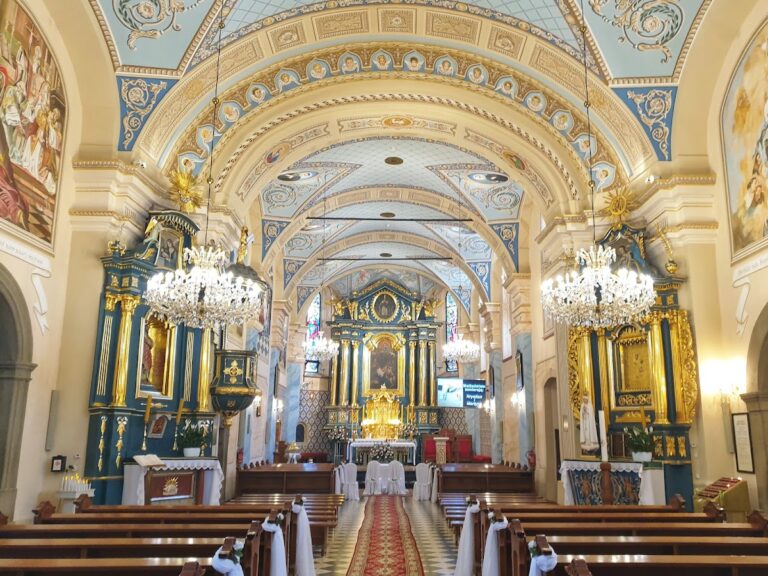
The abbey church follows a Latin-cross plan, with a long nave crossed by a shorter transept, and ends to the east in a semicircular apse, the rounded termination of the sanctuary. Built in masonry in 1620, it was remodeled in the eighteenth and nineteenth centuries. Its appearance brings together Gothic elements and Baroque treatment, preserving the architectural record of successive phases of the complex.
The main altar dates from 1642 and carries statues of Saint Adalbert and Saint Stanislaus. An eighteenth-century tabernacle, the structure used to reserve consecrated Eucharistic elements, and nineteenth-century choir stalls form part of the church’s interior furnishings. The altar also contains the reputedly miraculous image of Our Lady of Szczyrzyc, the central devotional object of the Marian shrine.
Monastery and cloister
The church is attached to a seventeenth-century monastery whose buildings form a square around an interior cloister garden. A cloister is a covered walkway surrounding an enclosed courtyard or garden. Two portals, altar mensae, and parts of the monastic cloisters derive from the earlier abbey destroyed by fire. An altar mensa is the horizontal stone or slab forming the top of an altar.
An eastern wing and a wooden bell tower with a bulbous cupola were added in 1831. The monastery preserves a fifteenth-century crucifix, a sixteenth-century stone stoup, and paintings of saints dating from the seventeenth to the nineteenth centuries. It also houses the reputedly miraculous icon of Our Lady of Wistycze, brought in 1938 from the former Cistercian church at Wistycze.
Abbot’s House and museum collections
Abbot’s House
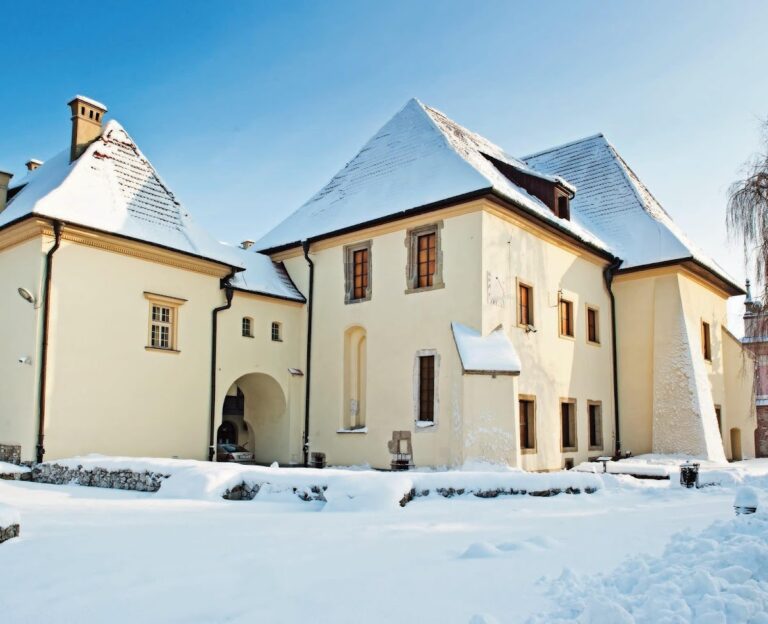
The masonry Abbot’s House dates from the sixteenth century and was later converted into a granary. Its stone portal bears the Korczak coat of arms. The building now houses the Szczyrzyc Monastery Museum, linking the surviving structure with the preservation of the abbey’s religious, literary, and economic history.
Historical collections
The museum contains parchment manuscripts, the fifteenth-century Cross of the Good Way, a relief votive offering commemorating the monastery’s survival, Mass chalices, swords, and more than 4,000 stones, including a fragment of a meteorite. A room devoted to Władysław Orkan contains memorabilia and manuscripts of three letters he wrote to his sister Maria.
Brewery exhibition
An exhibition on the abbey brewery includes a distinctive collection of Szczyrzyc beer labels. Few original labels remained at the monastery because the beer was sold in barrels and labeled later by wholesalers, so the exhibition was assembled through donations from private collectors. Old monastic chronicles describe traditional Cistercian beer as made from roasted grain, chicory, and hops according to a special low-alcohol recipe. The recipe was later recovered from old monastic records after it had been considered lost.
Krzesławice boulder and foundation tradition
A local legend attributes the monastery’s origin to a musician who gave the devil’s gold to the abbey after fearing that his wife would discover how he had obtained it. The devil supposedly tried to crush the monastery with a huge boulder, but the Virgin Mary made the stone too heavy for him to carry. He abandoned it at Krzesławice, about three kilometres from Szczyrzyc.
The boulder is described as approximately 55 metres long, 8 to 12 metres wide, and about 25 metres high. An abandoned hermitage stands at its foot, and its last hermit lived there until 1992. The stone is said to have been a place of worship in pre-Christian times and is traditionally believed to bear the imprint of the devil’s hoof. Together with the Marian image preserved at the abbey, the boulder remains part of the traditions associated with Szczyrzyc’s religious identity.
Nearby sites