Saint-Hubert Abbey: A Benedictine Monastic and Pilgrimage Centre in Belgium


Site at a Glance
- Rating
- 4.6
- Popularity
- Very Low
- Country
- Belgium
- Primary era
- Early Modern
- External website
- Open
- Eras represented
- Medieval, Early Modern, Modern
- Civilizations
- Holy Roman Empire
- Site type
- Religious
- Remains
- Monastery
On this page21 sections
History
Saint-Hubert Abbey is a former Benedictine abbey in Belgium, founded at Andage, also called Andain, around 687. Its surviving buildings combine Gothic, classical, Baroque, and Régence architecture, reflecting centuries of rebuilding and adaptation. The original community was established by regular clerics led by Bérégise at the initiative of Pepin of Herstal and his wife, Plectrude, and was dedicated to Saint Peter.
Foundation and Benedictine refoundation
The foundation tradition says that Plectrude discovered a written message beside a stream near the ruins of Ambra. Pepin then issued a charter and provided an initial endowment from the royal estate of Ambra. Bérégise, Pepin’s chaplain and a former monk of Saint-Trond, was charged with organizing the new religious community. A later abbey history also attributed an earlier church at Ambra to Saint Materne, bishop of Tongres, around AD 102.
The community stagnated or declined during the eighth century. Around 815, its clerics appealed to Walcaud, bishop of Liège. Following the Council of Aachen in 817, the foundation was reorganized under Benedictine monks, a Western Christian monastic tradition based on the Rule of Saint Benedict and its emphasis on communal prayer, disciplined religious life, and work. The monks settled at Ambra on 10 August 817, and the abbey became the southern branch of the diocese of Liège and a major centre for the evangelization of the Ardennes.
The refoundation was completed in 825 when the body of Saint Hubert was transferred from Liège to Ambra on 30 September. Saint Hubert, a seventh- and eighth-century bishop traditionally regarded as patron saint of hunters and of the Ardennes, was already developing a powerful religious cult. The transfer made the abbey a pilgrimage centre, and the settlement and institution gradually adopted the name Saint-Hubert. From the ninth century, Saint Hubert was regarded as the apostle and patron of the Ardennes, and annual pilgrimages to his tomb became obligatory.
Pilgrimage, settlement, and regional authority
Pilgrimage encouraged the growth of a settlement around the abbey. Farmers, leatherworkers, shoemakers, innkeepers, merchants, and smiths formed part of the local population, and the agglomeration eventually reached as many as 4,000 inhabitants. From at least the tenth century, the monks also bred a distinctive line of hunting dogs. These animals were used to search for travellers lost in the forest, and the modern bloodhound is traditionally believed to descend from them. Each year, the abbey presented the king of France with three pairs of dogs and three pairs of birds of prey or park birds.
Between the tenth and eighteenth centuries, Saint-Hubert exercised wide religious, cultural, intellectual, and artistic influence. It founded or controlled numerous priories and ecclesiastical dependencies, including Saint-Pierre before Bouillon, Saint-Michel at Mirwart and Cons-la-Grandville, Saint-Brice at Sancy, Saints-Jacques-et-Hubert at Moulins, Saint-Sulpice at Prix, Saint-Thibault at Château-Porcien, Sainte-Marie at Evergnicourt, and the Converserie. The abbey also inherited the collegiate institutions of Nassogne and Waha.
The abbot held extensive secular rights over villages and hamlets in the Ardennes and beyond. His feudal rights extended to more than 1,000 villages and hamlets between the Meuse and Rhine regions. Spiritually, the abbey depended on the diocese of Liège, while its territory remained relatively autonomous and politically neutral. Its position was contested by the duchies of Bouillon and Luxembourg, the principality of Liège, the Netherlands, and France. Charles V recognized the abbey’s independence in 1522.
Its prosperity and political position repeatedly attracted outside interference. France, the Netherlands, Liège, Luxembourg, and Bouillon variously sought to protect or control the institution, while successive abbots used changing alliances to preserve its autonomy. French royal protection extended from Louis XI to Louis XV. When the duchy of Bouillon separated from Liège in 1676, the prince-bishop’s influence over Saint-Hubert was reduced.
Fires, destruction, and continued influence
The abbey suffered major fires in 1130, 1261, and 1525. On 15 October 1568, Huguenot, or Calvinist, forces sacked and burned the abbey and town during the religious conflicts between Protestant and Catholic powers in the sixteenth-century Low Countries. The monks returned the following year. The sale of Saint Hubert’s shrine suggests that the principal relic may have been lost, yet pilgrimage to the abbey continued.
In the seventeenth and eighteenth centuries, the community generally comprised 35 to 40 priests and several dozen lay brothers and servants. Including guests, sick people, and poor people maintained by the abbey, approximately 100 residents could be associated with the institution. Its income came from pilgrimage, ovens and mills, agricultural tithes, forests, and timber sales. Timber alone provided almost half of its revenue.
The abbey was also active in literature and historical writing. Its chronicle, the Cantatorium of Saint-Hubert, was composed around 1100 and became an important source for the history of the Investiture Controversy in the diocese of Liège. That medieval conflict concerned whether secular rulers or the Church had authority to appoint bishops and other senior clergy. In the eighteenth century, Saint-Hubert remained an intellectual centre of the Ardennes, although internal disputes affected the community.
Economic failure and suppression
Abbot Nicolas Spirlet promoted agricultural and industrial innovation and invested in ovens, foundries, and factories. These projects ended in financial failure. By the end of the old regime, the abbey was bankrupt and its property was mortgaged. Its annual income during the eighteenth century had been 180,000 écus.
French troops entered Saint-Hubert on 25 May 1794 and pillaged the abbey. The last abbot, Nicolas Spirlet, took refuge with Capuchin friars at Montjoie and died on 16 September 1794. Religious properties were placed under sequestration in 1795, and the monks were finally expelled by force on 27 January 1797. The abbey was suppressed and sold later that year.
Parish church and later institutional uses
The abbey and its goods were auctioned in 1797 to Jean-Barthélemy Le Couteulx de Canteleu. He transferred the abbey church to Pierre Boignes in 1807, after which the church and remaining abbey buildings followed separate histories. The church was threatened with demolition for its materials, but local inhabitants and Joseph Pisani de la Gaude, bishop of Namur, organized collections that enabled its purchase and preservation for religious and artistic use in 1808. It became a parish church in 1809 and was raised to the rank of minor basilica on 6 June 1927, during commemorations of the 1,200th anniversary of Saint Hubert’s death.
The abbey was listed as built heritage in 1938 and recognized as an exceptional monument in 2016. During the French and Dutch occupations, the abbey quarter and associated buildings housed the central administration of the Department of the Forests from 16 November 1794 to 16 June 1795. Later they accommodated administrative services, a sub-prefecture, and a judicial district under successive French, Luxembourgish, and Belgian administrations until the separation of the two Luxembourgs in 1839.
The State Archives at Saint-Hubert occupied part of the former abbey buildings from 1962. They closed permanently on 1 March 2019, and their collections, including the important archival fonds of the former abbey, were transferred to the State Archives at Arlon. Other buildings accommodate cultural services of the Province of Luxembourg, provincial administrative services, and an outdoor activity centre.
Remains
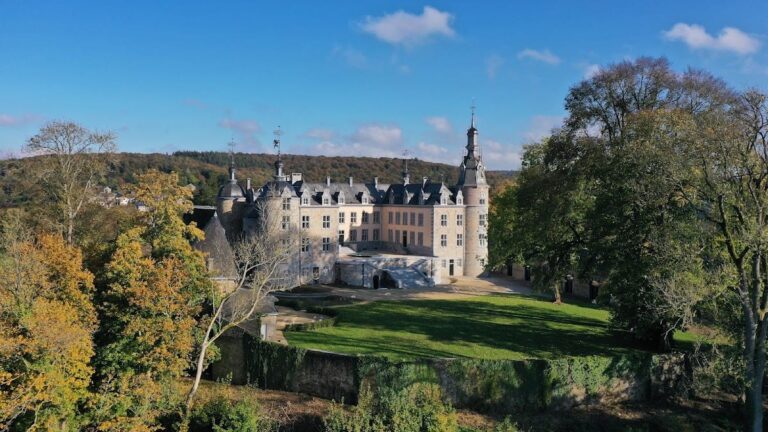
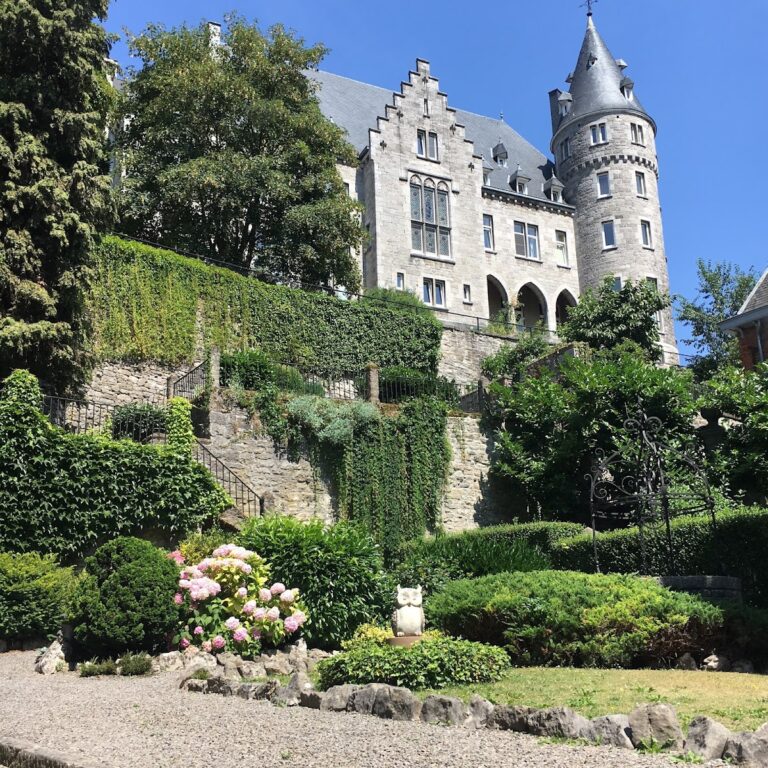
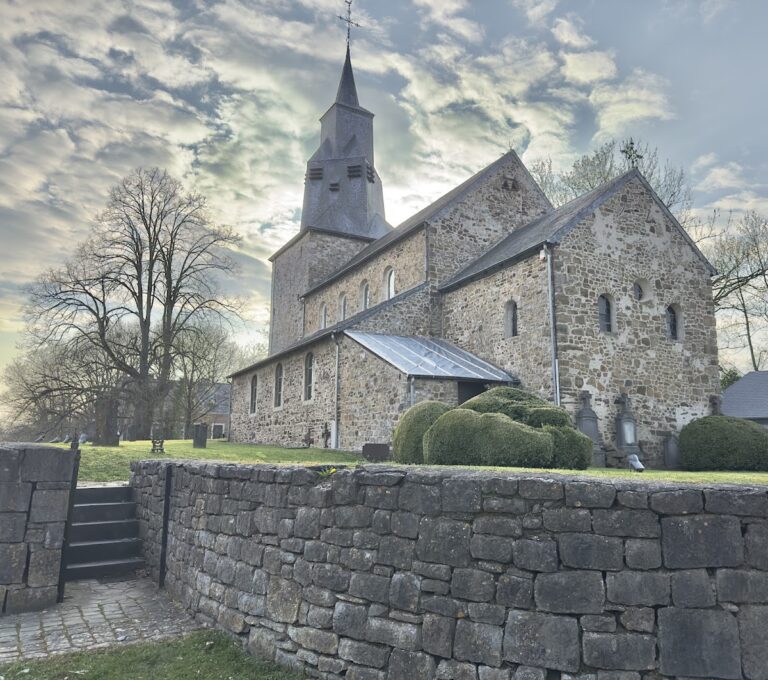
The surviving complex is organized around the former abbey church, now the Saint-Hubert Basilica, the abbey quarter, and parts of the conventual buildings. Most of the visible fabric dates from rebuilding and alteration between the sixteenth and eighteenth centuries. Together, the buildings retain evidence of medieval ecclesiastical planning, early modern monastic organization, administrative use, and the abbey’s industrial activities.
The basilica
Church structure and facade
The present church was built between 1526 and 1564 in Brabant Flamboyant Gothic style after the preceding church was destroyed by fire in 1525. It occupies the site of earlier churches and retains elements from the twelfth and thirteenth centuries. The large ogival sanctuary measures approximately 95 metres long and 30 metres wide, a scale suited to both the monastic community and the pilgrims received at Saint Hubert’s tomb.
A Romanesque church with three naves had been built between 1133 and 1167 under Abbots Gislebert and Jean de Wahart after the fire of 1130. Under Abbot Thierry III of Waha, its western entrance block was replaced in the thirteenth century by an Early Gothic forebody. The surviving towers incorporate elements of that Gothic phase. The present Baroque facade took its form around 1700 under Brother Bérégise and Arnold Hontoire. It includes the twin Early Gothic towers, modified after successive fires, and displays the arms of Abbot Clément Lefebvre above the portal.
A stone relief of the conversion of Saint Hubert was made around 1700 to 1702, probably by the Liège sculptor Arnold Hontoire. It is surmounted by a statue of the saint by Jean Willame, installed on 1 July 1986. The statue replaced an earlier one removed in 1958 after its head fell onto the Abbey Square in 1949.
Crypt and interior furnishings
A crypt beneath the choir dates from about 1080 and is a remnant of three crypts traditionally associated with Saint Thierry of Leernes. Its pavement, possibly from the fifteenth century, resembles that of the sanctuary of the former Saint-Jacques collegiate church in Liège. A copy of a thirteenth-century Sedes Sapientiae, a representation of the seated Virgin holding the Christ Child, was returned to the crypt in 1949; the original is preserved in the diocesan museum.
The church contains a Limoges enamel altarpiece of 24 panels dating from approximately 1530 to 1560. Associated with the workshop of Martin Didier and inspired by Albrecht Dürer’s Little Passion of 1511, it was heavily damaged by the forces that attacked the abbey in October 1568. Other furnishings include a stained-glass window installed in April 1542 and donated by Adolph of Schauenburg, coadjutor of Cologne, a painting of Saint Hubert dated 1648, an organ case from 1685, choir marble paneling from 1721, and a marble high altar from the same year.
The centre of the high altar is occupied by a Virgin and Child signed by Renier Panhay of Rendeux. The other statues, including the Triumphant Christ, Saints Peter and Paul, Saint Benedict, Saint Scholastica, angels, and cherubs, are attributed to Cornelis Vander Veken. The choir stalls, completed in 1733, were made by the joiner Pierre Martiny and the sculptor Jean-François Louis, Arnold Hontoire’s son-in-law. Four monumental statues of the Evangelists by Guillaume Evrard are also preserved in the church.
A Neo-Gothic stone cenotaph for Saint Hubert dates from 1847. Made of French stone, it is surmounted by a reclining statue of the saint in Carrara marble by Guillaume Geefs. Other preserved objects include Saint Hubert’s stole, a crozier volute, an oliphant, a liturgical comb, reliquaries associated with three Virgins of Cologne, and reliquaries associated with Saints Bérégise and Thierry of Leernes. The oliphant is a carved ivory horn, while the crozier volute is the spiral-shaped head of a bishop’s pastoral staff. A polychrome wooden statuette of a kneeling knight, about 82 centimetres high and probably made locally around 1445, is also preserved. Its identification as a gift from Louis XI remains uncertain.
Conventual and administrative buildings
Conventual wings
The conventual buildings were rebuilt after an abbey fire in 1635, with the work completed in 1639 under Abbot Nicolas de Fanson. Three wings from this period survive along the north side of the church around the lime-tree courtyard. One quadrangle served the monks, while another was intended for lay brothers and servants. The buildings later housed the Saint-Hubert athenaeum boarding school.
Abbey quarter and abbot’s palace
The abbey quarter served as an administrative chancery and as prestigious accommodation for important visitors. It was rebuilt between 1729 and 1731 under Abbot Célestin De Jong as a three-winged Régence, or early eighteenth-century French transitional, complex. Its main facade bears De Jong’s arms. The interior retains marble work, fireplace slabs, a gallery, a library with woodwork, remnants of painted ensembles by Nicolas Thierry of Verdun and Charles-Joseph Redouté, a door dated 1639, and a monumental wrought-iron staircase completed in 1731.
The former abbot’s palace contained the abbot’s residence, the abbey administration, the library, and the archives. Its library was dispersed after the suppression. About 100 manuscripts are preserved at Maredsous, while other holdings entered public and private collections or were lost. The palace was restored in 2003.
Porte du Parc and defensive remains
The Porte du Parc spans the street of the same name behind the basilica. It was rebuilt with the abbey enclosure between 1659 and 1662 under Abbot Benoît Laurenty de Lessive. Together with the bastion of Nicolas de Fanson, it forms one of the surviving remnants of the abbey’s defenses. Earlier fortifications, built around 940 under Abbot Frédéric, comprised roughly one kilometre of walls, nine towers, and at least four gates. The gate stood beside the monks’ cemetery, and its upper room served as a morgue.
Hospital and agricultural estate
Abbey hospital
An abbey hospital for sick people and pilgrims is recorded from the abbacy of Thierry of Leernes, between 1055 and 1086. Fires led to repeated rebuilding, and the hospital was reconstructed on Rue de la Fontaine in 1607 under Abbot Jean de Masbourg. The present building represents approximately one quarter of the former hospital complex and was later adapted for King Leopold I.
Chermont cattle farm
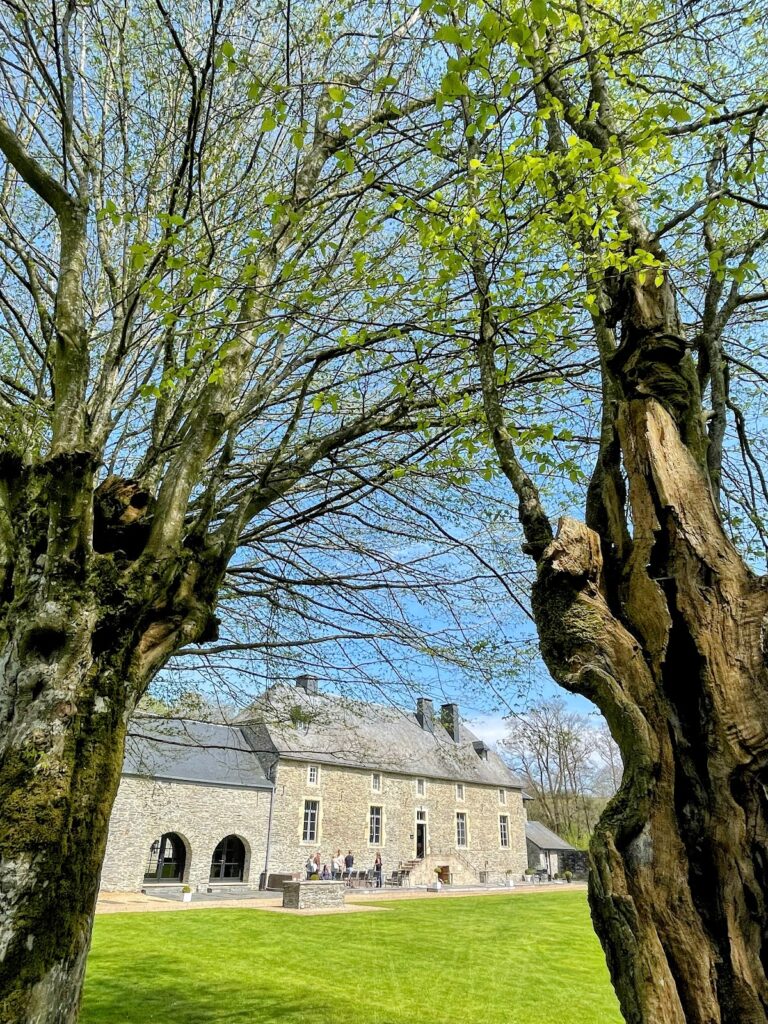
The Chermont cattle farm was built around 1645 under Nicolas de Fanson on the site of a deserted hamlet. It managed a single estate of more than 100 hectares where the abbey raised red cattle. Sold with the abbey properties in 1797, it became an agricultural and livestock farm during the nineteenth century and was later converted into a residence.
Outlying industrial and charitable properties
Fourneau de Masblette
The Fourneau de Masblette, now the Fourneau Saint-Michel museum complex, lies about seven kilometres north of Saint-Hubert beside the Masblette River. Abbot Nicolas Spirlet established an ironworks there between 1771 and 1773, comprising a furnace, forge, finery hearths, and foundry. A finery hearth was used to refine pig iron into wrought iron. Because the local ore proved inferior, production from 1776 concentrated on wrought iron, firebacks, and cannon. The buildings later served as a sawmill and inn before becoming an open-air museum.
Converserie hospice
The Converserie, about ten kilometres northeast of Saint-Hubert in present-day Tenneville, retains parts of its historic buildings. The abbey built its first hospice there in 1152 on land donated by Count Henry of La Roche. It served pilgrims and sick travellers crossing the forest towards Saint Hubert’s tomb and included agricultural buildings and a cleared settlement area.
Quarries and marble production
The abbey exploited limestone quarries at Bure, Forrières, Han, Rochefort, and Wavreille. In 1709 it acquired land for a marble quarry near Humain. Documents record the extraction of Famennian red marble there until 1757. The stone was generally lighter and greyer than the marble of Saint-Remy and carried characteristic cement-like veins.
Lay brothers supervised extraction at Humain. The marble was sawn and polished at an abbey mill at Grupont, then finished and assembled at Saint-Hubert. It was used in the former rood screen, pavements, choir paneling, altars, and sanctuary stairs of the church, as well as in columns, door surrounds, and fireplaces in the abbey palace. Surviving quarry faces preserve evidence of several extraction methods, including the direct use of a blade against the rock face to cut large blocks.