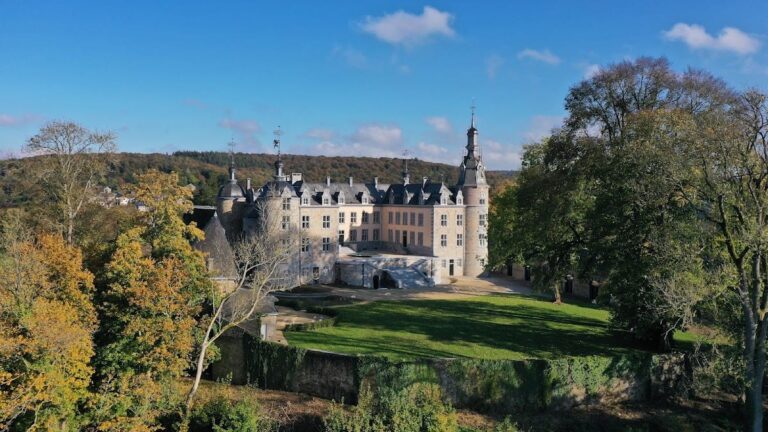
Château de Grandvoir: A Historic Château-Farm in Belgium


Site at a Glance
- Rating
- 4.6
- Popularity
- Low
- Country
- Belgium
- Primary era
- Early Modern
- Eras represented
- Early Modern
- Civilizations
- Duchy of Luxembourg, Habsburg, Holy Roman Empire, Spanish
- Site type
- Domestic
- Remains
- Castle
On this page15 sections
History
Château de Grandvoir is a château-farm in Belgium, at Neufchâteau, whose history is closely linked to the estate’s ironworks and the families who occupied it. The site may have begun in the Middle Ages as a fortified house, although the date and form of this early phase remain uncertain. By the seventeenth century, it was known as the “house of Grandvoir.” A tradition connects the name with a supposed Roman “great villa on the Vierre,” but that interpretation is uncertain.
From fortified estate to ironworks
No occupants of Grandvoir are known before the sixteenth century. The early estate may have been surrounded by a water-filled moat supplied by a diversion of the Vierre, with a drawbridge and portcullis near the present entrance. These defensive features remain hypothetical.
Nicolas de Mayeur, provost of Neufchâteau and general steward of the Arenberg forests, lived at Grandvoir and enlarged the estate by purchasing land at Torrimont and in the meadows near his residence. A provost was a local administrative and judicial official, while the Arenberg family was a major noble house with extensive land and forest interests in the region. De Mayeur died at the end of 1638.
About two decades later, Grandvoir passed to François de Valfleury, lord of Batilly and another Arenberg provost, probably through his marriage to Marguerite Hacher, the daughter of the owner of the Mellier ironworks. In 1668, François received permission from the lords of Neufchâteau to establish ironworks at Grandvoir. An ironworks was a furnace-based industrial complex that depended on charcoal and controlled water power.
The Valfleury family was living at the château by June 1671, when Jean Brunel became their chaplain. François de Valfleury died at the end of 1679. In 1683, his widow leased the Grandvoir ironworks, château, gardens, enclosures, meadows, and dependencies to Jean-Mathieu de Marchant, master of the Buzenol ironworks, for nine years.
The de Jacques family and industrial prosperity
Lambert Jacques, who had married Marie de Valfleury, Marguerite Hacher’s eldest daughter, managed the Grandvoir ironworks for five years. In 1700, he leased their operation to Servais-François de Marchant. A captain and provost as well as an industrial operator, Servais-François managed the works until 1707 while also running the Mellier ironworks and the Rulles furnace.
Catherine-Louise de Valfleury and her niece Catherine-Louise Jacques were living at Grandvoir in 1700. The Marchant lease covered the whole property until 1707, after which the two women appear to have returned to the château.
Lambert de Jacques II, born in 1672, was a lawyer, master of forges, and owner of the Grandvoir fief and ironworks. He was ennobled by letters dated 15 June 1727, a date also inscribed on the château. From 1729, he acquired woodland to secure charcoal for the ironworks, but died at Grandvoir in November 1735 before completing this undertaking.
Under his son, Lambert-Joseph de Jacques III, the ironworks reached their greatest prosperity around the middle of the eighteenth century. The flow of the Vierre was improved to regulate the factories’ water power, and the works appeared prominently in the 1765 survey of Luxembourg manufactures. Purchases of woodland, including Gérimont and Verlaine, expanded the estate to more than 140 hectares.
This prosperity did not last. In 1779, Lambert de Jacques was forced to borrow from his son-in-law Mathias Petit, and he died on 12 December 1789. François de Jacques de Rosière then faced debts, unpaid bills, and the economic disruption caused by the French Revolution, a period that brought major political and social change in France. He adopted the surname “de Rosière” to conceal his noble status.
On 12 May 1791, the de Jacques heirs sold the château, its dependent buildings, gardens, and adjoining enclosures to Mathias Petit, an engineer serving the imperial government. François-Nicolas de Jacques de Rosière died at Grandvoir on 25 August 1813, during the beginning of the ironworks’ decline.
The Petit and Collard families
Mathias Petit, an engineer and controller of the fortifications of Ghent, died at Grandvoir on 6 November 1808. In 1813, the estate was purchased by Jean-Herman Collard, a former member of the Council of Five Hundred and the Legislative Body, from Petit’s nephews. These were representative institutions of revolutionary and post-revolutionary France, and they account for Collard’s description as an ex-legislator.
Jean-Herman Collard was murdered at Le Blanc Caillou on the evening of 3 December 1814. The crime was never solved. His two daughters were placed under the care of their uncle Pierre-Joseph Collard, whose daughters were Joséphine and Élisabeth.
The Collard family occupied Grandvoir for nearly a century. Joséphine Collard married Charles Legardeur, an industrialist from Sedan, and later withdrew with him to Grandvoir after his reputation as a gambler led them to isolate themselves. She died in 1882.
Élisabeth Collard lived at Grandvoir and maintained a relationship with Prince Pierre-Napoléon Bonaparte. A Bonapartist prince, he was the son of Lucien Bonaparte and nephew of Napoleon I, and spent substantial periods in Belgium after exile from France. His connection with Élisabeth was linked to his interest in hunting rights on the Grandvoir estate, and he delivered a commemorative speech at Jean-Herman Collard’s funeral. Élisabeth acquired the château of Rochefort in the hope that he would settle there. She died on 5 January 1896.
Later ownership and present use
After Élisabeth Collard’s death, her godson Ferdinand Bretagne inherited Grandvoir. He ordered searches of the château and its dependencies, including the cellars, underground passages, attics, floors, and walls. He subsequently announced the public sale of the inherited movable and immovable property, including a library described as exceptionally rich in heritage value.
After passing through several owners, the property returned to the Petit family around 1920 through Georges Petit, Mathias Petit’s great-grandson. Château de Grandvoir is protected as part of Wallonia’s monumental heritage. It functions as a hotel and hunting lodge, while one wing has housed the Grandvoir brewery since September 2016. The brewery produces the high-fermentation blonde beer Le Vaurien.
Remains
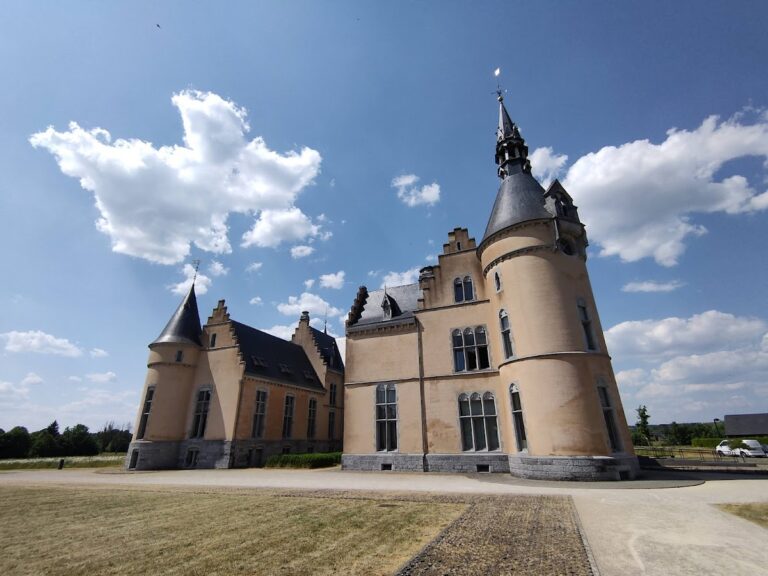
Château de Grandvoir is a massive quadrilateral château-farm built of schistose sandstone rubble around an internal courtyard. The complex contains two large residential ranges, a guardhouse, stables, and a barn. A vaulted entrance porch leads into the courtyard, which was repaved in the mid-twentieth century with a circular decorative pattern.
Residential ranges and chapel
Entrance range
The building facing the entrance was constructed in 1720 by Lambert de Jacques, a master of forges. It may have replaced a lower earlier structure, traces of which include a blocked doorway in the first-floor wall. The replacement building was approximately twenty metres long and had a central perron, a raised entrance platform or flight of steps.
Left wing and chapel
The left wing is considered the oldest part of the château. Its schist façade retains a chapel identified by its semicircular-headed windows. The chapel was already present in 1671, when the Valfleury family lived at Grandvoir.
Southern range
The inner face of the southern range carries the date 15 June 1727. The inscription commemorates Lambert de Jacques II’s ennoblement and links the building to the family’s eighteenth-century rise in status.
Dependencies and water system
The de Jacques family rebuilt the remaining sides of the quadrilateral during the eighteenth century, including the dependencies, barn, and stables. The dependencies are said to conceal an underground passage. A diversion of the Vierre reaches the road a few metres from the château and may have supplied a former moat around the entire complex. The possible moat, drawbridge, and portcullis remain uncertain elements of the site’s earlier defensive arrangement.
Interior features and artistic remains
Former library
A chimney in the former library bears the date 1642. Extensive later alterations make it impossible to establish with certainty which portions of the château belong to that date, but the chimney provides an early dated element within the complex.
Paintings
Several paintings by Abraham Gilson of Orval were recorded at the château. They date from the period of the ironworks’ prosperity in the eighteenth century and form part of the artistic associations of the residence.
Collard chapel and crypt
The Collard chapel contains a family crypt concealed beneath it. The crypt has six burial chambers, four of them covered by slabs bearing inscriptions. The chapel and its burial spaces were repeatedly profaned, leaving the crypt as a physical record of the Collard family’s connection with Grandvoir and of the disturbance that affected its burial places.
Nearby sites