Al-Sheikh Deeb Castle: A Medieval Citadel in Syria


Site at a Glance
- Rating
- 5
- Popularity
- Very Low
- Country
- Syria
- Primary era
- Medieval
- Eras represented
- Medieval
- Civilizations
- Mamluk, Nizari Ismaili State
- Site type
- Military
- Remains
- Castle
On this page6 sections
History
Al-Sheikh Deeb Castle, also known as Qulay’a, is a medieval citadel in Syria in the coastal mountains. It became one of the fortified centers controlled by the Nizari Ismailis, a branch of Shi’a Islam that established mountain strongholds in medieval Syria.
Nizari Ismaili and Mamluk control
The Nizari Ismailis took control of Qulay’a around the time they assumed control of Masyaf in 1140–1141. The fortress remained within their network until it surrendered between 1270 and 1273 to Baybars, the Mamluk sultan whose campaigns brought several Syrian Nizari Ismaili fortresses under Mamluk authority. Qulay’a was then annexed to the Mamluk realm.
Ottoman administration and later names
During the Ottoman period, the castle became the center of a nahiye, a small administrative subdistrict subordinate to a larger district or province, in the hill country west of Hama. Ottoman tax registers from 1547 and 1645 list the settlement. By the seventeenth century, the castle’s inhabitants were Alawites, a religious community with historical roots in the broader Shi’a Islamic tradition and a particular concentration in the Syrian coastal mountains.
The name Al-Sheikh Deeb came from the family that had inhabited the castle for approximately 300 years. During the Crusader period, the fortress also had the Latin name “Coleé,” apparently adapted from its Arabic name.
Remains
Fortress on the volcanic knoll
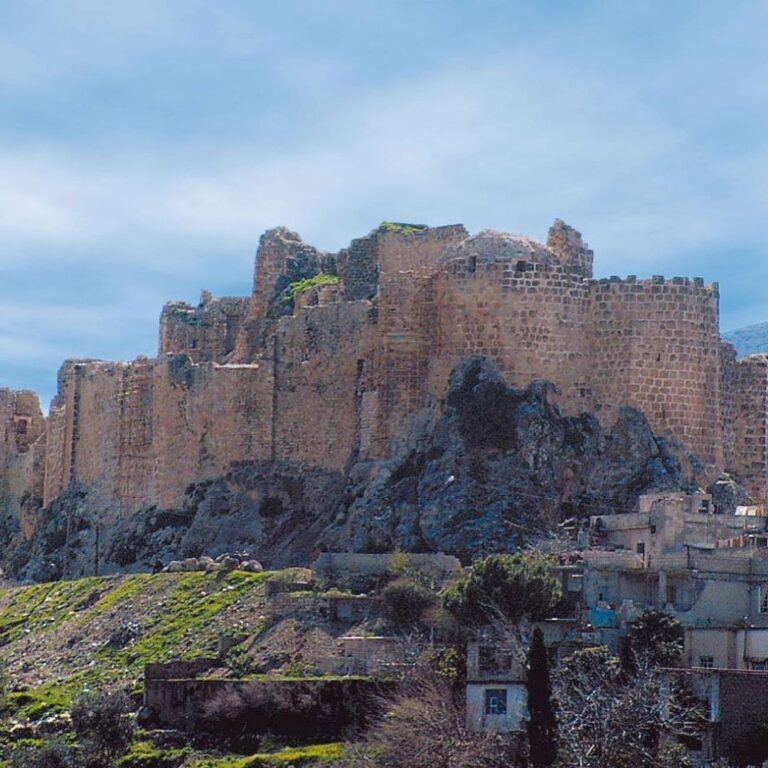
Al-Sheikh Deeb Castle stands on a volcanic rocky knoll integrated into a natural rock mass within a long valley, about 5 kilometres south of Husn Suleiman. Its surviving remains occupy a compact area of no more than approximately 230 square metres. Volcanic stone forms the construction, while sections of wall close gaps between natural rock outcrops. The village of Qulay’a lies below the hilltop fortress.
Water supply and lower settlement
A well cut into the bedrock survives within the castle. The fortress may also have been associated with a small settlement below the hill near the abundant spring of al-Sardad. Analysis of the spring water found it to be mineral-rich.
Nearby sites