Saint Martin Collegiate Church: Treviglio’s Historic Basilica
Site at a Glance
- Rating
- 4.8
- Popularity
- Very Low
- Country
- Italy
- Primary era
- Medieval
- Eras represented
- Medieval, Early Modern, Modern
- Civilizations
- Habsburg, Holy Roman Empire, Venetian
- Site type
- Religious
- Remains
- Basilica
On this page18 sections
History
Saint Martin Collegiate Church, also known as the Basilica of Saint Martin and Saint Mary of the Assumption, is the principal parish church of Treviglio, Italy. Its present building was constructed in 1008 on the site of a small Lombard church, and its dedication recalls Saint Martin of Tours, a fourth-century Christian bishop, and the Assumption of Mary, the Christian belief that Mary was taken into heavenly glory.
Lombard and Romanesque origins
The church’s beginnings are associated with a fifth-century Lombard building dedicated to the Savior and the Assumption. That earlier church was small, oriented from north to south, and occupied the area later taken by the apse of the present basilica. Around 1000, a Romanesque civic bell tower was built nearby. The current church followed in 1008, replacing the earlier Lombard structure on the same site.
Gothic enlargement and collegiate development
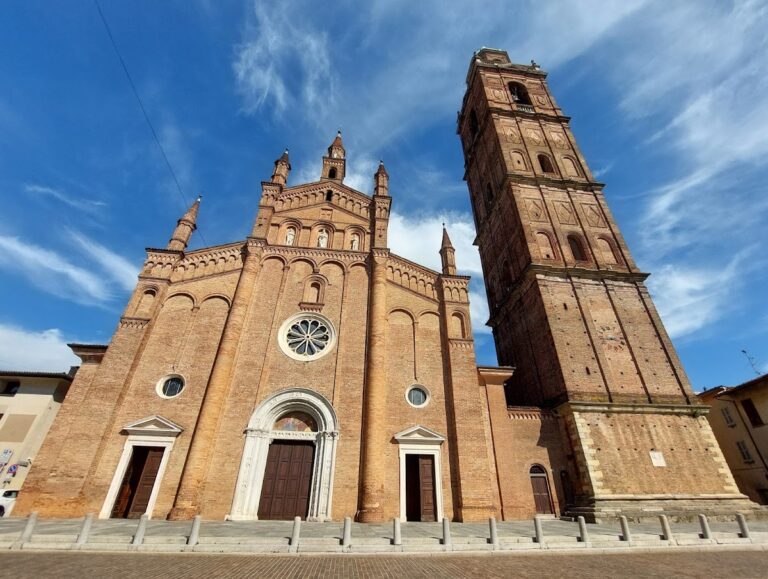
In 1482 the church underwent an extensive enlargement and remodelling in the Lombard Gothic tradition, the regional Gothic style of northern Italy. The civic bell tower was incorporated into the church during this work and raised in Gothic form. Its increasing height became the subject of disagreement with nearby Caravaggio, whose bell tower was higher. Frescoes from this remodelling survive in the Gothic Chapel.
Stefano Maldotti, a fifteenth-century Italian benefactor, provided for a college of clergy attached to Saint Martin through his will of 1476. A collegiate church is served by an organised body of clergy rather than a monastic community, and this institution continued until 1798. In 1577 Saint Martin became the religious centre of the Pieve of Gera d’Adda, a historic ecclesiastical district supervising several parish churches. Archbishop Carlo Borromeo raised it to collegiate status in 1583, with 17 parishes belonging to it. Inheritances dedicated to the building fund and the growth of confraternities later increased the church’s resources.
Later remodelling and status
Repeated restoration and modernisation gave the church its combination of Romanesque, Lombard Gothic, Renaissance, Neoclassical, and late Baroque elements. The facade was remodelled in 1740, completing its late Baroque appearance around a Renaissance portal. The collegiate institution permanently lost its privileges in 1798 under the Cisalpine Republic, a French-supported republic established in northern Italy in 1797 and reorganised under French control in 1802.
In June 1951, Pope Pius XII elevated the church to the rank of minor basilica, a papally granted title recognising particular religious and historical importance. The building also holds the status of an Italian national monument. It stands on Treviglio’s central square, opposite the town hall.
Remains
The basilica has a conventional east-west orientation and a three-aisled interior. Its surviving fabric brings together several historical phases, while the facade, bell tower, chapels, paintings, sculpture, and carved furnishings preserve evidence of the church’s successive alterations.
Facade and bell tower
Late Baroque facade
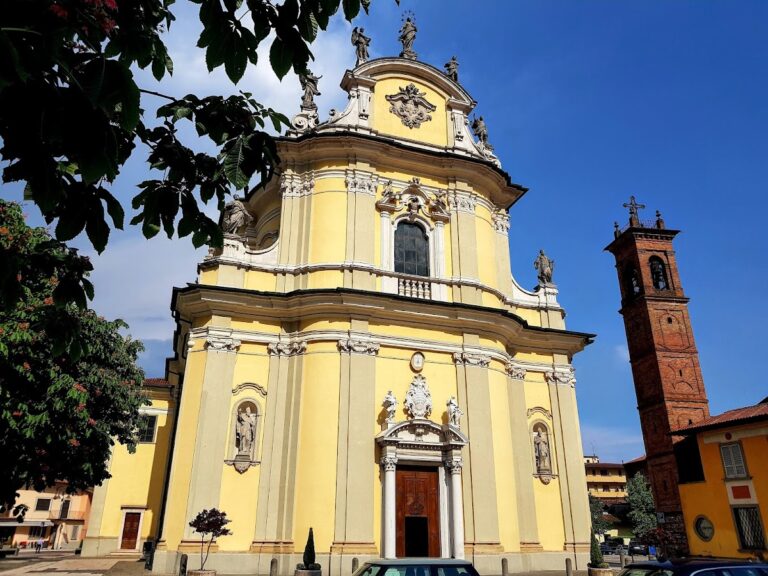
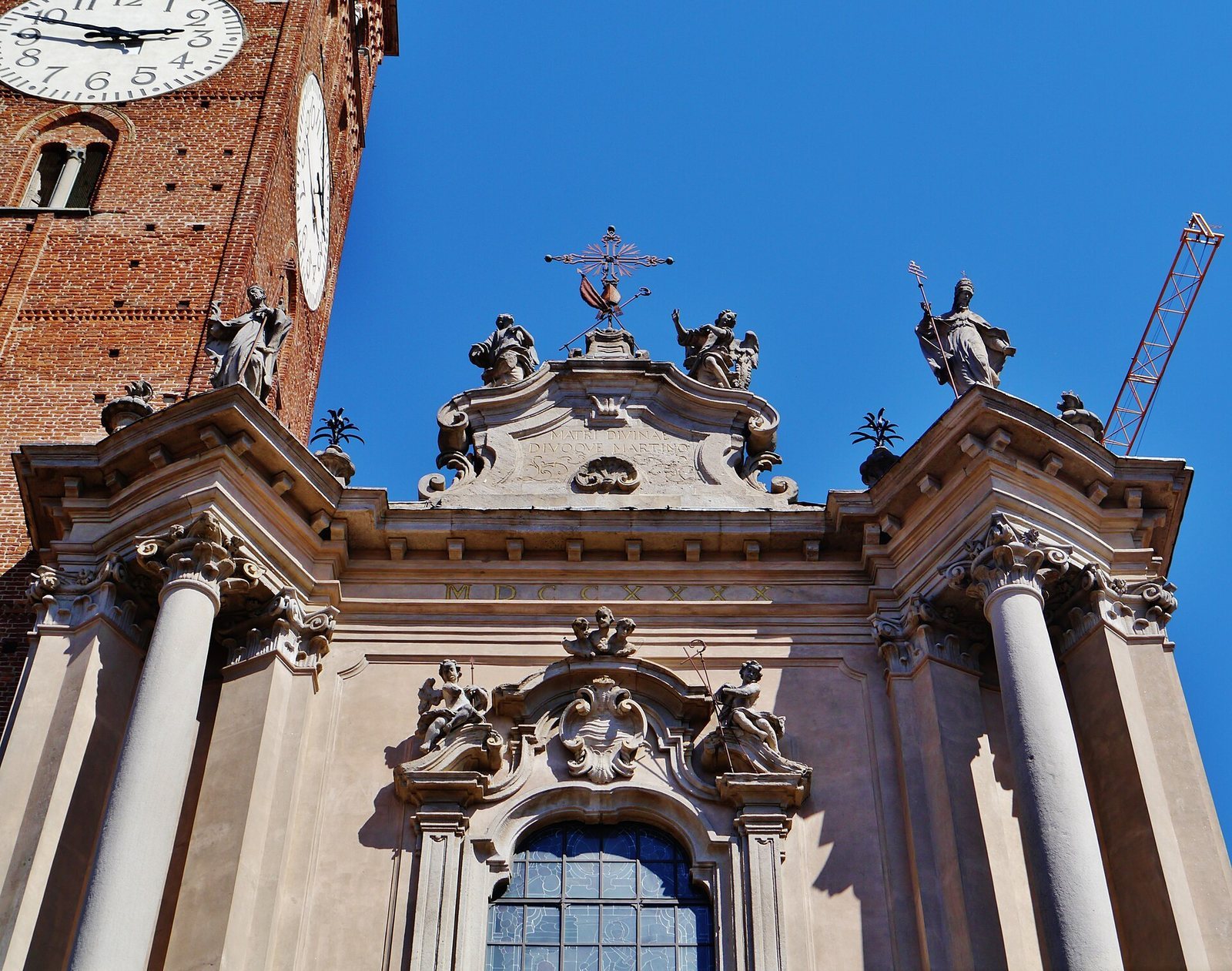
Giovanni Ruggeri designed the two-level late Baroque facade, which was completed in 1740 around a sixteenth-century Renaissance portal. Above the portal, a framed statue of Saint Martin of Tours was made by Antonio Maria Pirovano, who also created the figures of Saint John Nepomuk and Saint Francis Xavier in the two side niches. The upper level contains statues of Saints Ambrose and Charles, both bishops of Milan. At the summit are Saint Felix, whose relics are preserved inside the church, and Saint Gregory the Great.
Romanesque civic tower
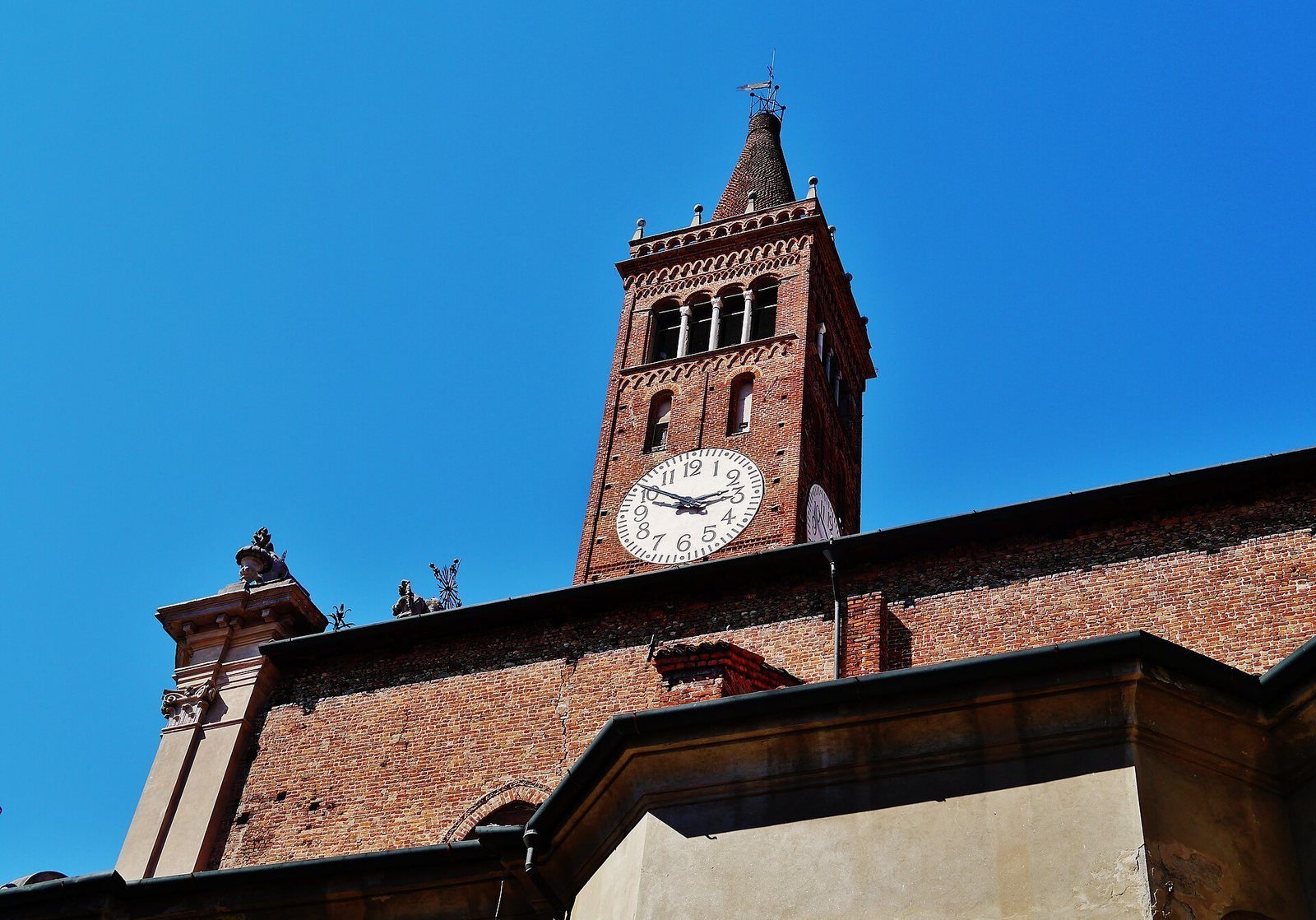
The bell tower began as a Romanesque civic structure dating from around 1000. It was attached to the church in 1482 and raised in Gothic style during the enlargement. Its height formed part of a dispute with Caravaggio, whose bell tower exceeded it.
Chapels and altar area
Gothic Chapel
The Gothic Chapel to the left of the entrance retains some frescoes from the Lombard Gothic remodelling of the church. These paintings remain connected with the fifteenth-century phase that enlarged and reshaped the building.
High altar and polyptych
Bernardo Zenale and Bernardino Butinone produced the church’s polyptych between 1485 and 1505, after roughly twenty years of work. A polyptych is an artwork made from multiple adjoining or hinged panels. The work originally stood on the high altar, where it remained until Pietro Pestagalli remodelled the altar in Neoclassical style in 1830.
Ambulatory and Chapel of the Relics
Camillo Procaccini painted the Assumption, now displayed in the ambulatory behind the high altar, and the Annunciation in the Chapel of the Relics. The ambulatory was constructed by the Galliari brothers during the church’s later remodelling. The same area contains a painting of Saint Jerome by Genovesino.
Nave paintings and vault decoration
Paintings by the Cavagna family
Gian Paolo Cavagna painted large canvases of the Last Supper, the Descent of the Manna, and the Mystic Marriage of Saint Catherine. He also worked with his son Francesco on frescoes for the nave vault. Francesco painted the three canvases showing the Stories of David on the choir-loft parapet.
Stories of Saint Martin
The large canvases depicting the Stories of Saint Martin were placed beneath the nave vault after the eighteenth-century remodelling by the Galliari brothers. Giovanni Stefano Danedi, known as Montalto, painted them. The Galliari brothers also created the illusionistic perspective scheme on the vault. This trompe-l’oeil technique uses painted forms to create the impression of three-dimensional architecture.
Later vault frescoes
Federico Ferrario painted the vault frescoes depicting the Assumption and Saint Martin. Other paintings in the basilica are by Nicola Moietta, Antonio Molinari, and Giovanni Stefano Manetta.
Sacristy furnishing
Carved wooden Nativity
The sacristy preserves a carved wooden Nativity scene made by Giovanni Angelo Del Maino around 1515. It forms part of the church’s surviving sculptural furnishings and represents an early sixteenth-century work within the later architectural setting.