Saint Elisabeth of Hungary Sanctuary in Warsaw-Powsin: A Baroque Parish Church and Marian Sanctuary


Site at a Glance
- Rating
- 4.6
- Popularity
- Low
- Country
- Poland
- Primary era
- Early Modern
- External website
- Open
- Eras represented
- Early Modern, Modern
- Civilizations
- Polish–Lithuanian Commonwealth, Russian
- Site type
- Religious
- Remains
- Church
On this page8 sections
History
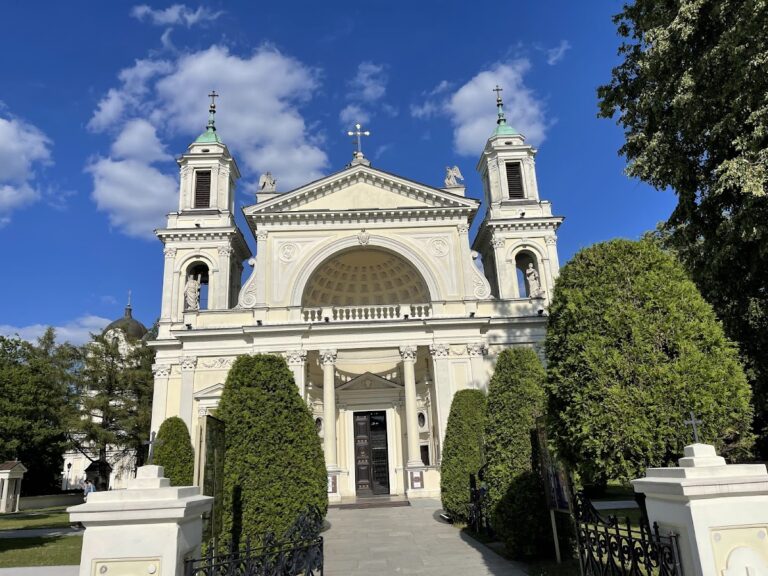
Saint Elisabeth of Hungary Sanctuary in Warsaw-Powsin is a Roman Catholic parish church and Marian sanctuary in Warsaw, Poland, with a Baroque core built in the eighteenth century. Dedicated to Saint Elisabeth of Hungary, a thirteenth-century Hungarian princess remembered for charitable work and later venerated as a Catholic saint, the church belongs to the Archdiocese of Warsaw and is also known as the Sanctuary of Our Lady of Longing in Powsin.
Foundation and parish formation
In 1398, Elżbieta Ciołkowa, widow of Andrzej Ciołek, the castellan of Czersk, founded a wooden church at Powsin. A castellan was a senior official traditionally responsible for administering a castle and its surrounding territory. The church was dedicated to Saint Andrew the Apostle and Saint Elisabeth. Elżbieta acted with the advice of her sons Wygand, Andrzej, Stanisław, and Klemens, intending the foundation as a prayer for her husband, her believing friends, and the glory of God and the Virgin Mary.
The Powsin parish was formally established in 1410, when Wojciech, bishop of Poznań, separated Powsino, Jeziorna, and Lisy from the Wilanów parish. Their inhabitants regarded the church in Wilanów as too distant, and the new church became the center of religious life for the three villages.
Wooden church and Baroque rebuilding
The first wooden church was probably destroyed during the Swedish Deluge, the seventeenth-century invasion and occupation of much of the Polish-Lithuanian Commonwealth by Swedish forces. A second wooden church was then erected on the site, but it apparently remained unfinished and deteriorated.
In 1725, Elżbieta Lubomirska Sieniawska, owner of the Wilanów estates, including Powsin, financed a substantial brick church. Designed by the Baroque architect Józef Fontana, the building belonged to a European period known for dynamic forms, strong spatial effects, and elaborate decoration. Fontana’s church supplied the architectural core of the present sanctuary.
From 1803 to 1815, the parish priest and caretaker was Jan Paweł Woronicz, who later became Primate of the Kingdom of Poland. A primate holds a historically important senior leadership title within a national or regional Catholic hierarchy.
Extensions and modern status
As the parish grew, the church was enlarged in 1889 through the efforts of Countess Aleksandra Potocka, who supplied much of the funding together with contributions from parishioners. Further reconstruction began in 1921 at the initiative of parish priest Teofil Mierzejewski. The work followed plans by Józef Dziekoński and established the church’s present overall form by extending the three naves toward the vestibule, removing the two nineteenth-century towers, and adding a detached bell tower.
The church was entered in Warsaw’s register of historic monuments under number 641 on 1 July 1965. Its principal devotional object is the image of Our Lady of Longing, also called Our Lady of Powsin. The image has been venerated as miraculous for more than three centuries, although the date of its installation in the church is unknown.
Devotion to Our Lady of Longing
In 1675, Bishop Stanisław Święcicki described the image as miraculous and recorded early votive offerings, objects given in gratitude for perceived divine favor. Stories of miracles connected with the painting continued to circulate orally for centuries. Devotion was partly restricted during the period when Poland was divided among neighboring powers, but the image received particular veneration during the Second World War and the Warsaw Uprising. Worshippers believed that its intercession could bring the salvation and rebirth of the homeland.
A major restoration of the image was completed in 1975, after which a new covering was prepared. During celebrations of the church’s six-hundredth anniversary on 28 June 1998, Cardinal Józef Glemp, Primate of Poland, ceremonially placed a papal crown on the Madonna’s head.
Remains
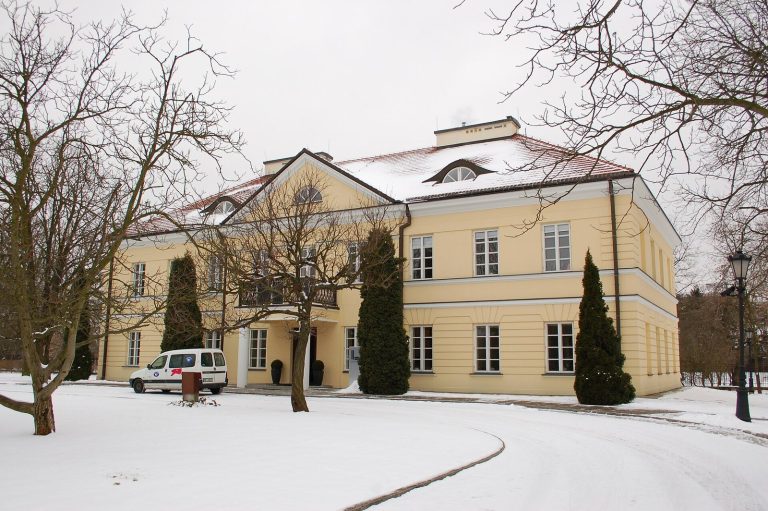
The sanctuary is a brick Baroque basilica organized around three longitudinal naves. The present structure incorporates the eighteenth-century church designed by Józef Fontana, but its current arrangement also reflects the extensions and reorganizations carried out in the nineteenth and twentieth centuries. The naves continue toward the vestibule, while the bell tower stands separately from the main church building.
Main altar and Marian image
The image of Our Lady of Longing occupies the main altar. It is an oil painting on canvas, probably made in the first half of the seventeenth century by an unknown artist. Its style displays characteristics of the seventeenth-century Italian school. The Virgin Mary is shown with her hands folded over her chest in prayer and her face turned upward. Numerous votive offerings stand beside the image, expressing the continuing devotional practice associated with it.
For many decades, the painting was presented with a silver dress or covering and a gilded crown held by two angels. The covering made after the 1975 restoration conceals Mary’s entire figure, leaving her face and hands visible against the background. A gold papal crown adorns the Madonna’s head.
Painting of the Holy Trinity
Since 1753, the image has been covered by a wooden-panel painting of the Holy Trinity. The Marian image is uncovered during May and October devotions and on Marian feasts and solemnities, allowing the principal object of worship to be displayed according to the liturgical calendar.