Fort X “Augustówka”: A Nineteenth-Century Artillery Fort in Warsaw


Site at a Glance
- Rating
- 4.5
- Popularity
- Low
- Country
- Poland
- Primary era
- Modern
- External website
- Open
- Eras represented
- Modern
- Civilizations
- Russian
- Site type
- Military
- Remains
- Fort
On this page7 sections
History
Fort X “Augustówka” is a nineteenth-century artillery fort in Warsaw, Poland, built during the 1880s as part of the outer defensive ring of the Warsaw Fortress. This ring was a chain of forts beyond the city’s central defenses. The fort stood in the present-day Siekierki area of Mokotów and formed the last fort on the western side of the Vistula, defending the southern approach and closing the river valley.
Construction and defensive role
The fort was also known as Fort “Augustówka” or Fort “Siekierki.” Its position was linked westward to Fort IX and formed part of the wider system of defensive works around Warsaw. Because it occupied wet ground near the Vistula, the fort was built without brick or concrete shelters. Accommodation probably consisted of wooden structures or tents, reflecting the difficult conditions of the site.
Abandonment and wartime use
In 1913, during the large-scale abandonment and dismantling of the Warsaw Fortress, parts of Fort X were destroyed. The position was reactivated in 1939, when Polish forces used it during the defense of Warsaw. German troops later fought from the site in 1944.
Post-war changes
After the Second World War, the army established a firing range on the fort site. The range has since closed. Several smaller defensive positions once surrounded the fort, including one near present-day Wolicka 13 that remains clearly visible in aerial photographs from the 1930s and 1940s.
Remains
Earthworks and wet ditch
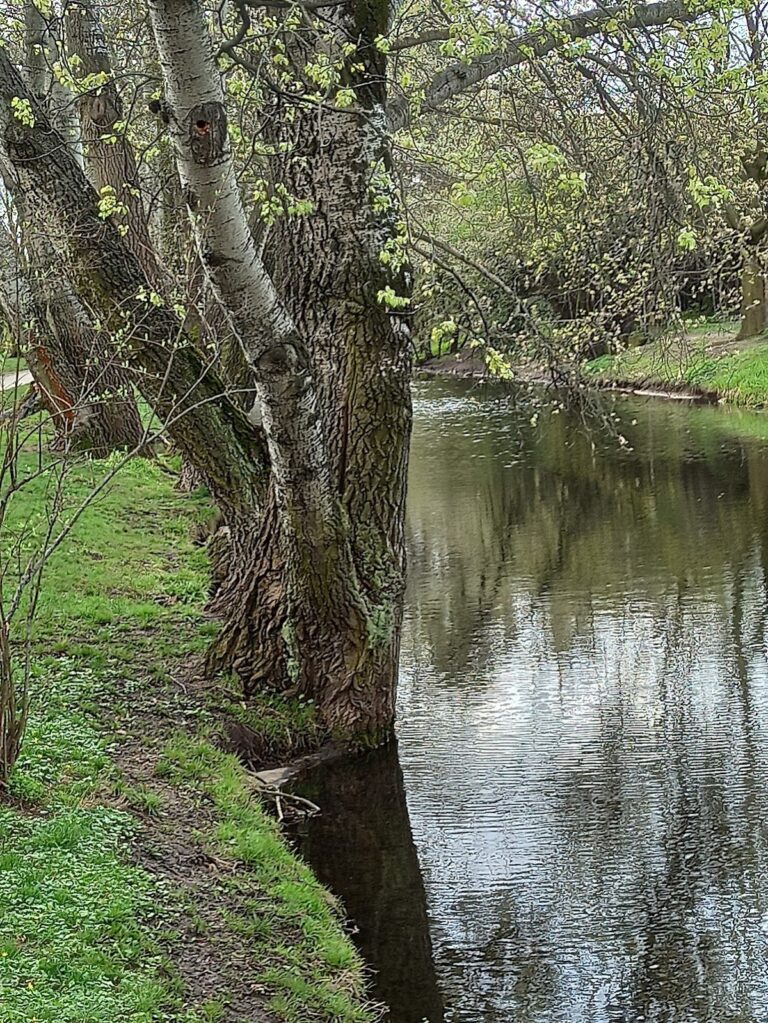
Fort X was an earthen artillery battery with two ramparts, raised protective earthworks behind which guns and defenders could operate. A wet defensive ditch surrounded the position and also helped drain the marshy ground. The former ditch has been renovated and incorporated into a newly laid east-west bicycle path. The main rampart along the principal direction of defense is now wooded, while a later embankment built for the inner firing range occupies part of the fort area. The surviving earthworks and ditch remain visible, although sections of the original fort were destroyed in 1913.
Reused fort landscape
The former gorge, or rear side of the fort opposite its main defensive front, now contains a football field. Bicycle tracks use the slopes of the former fortification, and a motocross track occupies the area outside its southwestern flank. Construction of the Siekierkowski Route crossed the western part of the site, during which the terrain was cleared and reorganized.
Nearby sites