Fort IX: An Artillery Fort of the Warsaw Fortress
Site at a Glance
- Rating
- 4.7
- Popularity
- Low
- Country
- Poland
- Primary era
- Modern
- Eras represented
- Modern
- Civilizations
- Russian
- Site type
- Military
- Remains
- Fort
On this page12 sections
History
Russian imperial fortification
Fort IX is an artillery fort in Warsaw, Poland, built by the Russian Empire between 1883 and 1887 as part of the outer defensive ring of the Warsaw Fortress. That nineteenth-century military system consisted of a citadel and inner and outer rings of forts protecting Warsaw and its approaches. Fort IX stood between Fort VIII “Służew” and Fort X “Augustówka,” in the area associated with the historic locality of Czerniaków and now known as Sadyba, within Warsaw’s Mokotów district.
The fort’s principal defensive direction faced southeast toward Wilanów, approximately 2 kilometres away. It was also known as Fort “Czerniaków,” Fort Dąbrowskiego, and Fort “Sadyba.” Following the Russian decision in 1909 to liquidate the Warsaw Fortress, most of its combat installations were demolished with explosives in 1913. The barracks casemates and earthworks survived, although the casemates acquired distinctive blast damage during the partial destruction.
Interwar transformation
In the interwar period, the remaining fort was named after Jan Henryk Dąbrowski, a Polish general and national military figure associated with the creation of Polish formations during the Napoleonic period. “Dąbrowskiego” was also used as an official name from 1938.
From 1924, housing for distinguished Polish Army officers was built on the former esplanade, the cleared zone around a fort that limited cover for attackers and gave defenders open fields of fire. This development became the nucleus of the later Sadyba district. By the outbreak of the Second World War, about 30 houses stood along the newly laid-out Okrężna and Morszyńska streets. Tadeusz Tołwiński and Oskar Sosnowski planned the area using forms inspired by eighteenth- and nineteenth-century Polish domestic architecture, together with ideas associated with the garden-city movement of Ebenezer Howard.
The fort’s setting was further altered in the 1930s. Powsińska Street was laid through the site in 1935 to connect Warsaw with Wilanów. In 1936, the fort buildings in the eastern section, separated from the rest of the complex by the new road, were demolished and the area was converted into a public park. A proposed extension of Klarysewska Street through the western part was abandoned.
Wartime fighting
During the defence of Warsaw in September 1939, Fort IX served as a defensive position for a formation made up of a volunteer company and parts of the 2nd Battalion of the 360th Infantry Regiment. German forces captured the fort on 26 September, and 20 Polish defenders were killed. Janusz Kusociński, a Polish Olympic champion in long-distance running who served as a soldier during the defence of Warsaw, was wounded during the fighting. A memorial stone commemorating him was unveiled beside the fort in 1989.
Fort IX again became a military position during the Warsaw Uprising of 1944, an armed struggle by the Polish underground against German occupation forces. German troops abandoned the fort on 7 August. It was then occupied by insurgents of the “Oaza” Battalion from the 5th Region of the V District of Mokotów, commanded by Czesław Szczubełek, a Polish Army captain, physician, and Home Army member. On 1 September, superior German forces attacked Sadyba. A Luftwaffe bombing, carried out by Nazi Germany’s air force, struck the fort’s casemates and killed insurgents, including Szczubełek.
Postwar uses and protection
Part of the officers’ villas around the former esplanade was destroyed during the Second World War. In 1958, the Stanisław Nowakowski Housing Cooperative built 13 new buildings on their sites. Many surviving villas were later altered, while only a few retained their original appearance.
After the war, the eastern part of the fort area became a park, while the western part remained in military use until 1990. From the beginning of the 1990s, the western section served as an inaccessible storage facility for equipment belonging to the Polish Army Museum. Two museum branches opened there in the late 1990s, the Museum of Polish Military Technology and the Katyń Museum. The Katyń Museum remained at the fort until 2009, after which the future use of the complex became uncertain amid plans to relocate the Polish Army Museum to the Warsaw Citadel and reorganize its branches.
The Mokotów district council officially named the park Czesław Szczubełek Park on 16 July 1993. Fort IX entered Warsaw’s register of monuments in March 1973 under the name Fort “Czerniaków.”
Remains
Fortification layout
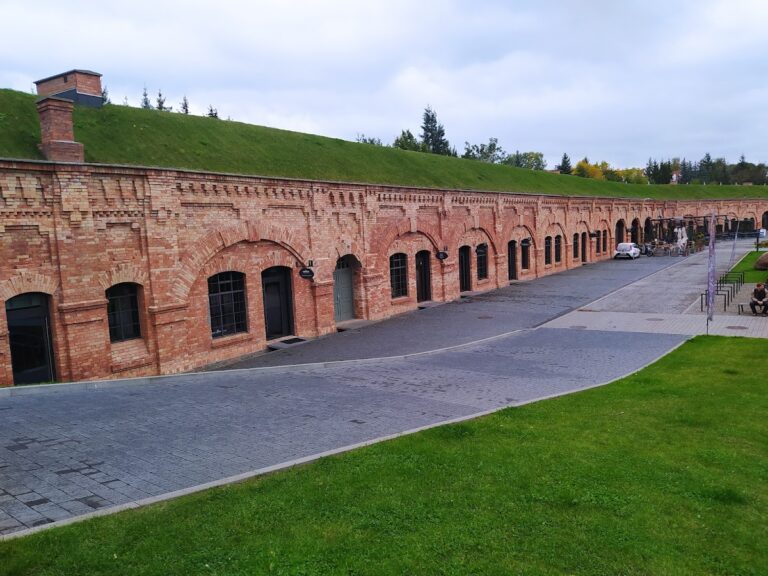
Fort IX was built on a roughly pentagonal plan and originally formed part of a larger defensive complex with a rear area. Its brick-built barracks and combat casemates were set within earthworks and protected by a wet moat, required because the fort stood on waterlogged ground. Approximately one-third of the former fort is now cut by Powsińska Street, leaving the principal surviving structures in the western section and the former rear area beyond the road.
Brick casemates
The surviving casemates are fortified, usually vaulted chambers that served troops, storage, or protected weapons. At Fort IX, the brick casemates formed part of both the barracks and combat installations. Some are partially collapsed, while others remain directly beside Powsińska Street. Their damaged masonry reflects the explosive demolition of 1913 and the later bombing during the Warsaw Uprising.
Moat and bridge
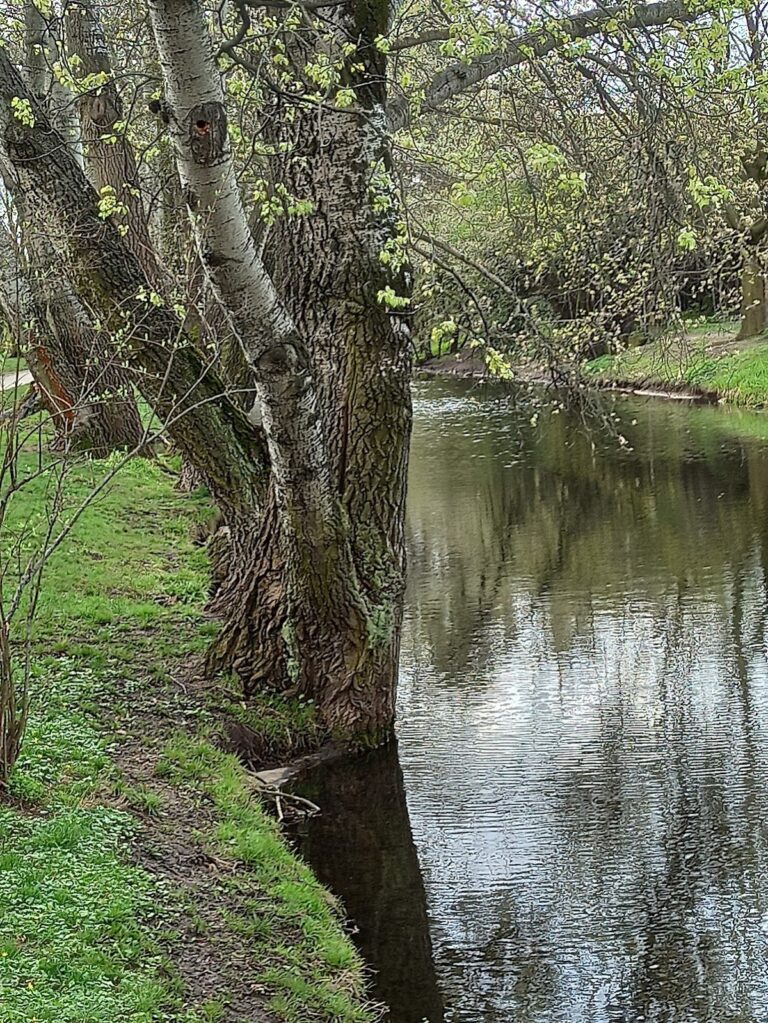
Large sections of the wet moat remain around the fort. Access from the gorge side, the rear side of the fortification, was provided by a steel bridge, fragments of which survive. Powsińska Street crossed the moat twice on bridges and carried motor traffic as well as a tramway that is no longer in use.
Former rear area and surrounding development
Park and school grounds
The former rear area is now occupied by park and school grounds enclosed by Morszyńska and Okrężna streets. Primary School No. 115 began on 1 September 1933 as a temporary wooden structure. From 1955 it was rebuilt as a three-storey brick building and is now named after Wanda Turowska. The eastern area beyond Powsińska Street is landscaped as a small park, while the western section retains the main fort structures and casemates.
Officers’ housing
Housing around the former esplanade was arranged along Okrężna and Morszyńska streets. The original villas used forms inspired by eighteenth- and nineteenth-century Polish domestic architecture. Their surviving fabric, together with later housing built on destroyed villa sites, records the conversion of land once reserved for the fort’s defensive clearance zone into a residential part of Sadyba.
Nearby sites