Saint Andrew Church in Ružomberok: A Roman Catholic Parish Church
Site at a Glance
- Popularity
- Low
- Country
- Slovakia
- Primary era
- Modern
- Eras represented
- Medieval, Early Modern, Modern
- Civilizations
- Austria-Hungary, Habsburg, Hungarian
- Site type
- Religious
- Remains
- Church
On this page11 sections
History
Saint Andrew Church in Ružomberok is a Roman Catholic parish church in Slovakia, built in the early-Gothic style around the turn of the 13th and 14th centuries. It is the oldest church in Ružomberok and has been reshaped by successive religious and architectural changes.
Medieval origins and rebuilding
The church is first mentioned in the 1340s. In 1445, its precinct was fortified in response to attacks by the Bratríci, armed bands associated with former Hussite soldiers. A major rebuilding after 1500 added a polygonal presbytery, the area around the main altar, and a two-storey sacristy, a room for items used in worship. The church was originally dedicated to Saint Ladislaus, the medieval king of Hungary venerated as a saint. Its dedication probably changed to Saint Andrew around 1506, possibly when a new bell was installed.
Confessional change and later alterations
A fire destroyed the church in 1583, and it was rebuilt in 1585 in Renaissance style, reusing parts of the earlier foundations. A Protestant congregation began using it in 1611. Control shifted repeatedly between Protestant and Roman Catholic communities: the church was Catholic in 1672, Protestant in 1683, Catholic again in 1686, Protestant in 1706, and Catholic in 1709. It remained under Roman Catholic administration from then onward. Further reconstruction took place in 1618 and 1755, with additional work during the 18th century. Baroque alterations in the 17th and 18th centuries chiefly affected the tower.
During the 19th century, the church gained the Chapel of Saint John of Nepomuk, a new sacristy, and the Chapel of the Holy Sepulchre, the traditional site of Jesus’ burial in Jerusalem.
Modern rebuilding and parish history
A major rebuilding in 1900–1902 gave the church its present Neo-Romanesque character, a revival of Romanesque forms. The work followed a design by local builder Ján Króner. Jozef Hanula painted frescoes, murals made on wet plaster, in 1902–1903; some were later overpainted or destroyed.
Slovak Catholic priest and political leader Andrej Hlinka served as parish priest from 1905 until his death in August 1938. His mausoleum was built in 1938–1939. In 1940 the church interior was redecorated with frescoes by E. Massányi and travertine and marble cladding, with the stated aim of giving it a more representational character in connection with Hlinka. During the 1940s, the enclosed church grounds, including the rectory and a Catholic school, were removed to make way for the mausoleum. Another reconstruction took place in 1964, and a renovation in 2002 focused on the façades.
The church belongs to the Diocese of Spiš, a regional church jurisdiction, and the Ružomberok deanery, a grouping of parishes, within the Eastern Province, which groups dioceses. It is part of Ružomberok’s urban heritage zone and was registered as a Slovak National Cultural Monument in 1963.
Remains
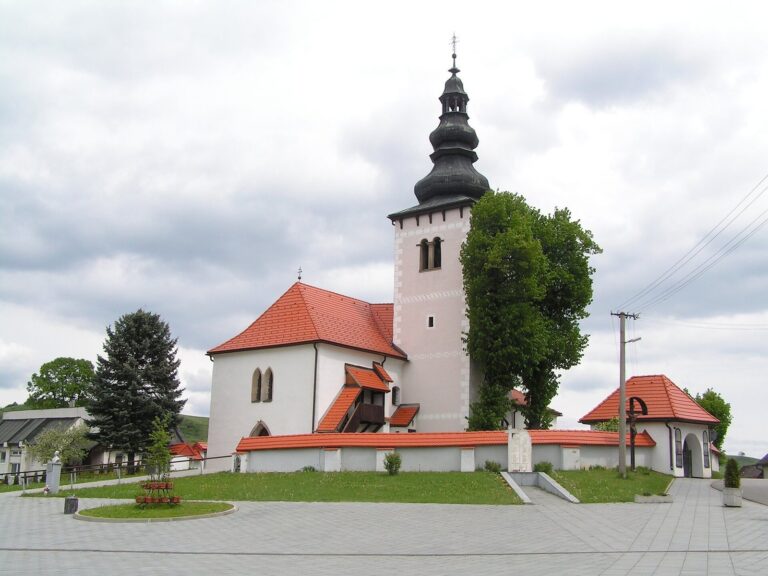
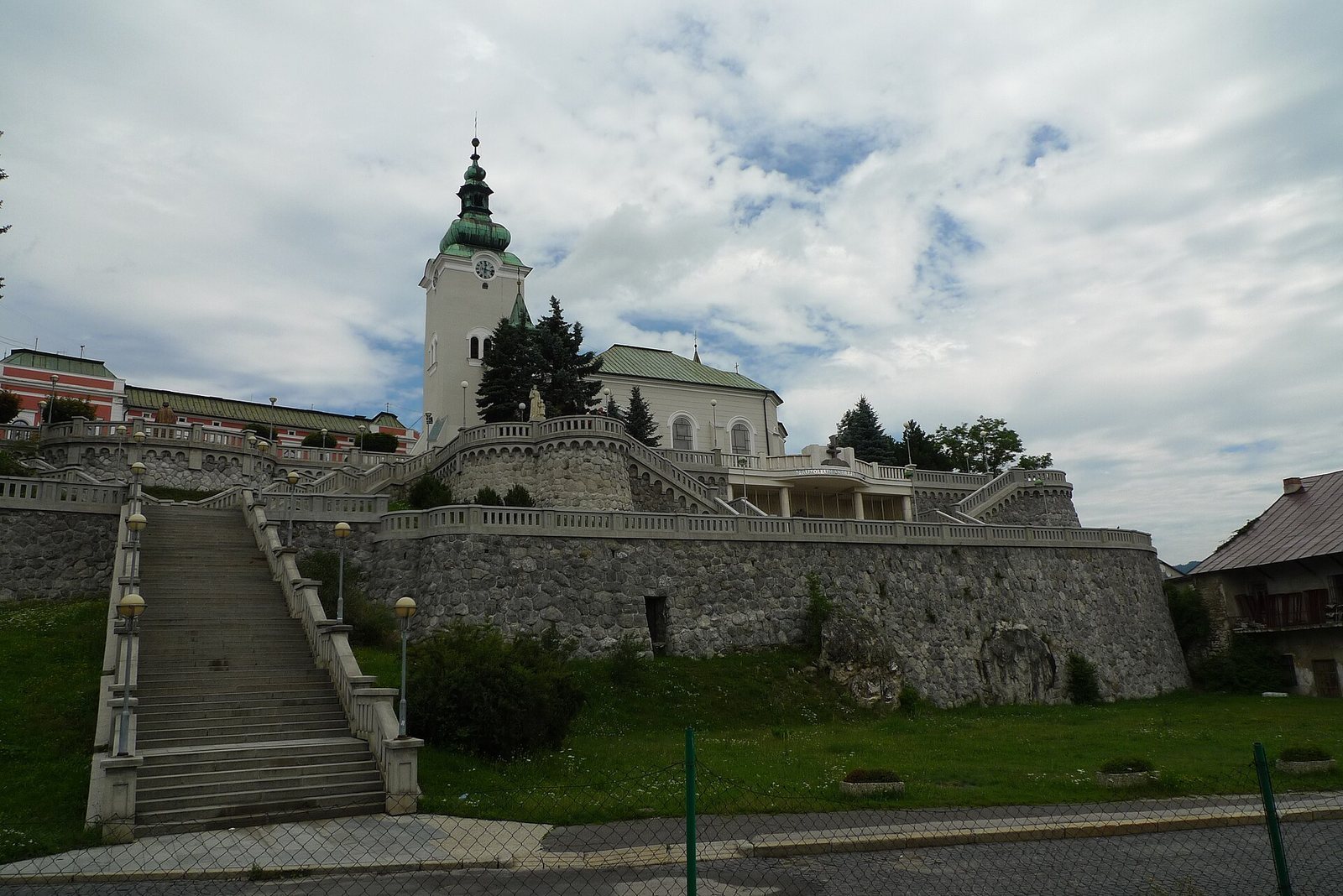
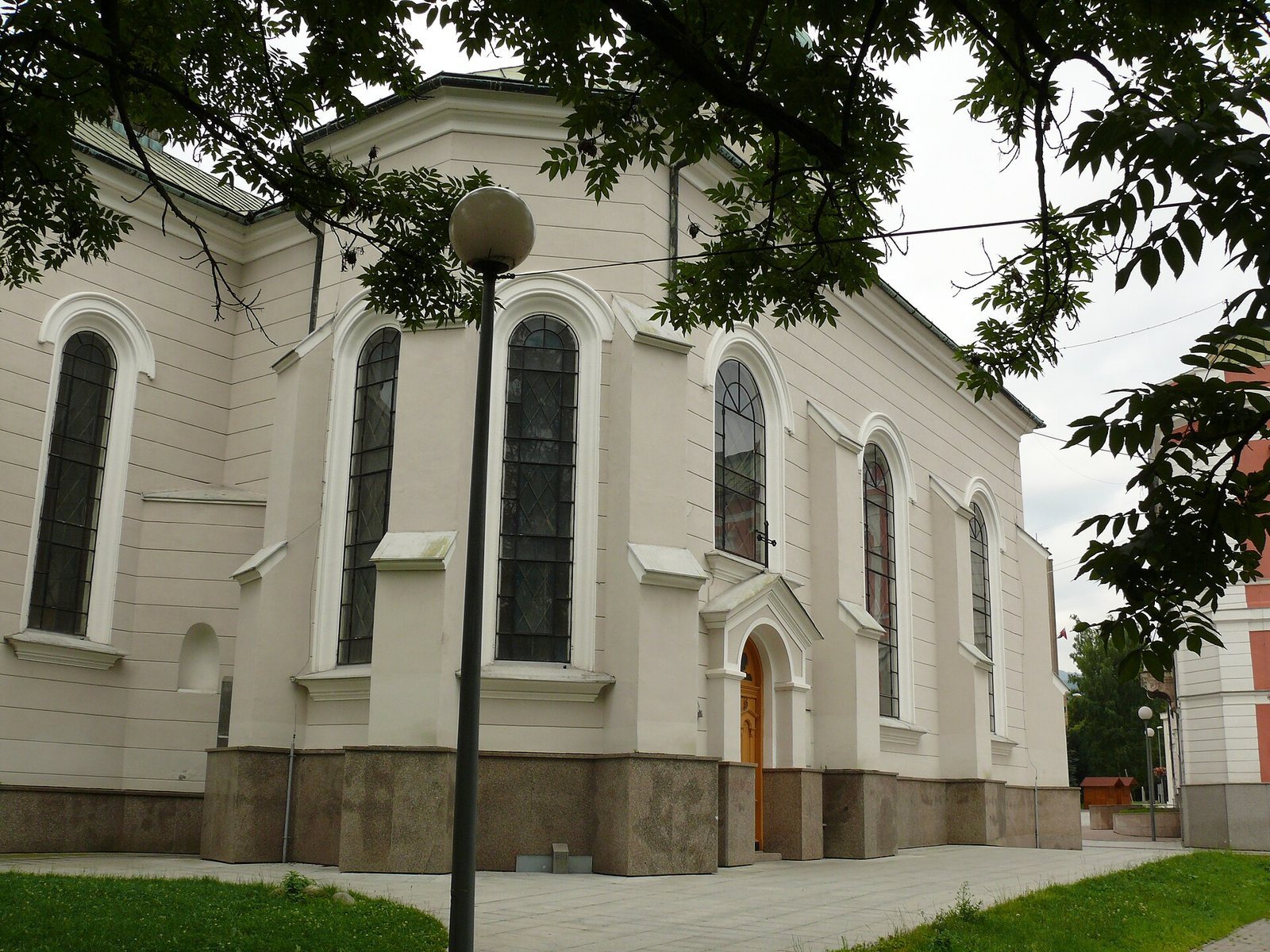
The stone church stands on elevated ground at the northeastern corner of Andrej Hlinka Square in Ružomberok’s historic centre, beside the town hall. Its rectangular plan has two aisles, which run alongside the main body of the church, and a polygonal end with several angled sides. The building has two towers and a chapel.
Plan and architectural fabric
The original early-Gothic church probably had a square presbytery and a large tower, which survives. The rebuilding after 1500 gave the presbytery its polygonal form. The 1585 reconstruction produced a three-aisled church, with semicircular vaults, or arched ceilings, over the nave and presbytery. Four pillars support the vaults, and an elevated gallery was added at the west end. The 19th-century additions included two chapels and a new sacristy; the rebuilding of 1900–1902 added structures on the north and south sides and a new stair tower.
Interior and furnishings
Baptismal font
Inside the church, a Gothic baptismal font from the early 16th century is described as the principal surviving reminder of the medieval building.
Tower bell
The tower holds a bell cast in 1506 and named Andrew. Bellfounder Andrej Sladič of Banská Bystrica made it; it is the oldest bell in the Liptov region.
Paintings, windows, and cladding
The interior includes frescoes by Jozef Hanula and E. Massányi, as well as travertine and marble cladding. Some of Hanula’s paintings were later painted over or destroyed. The southern windows contain stained glass by Slovak artist Ľudovít Fulla.
Hlinka’s mausoleum
Hlinka’s mausoleum lies directly beneath the church. It contains a tomb and a sarcophagus, a stone coffin.