All Saints Church in Ludrová: An Early Gothic Monument in Slovakia


Site at a Glance
- Rating
- 4.7
- Popularity
- Very Low
- Country
- Slovakia
- Primary era
- Medieval
- External website
- Open
- Eras represented
- Medieval, Early Modern
- Civilizations
- Hungarian
- Site type
- Religious
- Remains
- Church
On this page11 sections
History
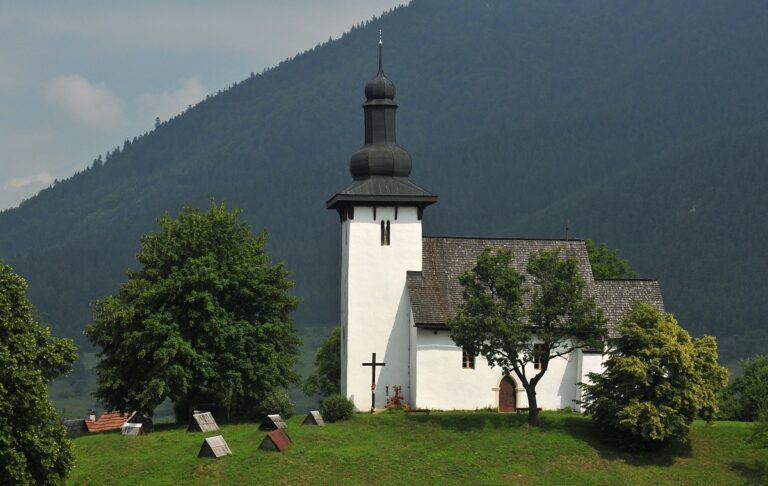
All Saints Church in Ludrová, Slovakia, is a Roman Catholic church probably built during the third quarter of the thirteenth century. Its Romanesque windows in the chancel point to an early phase before the full development of Gothic architecture. The church is regarded as an important Early Gothic monument in present-day Slovakia and is the oldest church in Ludrová and the Liptov region.
Medieval foundation and later additions
The original church consisted of an east-oriented square nave with massive Gothic cross-rib vaults, a vaulted ceiling supported by intersecting ribs. A southern aisle and a tower were added at the turn of the fifteenth and sixteenth centuries. The tower was enlarged during the seventeenth century. A rood screen, a partition separating the chancel from the main body of the church, was also installed in the seventeenth century.
Frescoes and local tradition
Around 1420, an unknown painter created the church’s principal frescoes. Their 34 scenes from the life of Jesus form the largest Christological cycle in Slovakia. The interior paintings contribute to the church’s importance as an Early Gothic monument and preserve an extensive account of episodes associated with Jesus, the central figure of Christianity.
The entrance portal is linked to a local tradition about its numerous sword cuts. According to the legend, nobles made the cuts with their swords as a gesture of honor to the master of the house, understood here as God. The most visible cut is traditionally attributed to Jan III Sobieski, king of Poland from 1674 to 1696, who allegedly made it in 1683 while returning from Vienna after a campaign against the Ottoman Empire.
Remains
The church stands on a hill near Ružomberok, about four kilometers from the town. Its surviving fabric combines the original east-oriented square nave with the later southern aisle and tower. The nave lies north of the sacristy, while the chancel preserves Romanesque windows that help indicate the building’s early date.
Medieval interior
Christological fresco cycle
The principal fresco cycle occupies the interior and contains 34 scenes from the life of Jesus. The Last Supper draws on all four Gospels and includes the episode of Christ washing the apostles’ feet. Another scene shows Judas Iscariot hanged. Judas was one of Jesus’s apostles and is traditionally associated with his betrayal. The vault is dominated by images of the Coronation of the Virgin Mary and the Last Judgment.
Nave paintings and consecration crosses
Further paintings in the nave include a Madonna triptych and a depiction of John the Baptist dating from 1400 to 1410. John the Baptist was a Jewish preacher whom Christian tradition associates with baptizing Jesus. Four consecration crosses are also visible. Such crosses mark places ceremonially anointed during the consecration of a church. Two later crosses apparently relate to paintings on the inner wall of the triumphal arch, the arch marking the passage between the nave and chancel.
Exterior and furnishings
Entrance portal
The entrance portal bears numerous sword cuts, with one particularly prominent mark associated by tradition with Jan III Sobieski. The cuts form part of the portal’s surviving physical appearance and preserve the connection between the building and the local story about acts of honor.
Exterior fresco fragment
A fragment of a fresco showing Saint Christopher survives on the eastern exterior wall. Saint Christopher is a Christian saint traditionally associated with protecting travelers.
Late Gothic altar
A Late Gothic altar depicting the Coronation of the Virgin Mary dates from 1510 to 1520. The altar is now held by the Liptov Museum rather than remaining inside the church. The Virgin Mary is the mother of Jesus in Christian tradition.
A linden tree standing near the church is at least 400 years old, adding a long-lived natural feature to the historic setting of the building.