Sadowara Castle: A Japanese Mountain Castle and Domain Seat
Site at a Glance
- Rating
- 3.8
- Popularity
- Low
- Country
- Japan
- Primary era
- Early Modern
- External website
- Open
- Eras represented
- Medieval, Early Modern
- Civilizations
- Shimazu, Tokugawa
- Site type
- Military
- Remains
- Castle
On this page10 sections
History
Sadowara Castle is a Japanese mountain castle on Mount Kakusho in Sadowara, Miyazaki, Japan, established in the mid-fourteenth century as Tajima Castle. Built by a cadet branch of the Itō warrior clan, it controlled access from a small valley to the plateau and served as a residence and administrative center near a commercial town and river port. The nearby Tonokōri Castle, about 5 kilometers east, functioned as the Itō family’s principal military base.
Itō Origins and Expansion
The area between the Hitotsuse and Ōyodo rivers formed an Itō stronghold from the Kamakura period, the era of the Kamakura shogunate. Tajima Kyusuke established the castle in the mid-fourteenth century. The Tajima family administered estates in Hyūga Province that had been awarded to Itō Suketoki, whose father, Kudō Suketsune, was associated with the events recounted in the Soga Monogatari.
In 1427, a member of the Itō main line entered the castle, and the Tajima family adopted the name Sadowara. The site consequently became commonly known as Sadowara Castle. In 1480, another member of the Itō main line entered the Sadowara family through adoption. This brought the castle under the formal control of the main Itō line and made it one of the clan’s “Forty-Eight Castles.”
A major fire in 1536 and 1537 was followed by a substantial rebuilding and enlargement under Itō Yoshisuke around 1542 and 1543. The castle was then called Tsurumatsu Castle, although Sadowara Castle remained its familiar name. The expanded stronghold occupied the entire mountain and developed alongside Tonokōri Castle, the Itō family’s principal residence.
Shimazu Rule and the Creation of Sadowara Domain
The Itō clan’s defeat by the Shimazu clan during the 1570s forced the Itō into exile and transferred Sadowara Castle to the Shimazu, a powerful warrior family of southern Kyushu. Shimazu Iehisa, the younger brother of Shimazu Yoshihisa, became castellan. After the Shimazu surrender to Toyotomi Hideyoshi in 1587, Iehisa died suddenly at the castle. Some traditions attributed his death to poisoning ordered by Hideyoshi, who had unified much of Japan, but the cause remains uncertain. Iehisa’s son, Shimazu Toyohisa, later became castellan.
During the 1600 Battle of Sekigahara, a conflict that established Tokugawa dominance over Japan, the Shimazu supported the Western Army, and Toyohisa was killed. Tokugawa authority temporarily administered Sadowara Castle through an appointed official. In 1603, however, Tokugawa Ieyasu, founder of the Tokugawa shogunate, transferred the castle to a cadet branch of the Shimazu led by Shimazu Mochihisa. This transfer established Sadowara Domain, which remained under the Sadowara branch of the Shimazu until the domain system was abolished.
Rebuilding, Decline, and Abandonment
Sadowara Castle was rebuilt in 1611 with stone walls, a keep, and turret structures. Fourteen years later, the keep was demolished, principally because the domain could no longer afford its maintenance. In 1625, under Shimazu Tadaoki, the buildings and fortifications on the hilltop were dismantled, and the domain residence moved to the lower area. The official name then became Shokaku Castle, although Sadowara Castle continued to be used popularly.
The abandonment of the hilltop reflected declining external military threats and the rising cost of repairs. It also followed regulations issued under the 1615 warrior laws, which restricted the construction of new castles and required notification for repairs to castles belonging to daimyo, the great feudal lords of Tokugawa Japan.
In the final years of the Tokugawa shogunate, known as the Bakumatsu, and during the early Meiji period that followed its overthrow, the domain planned to move its administrative seat to Hirose Castle. The administration transferred there around 1869 and 1870, but the new castle remained unfinished and was dismantled after the abolition of the domain system. Sadowara Castle itself was abandoned in 1870.
Archaeology and Preservation
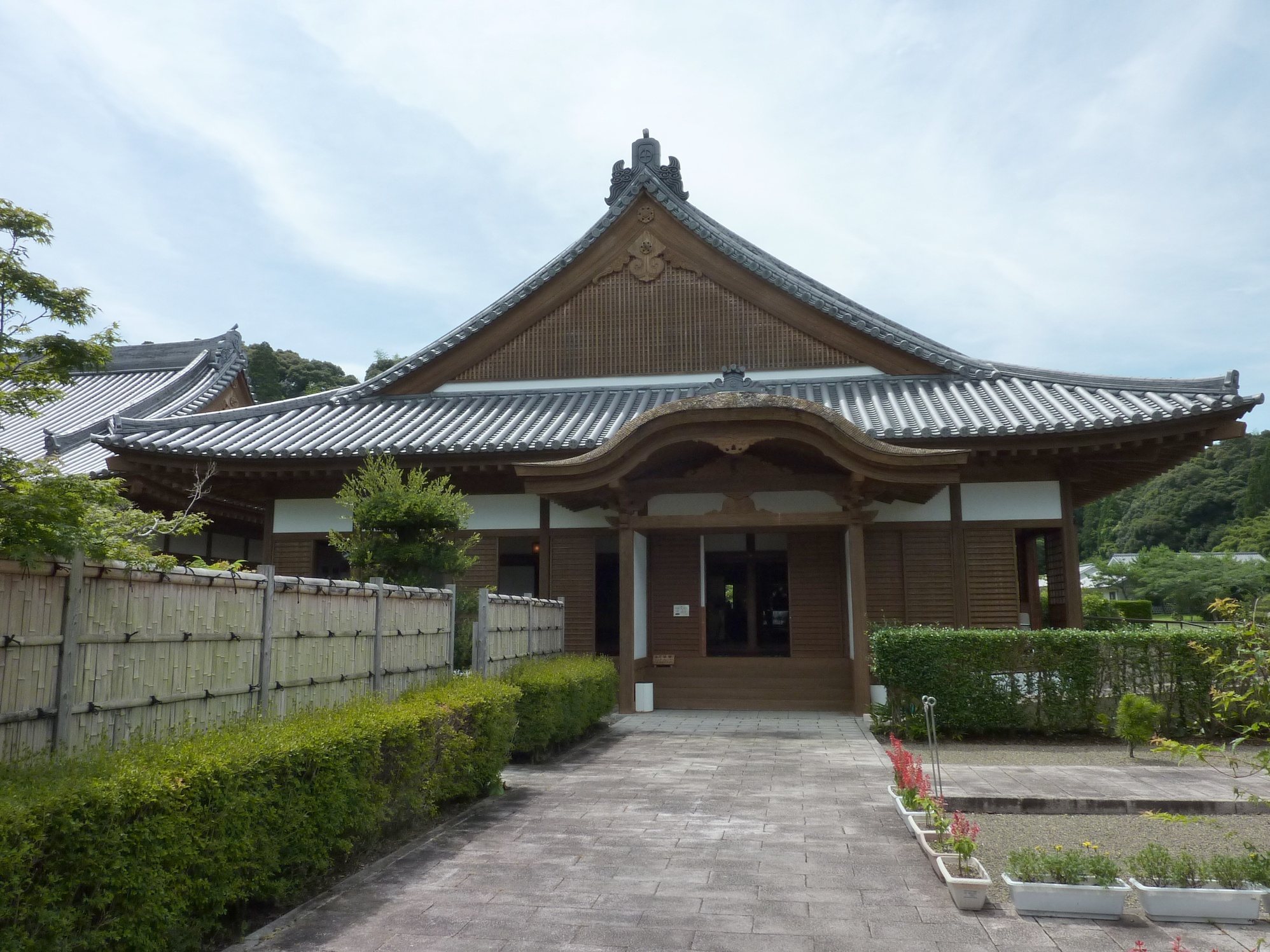
Archaeological investigations led to a partial reconstruction of the lower residence in 1993. The Sadowara Castle site was designated a National Historic Site in 2004 and selected for the Continued Top 100 Japanese Castles in 2017. The reconstructed residence now accommodates the Sadowara Castle Historical Museum, which presents the history of the castle.
Remains
Sadowara Castle occupied a roughly 100-meter-high hill at the entrance to a valley on the north-central part of the plateau near Sadowara. Its upper and lower areas formed separate functional zones. The mountain castle spread across several enclosures along the ridge, adapting its defenses to the natural terrain, while the residence and administrative area later developed at the foot of the hill.
Hilltop Enclosures and Defenses
Ridge Enclosures
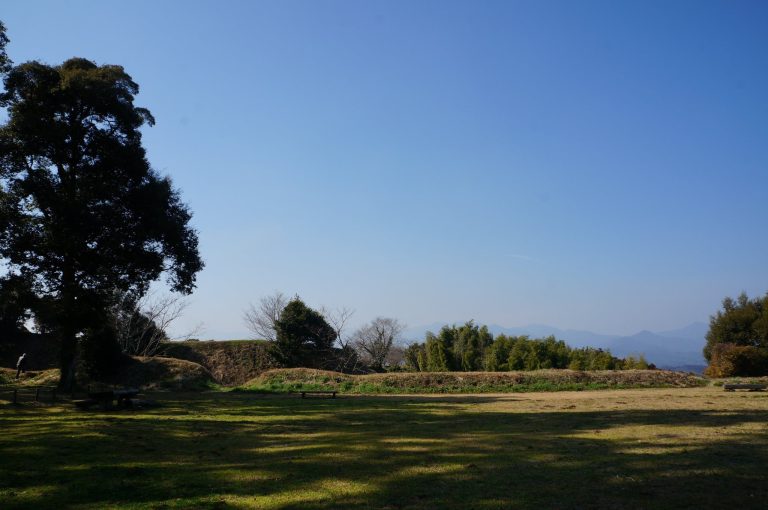
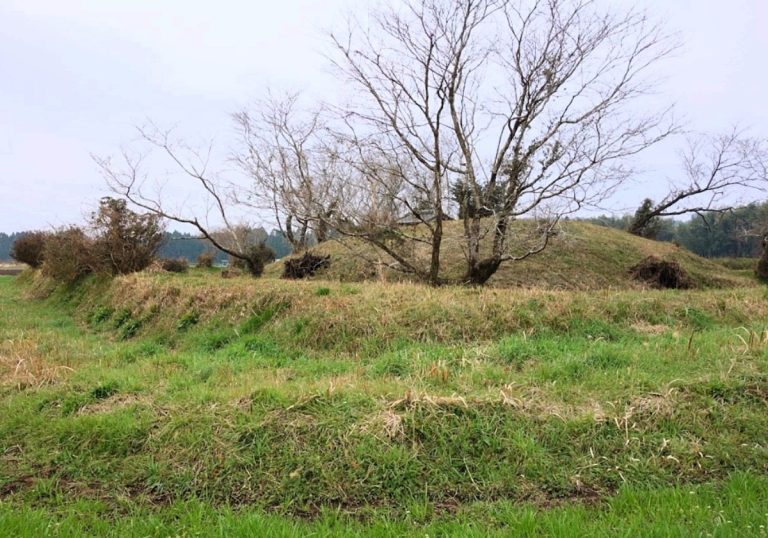
The principal hilltop areas were the Honmaru, or main bailey, the Ni-no-maru, or second bailey, together with the Minami-no-jo and Matsuomaru enclosures. Earthen ramparts and dry moats protected these areas, with further earthworks and moats arranged along three sides. The general form of the hilltop remains visible through low walls, ramparts, and defensive ditches, while the upper castle’s surviving archaeological evidence is concentrated in foundations and earthworks.
Keep and Compound Gate
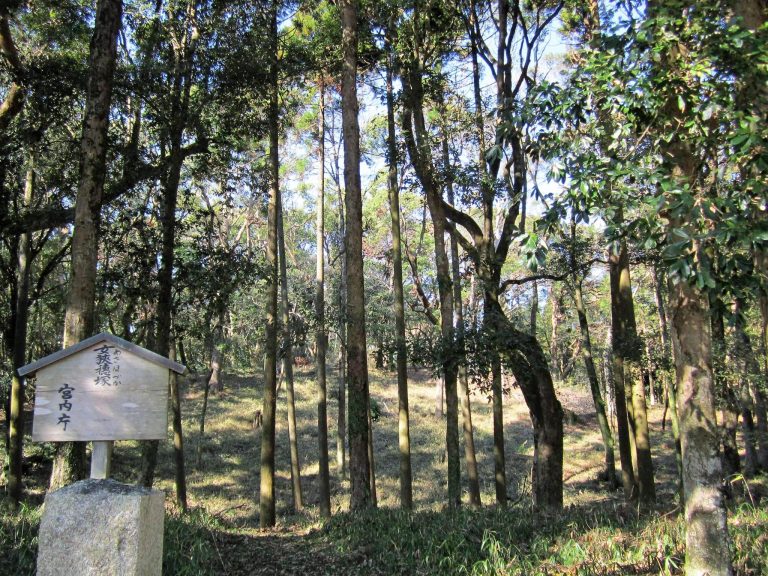
An early illustration shows a three-story, three-level keep topped by a shachihoko, a decorative roof finial shaped like a mythical carp or tiger-like creature. Excavation identified the keep foundation in the inner bailey and recovered fragments of gold-leaf roof tiles, confirming the presence of a keep. The foundation is regarded as the southernmost keep foundation in Japan.
The date of the keep remains uncertain. It has been associated with Itō Yoshisuke’s development of the castle, with Shimazu Toyohisa’s rule under the Toyotomi regime, or with the early years of Sadowara Domain under Tokugawa authority. Both Itō-period roof tiles and later tiles came from the area of the keep foundation. Excavation also revealed a masugata-style compound gate, an arrangement in which an enclosed space between gates made a direct assault more difficult, along with fourteenth-century ceramics and a gold-leaf shachihoko roof tile.
Lower Residence
The lower residence was reconstructed in wood in 1993 on the basis of archaeological findings. The reconstruction includes an entrance area, a formal reception hall, the lord’s private quarters, and a shoin, a formal Japanese reception or study room. It also incorporates a garden, an upper gate, earthen ramparts, and dry moats. Part of the reconstructed complex serves as the Sadowara Castle Historical Museum.