Ryczyn Castle: A Medieval Stronghold in Poland

Site at a Glance
- Rating
- 4.4
- Popularity
- Low
- Country
- Poland
- Primary era
- Medieval
- External website
- Open
- Eras represented
- Medieval
- Civilizations
- Unclassified
- Site type
- Military
- Remains
- Fort
On this page15 sections
History
Ryczyn Castle is a medieval Slavic stronghold in Poland, near present-day Lipowa and east or southeast of Oława. Traditionally founded before AD 1000, it controlled the surrounding territory and an Oder crossing, combining defensive, administrative, and religious functions. Its name is Slavic and is understood to mean “near the river” or “in the vicinity of the river.”
Origins and Christianization
Ryczyn may have been one of the 15 settlements of the Slenzans, a Slavic people associated with Silesia, listed in the ninth-century Latin text known as the Bavarian Geographer. This identification remains uncertain. Tradition places the stronghold’s foundation before AD 1000, when it supposedly protected local people and livestock from Czech and German raids. Its fortifications and the quantity of remains found there indicate that it was more than a refuge. Its position at a crossing of the Oder gave it control over movement through the surrounding region.
On the orders of Mieszko I, the first historically attested ruler of the Polish state, a church was established at Ryczyn. It was regarded as the second church in Silesia after the one at Smogorzów. Following the Congress of Gniezno in AD 1000, the meeting associated with the organization of the Polish church and the foundation of the Wrocław bishopric, the church at Ryczyn came under the bishopric’s authority.
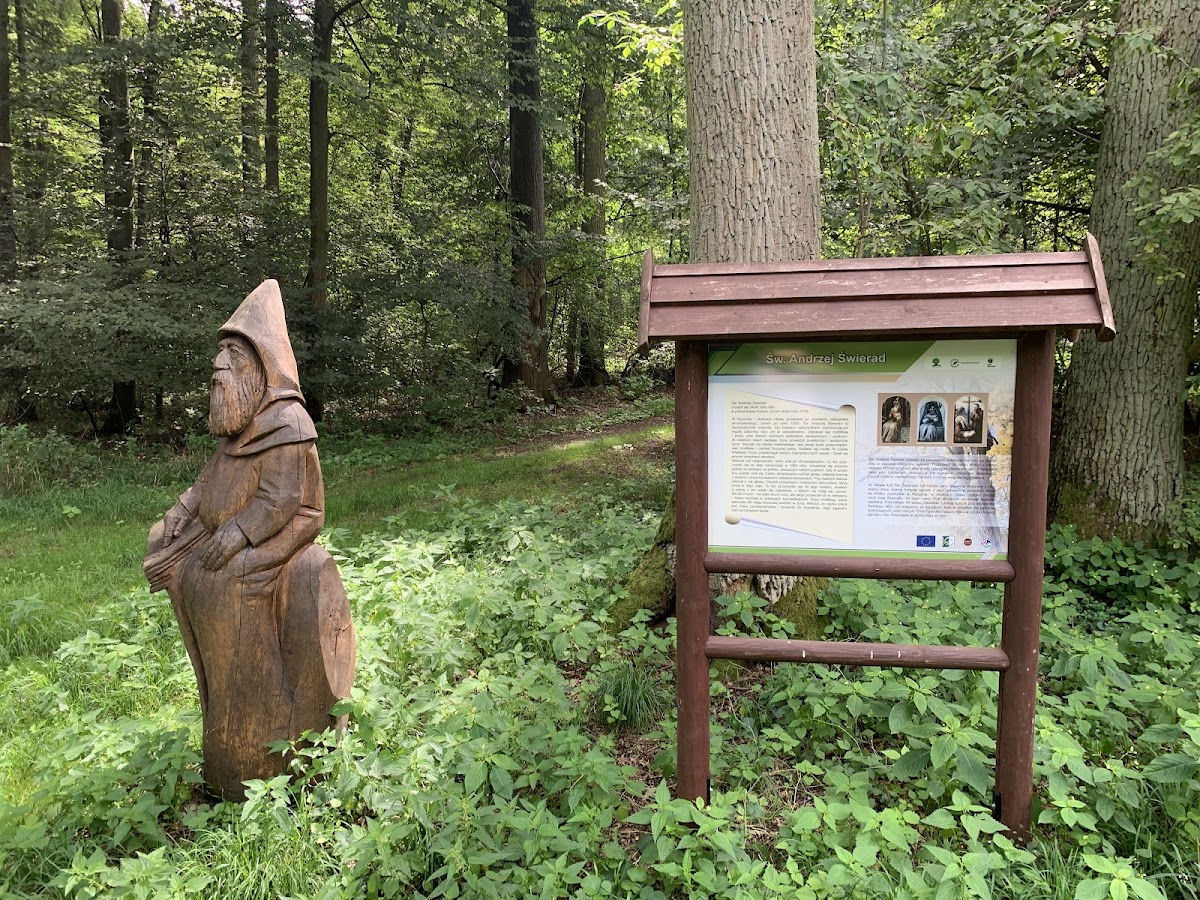
Between about AD 1000 and 1010, the Benedictine hermit Andrzej Świerad, also known as Andreas Zoerardus, may have undertaken missionary work in the Oława and Ryczyn area. During the pagan reaction of the early 1030s, a revolt against the political and religious order established by Christianizing Polish rulers, tradition says that a bishop expelled from Wrocław took refuge first at Smogorzów and then at Ryczyn. His name is not preserved.
Stronghold and castellany
In 1038, during the invasion of the Polish lands by the Bohemian duke Břetisław I, the Wrocław bishopric may have moved its seat temporarily to Ryczyn. Tomasz Jurek places the temporary seat of the Silesian bishopric at Ryczyn from 1051 to 1075, after which Bolesław II the Generous is said to have restored the diocesan seat to Wrocław. Parish priests at Ryczyn appear in records from the late thirteenth century, with the last recorded mention dating to 1454.
Ryczyn appears in Cosmas of Prague’s Chronicle of the Bohemians around 1093 and in papal documents from 1093, 1155, and 1245. The later two documents identify its castellany, a medieval district centered on a fortified settlement and governed by a castellan with military, judicial, and administrative authority. Around 1093, Břetisław II destroyed the stronghold during an invasion of Silesia. It was rebuilt and became one of the important defensive centers of the region.
Ryczyn resisted a joint siege by the Bohemian duke Bořivoj II and Svatopluk II of Olomouc in 1103. In 1109, an expedition led by the German king Henry V toward Kraków was halted near the stronghold. The first castellan known by name was Imbram, son of Gniewomir, who appears in 1203. His role as a witness in disputes involving Henryków monastery reflects the standing held by the castellans of Ryczyn.
The recorded castellans included Imbram Gniewomirowic of Strzegom, Jarosław Jarachowic of the Pogorzela lords, Bogusław the Elder of Strzelin, Klemens, Teodoryk, Mroczek of Pogorzela, Berold of the Kobylejgłowy family, Jan of Wierzbno of the Lis coat of arms, and Racław, known as Drzemlik. Racław, active from 1272 to 1284, was the last recorded castellan. Ryczyn remained the seat of a castellany until 1297.
Decline and later history
Ryczyn’s importance declined toward the end of the thirteenth century. By 1340, the stronghold had been transferred to the Dominican friars of Brześć. As the Oder crossing lost importance during the fourteenth century, administrative functions were probably moved to Oława and Brzeg.
In 1390, Louis I, duke of Legnica and Brzeg, ordered a search at Ryczyn for the remains of the legendary first bishops of Wrocław. The investigation is among the earliest recorded archaeological investigations in Poland. No surviving account gives its results, and the excavations found no graves of the Wrocław bishops. Further investigations ordered by Count Carmer in 1779 revealed no building remains. In 1891, a new forest path exposed parts of the embankments, probable church foundations, and many human bones.
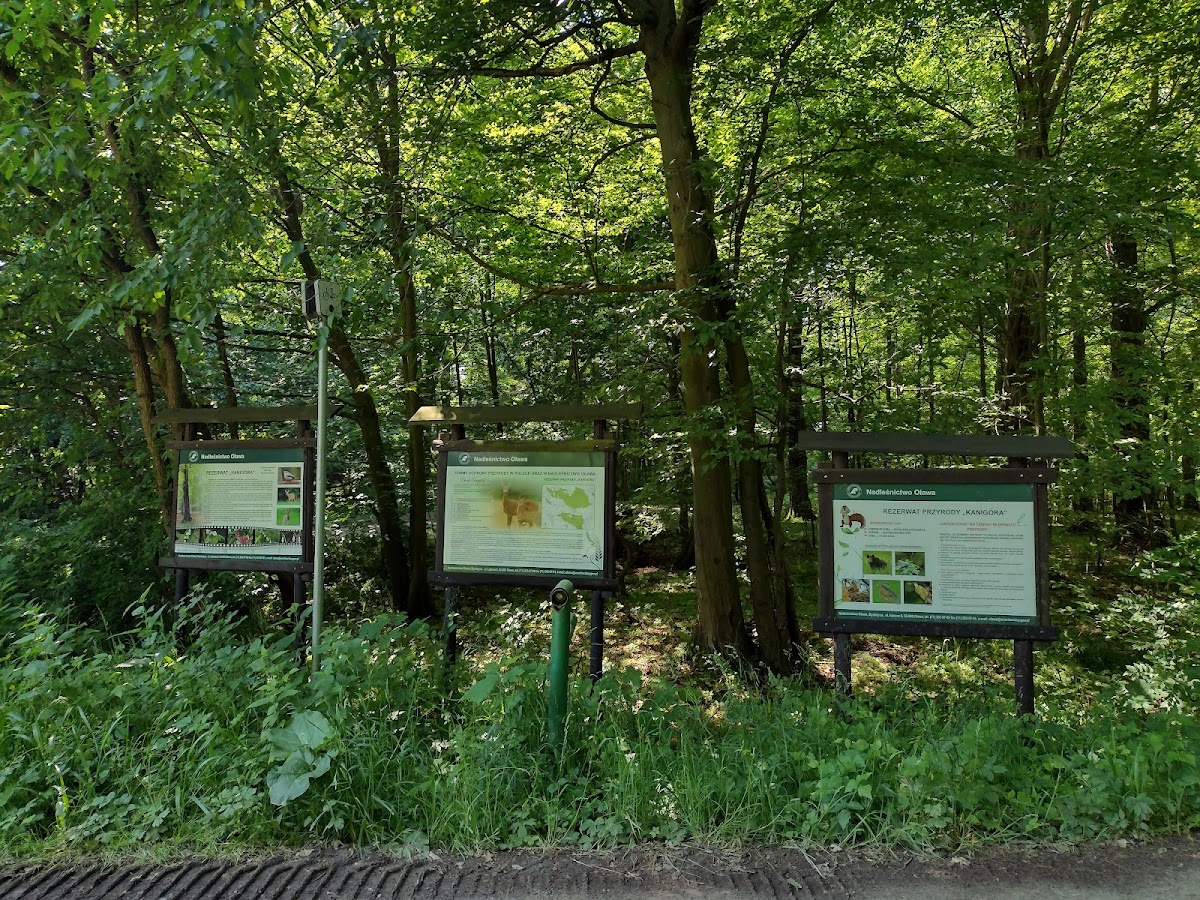
Excavations in 1958, 1959, and 1962, led by Janusz Kramarek of the Archaeological Museum in Wrocław, clarified the fortifications and the positions of nearby settlements and the cemetery. Work carried out from 2004 by archaeologists from the Polish Academy of Sciences in Wrocław and the University of Opole added evidence of burials and settlement and changed earlier interpretations of the first centuries of Christianity in Silesia. In 1958, the area containing both Ryczyn strongholds became the Grodzisko Ryczyńskie nature reserve, protecting an archaeological and forest landscape in the floodplain.
The stronghold and its church were destroyed by the forces of Casimir IV Jagiellon during his Silesian campaign in 1474. Ryczyn later appeared in Jan Długosz’s fifteenth-century geographical description of Silesia, in two descriptions by Hartmann Schedel, and on Martin Helwig’s map of Silesia in the second half of the sixteenth century. On the map it was shown as a small rural settlement. Later settlement references do not survive, and the site and its cemeteries became overgrown as Oława and Brzeg gained importance. A local legend says that inhabitants trying to take away the church bell by boat dropped it into the moat, from which its sound is sometimes said to rise.
Remains
Ryczyn stood amid forest and wetlands on marshy ground beside the Oder. The principal stronghold was raised above flood level by laying wooden beams and covering them with earth, a process that probably took decades. Its surviving layout includes a ring-shaped embankment about 4 to 5 metres high, 8 metres wide, and approximately 600 metres in circumference, together with the central courtyard or inner area. A moat 5 to 10 metres wide ran along the Oder side, where the entrance was located.
Fortifications and associated settlements
Main stronghold
The large fortified settlement formed the core of the Ryczyn complex. Its embankment enclosed the courtyard and supported a defensive system built from timber and earth. The marshland setting shaped both its construction and its protection. The embankments and central courtyard remain visible as the principal physical elements of the site.
Oder watch post
About 60 metres west of the main stronghold stood a smaller, conical fortified area covering 143 square metres. It served as an advanced watch post directed toward the Oder. A single wooden building stood within it and was used to monitor the river and its banks.
Left-bank settlement
A third settlement belonging to the Ryczyn complex occupied the left bank of the Oder near Lipki. It had strategic, provisioning, and economic functions. Metalworking workshops there produced iron for the strongholds, linking the settlement’s craft activity to the needs of the fortified complex.
Rural settlements
Traces of three probably rural early-medieval settlements lay about 120 metres northeast and west of the main stronghold. Together with the left-bank settlement, they formed part of the wider settlement system associated with Ryczyn.
Burial and religious features
Courtyard temple and burials
Archaeological investigations uncovered a pagan temple and numerous graves within the courtyard of the larger stronghold. The burials occupied a substantial part of the fortified settlement and represent an unusual early-medieval burial area inside a stronghold. Their presence, together with other evidence from Ryczyn, shows that Slavic religious practices continued long after the official introduction of Christianity.
Burial mounds and ritual boat
Seven burial mounds stood in the northern part of the stronghold near a water reservoir. Used from the tenth to the twelfth century, each mound could contain the cremated remains of as many as seven people. Animal bones indicate that animal offerings were also made there.
Near the mounds were the remains of an oak-and-fir boat made from trees felled in autumn AD 983. It had neither rivets nor sewn construction and was not intended to float. Instead, it had been placed symbolically and burned in a rite comparable to burial practices known from northeastern Rus.
External cemetery and churches
An early-medieval inhumation cemetery, where bodies were buried rather than cremated, lay about 90 metres southwest of the main stronghold. It was used from the tenth century until the beginning of the fifteenth century and contained several dozen human skeletons, many of them complete. Some bore blows from sharp implements and have been interpreted as victims of Casimir IV Jagiellon’s campaign in Silesia.
Near the cemetery are remains of a church dated to the turn of the fourteenth and fifteenth centuries, along with traces of an earlier wooden church. Excavation also identified remains interpreted as both a wooden and a stone village church. The cemetery’s burial mounds were finally destroyed by the Brześć Dominicans in the late fourteenth century.
Archaeological evidence
Ryczyn has yielded large quantities of early-medieval pottery, animal bones, metal, stone, bone, and clay artefacts. Weapons include axes, knives, and spearheads, while numerous nails provide further evidence for local metalworking. Excavations also exposed trenches made during Louis I’s fourteenth-century search for the graves of the bishops of Wrocław, preserving physical traces of that early investigation.