Rumelihisarı: An Ottoman Fortress Controlling the Bosphorus


Site at a Glance
- Rating
- 4.5
- Popularity
- High
- Country
- Turkey
- Primary era
- Medieval
- External website
- Open
- Eras represented
- Medieval
- Civilizations
- Ottoman
- Site type
- Military
- Remains
- Fort
On this page11 sections
History
Rumelihisarı is a medieval Ottoman fortress in Istanbul, Turkey, built in 1452 at the narrowest point of the Bosphorus to control maritime movement during the planned conquest of Constantinople. Also known as the Rumelian Fortress and Boğazkesen Fortress, it was constructed by order of Sultan Mehmed II, later called Mehmed the Conqueror, to prevent military and logistical aid from reaching the Byzantine capital.
Foundation and Construction
Mehmed II conceived the fortress after becoming sultan in 1451. An earlier attempt by his father and predecessor, Murad II, had been hindered when a Byzantine naval blockade restricted Ottoman operations. The new fortress was placed directly opposite Anadoluhisarı, the older Ottoman stronghold built by Bayezid I between 1393 and 1394 on the Asian shore. Together, the two fortresses could restrict passage through the Bosphorus.
The accession of Mehmed II also brought a confrontation with Byzantine Emperor Constantine XI, the last Byzantine emperor. Constantine threatened to release Orhan, a claimant to the Ottoman throne, which could have provoked conflict within the Ottoman state. This threat became a pretext for war and strengthened Mehmed’s resolve to complete the fortress and proceed against Constantinople.
Construction began on 15 April 1452 and ended on 31 August of the same year, after four months and sixteen days. The architect Müslihiddin designed the fortress, while Mehmed II personally inspected the work. The three principal towers were supervised by senior officials: Çandarlı Halil Pasha oversaw the tower beside the gate, Zağanos Pasha the southern tower, and Sarıca Pasha the northern tower. The plan was traditionally understood to represent the Arabic forms of Mehmed’s name and the name of Muhammad.
Role in the Conquest of Constantinople
The fortress and Anadoluhisarı operated together during the final Ottoman siege of Constantinople in 1453. Their position restricted naval traffic and assistance moving through the Bosphorus, including aid from Genoese colonies on the Black Sea such as Caffa, Sinop, and Amasra.
The name Boğazkesen means “Strait Cutter,” referring to the Bosphorus. In Turkish, it also carries the darker meaning “throat.” The fortress was later called Rumelihisarı, meaning “Fortress in the Land of the Romans,” a reference to Byzantine Europe or the Balkans.
A garrison of 400 Janissaries, the sultan’s elite standing infantry, was stationed there. Mehmed II imposed tolls on ships within range of the fortress guns. When a Venetian vessel ignored orders to stop, it was sunk. The surviving sailors were executed, apart from the captain, who was impaled as a warning. The cannons remained in use until the second half of the nineteenth century and were also fired to salute the sultan when he passed by sea.
Customs Station, Prison, and Later History
After the Ottoman conquest of Constantinople in 1453, Rumelihisarı became a customs checkpoint. Its strategic importance later declined when another pair of fortresses was built farther up the Bosphorus, near the strait’s junction with the Black Sea.
During the seventeenth century, the fortress served mainly as a prison for foreign prisoners of war. It was also used at times for personnel from embassies belonging to states at war with the Ottoman Empire. An earthquake in 1509 caused extensive damage, followed by repairs. A fire in 1746 destroyed the wooden parts of two principal towers, and Sultan Selim III ordered further restoration.
The fortress remained in continuous use until the late nineteenth century. After its abandonment during that century, a residential settlement developed inside the walls. In 1953, on the orders of President Celal Bayar, the inhabitants were relocated. Extensive restoration began on 16 May 1955 and continued until 29 May 1958. Rumelihisarı became a museum in 1960 and is also used as an open-air venue for seasonal concerts, art festivals, and special events.
Remains
Rumelihisarı occupies a hilltop on the European bank of the Bosphorus, where the waterway is approximately 660 meters wide. The fortress forms an Ottoman military complex of towers, defensive walls, gates, water installations, and religious remains. Its outer walls extend about 250 meters from north to south and between 50 and 125 meters from east to west, enclosing approximately 31,250 square meters.
Principal Towers
Sarıca Pasha Tower
Sarıca Pasha Tower, the northern principal tower, is cylindrical and rises 28 meters. It measures 23.30 meters in diameter, has walls 7 meters thick, and contains nine stories. It is also called Fatih Tower, after Mehmed II’s title, “the Conqueror.”
Halil Pasha Tower
Halil Pasha Tower stands at the center of the fortress beside the waterfront. It is a twelve-sided tower with nine stories, a height of 22 meters, a diameter of 23.30 meters, and walls 6.50 meters thick.
Zağanos Pasha Tower
Zağanos Pasha Tower forms the southern principal tower. It is cylindrical, has eight stories, stands 21 meters high, and measures 26.70 meters across. Its walls are 5.70 meters thick.
Walls, Gates, and Watchtowers
The fortification includes one small tower, the three principal towers, and thirteen smaller watchtowers joined by defensive walls. Among the watchtowers, one has a quadrangular-prism form, six are polygonal prisms, and six are cylindrical. Three main gates stand beside the principal towers, while a side gate and two concealed gates provided access to the arsenal and food storerooms near the southern tower.
Interior Installations
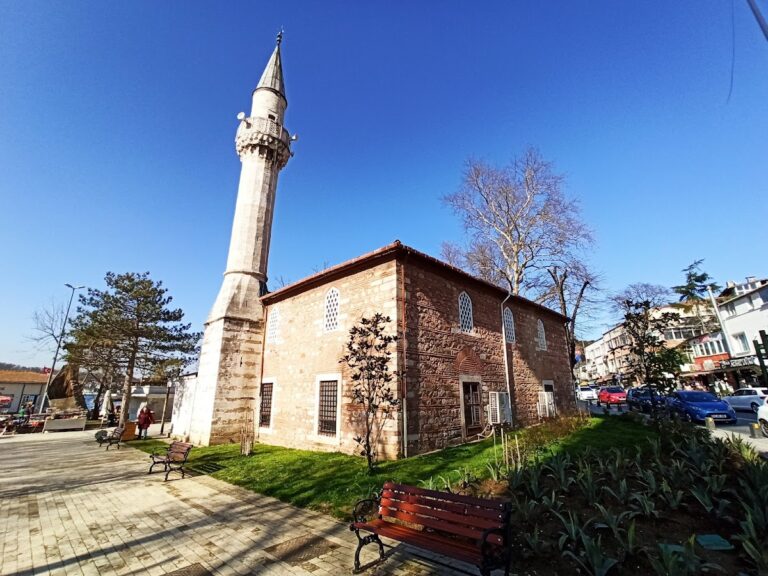
Wooden floors divided the interiors of the principal towers, and each level contained a furnace. Wooden houses for soldiers stood within the fortress. A small mosque endowed by the sultan was built during the original construction, and its surviving minaret shaft remains within the complex. A later mosque was built on the site.
A large cistern beneath the mosque supplied water to the garrison. Three wall fountains distributed the water through the fortress, with one fountain remaining. Two inscribed plaques are attached to the walls, adding written evidence to the surviving military and residential fabric.
Nearby sites