Château de Saint-Germain (Ain): A Former Fortified Castle and Seat of Lordship


Site at a Glance
- Rating
- 4.6
- Popularity
- Very Low
- Country
- France
- Primary era
- Medieval
- Eras represented
- Medieval
- Civilizations
- Holy Roman Empire, Merovingian
- Site type
- Military
- Remains
- Castle
On this page14 sections
History
Château de Saint-Germain is a former fortified castle in France, above the village of Saint-Germain near Ambérieu-en-Bugey. Occupied from the end of the Roman Empire, it developed into a medieval stronghold and the center of the lordship and castellany of Saint-Germain-d’Ambérieu. Construction probably began in the late twelfth or early thirteenth century under the Sires of Coligny, with work continuing into the fourteenth century.
Before the medieval castle
The promontory was already in use during the early medieval period. A chapel from the Merovingian period, the era of Frankish rule between the fifth and eighth centuries, dates to the sixth or seventh century. Its presence indicates continued occupation before the later fortified castle was established. The site’s position above the Albarine valley gave it control over an important boundary area between major lordships.
The castle is mentioned in 1141 and again in 1151. By 1210 it had come under the control of the Sires of La Tour du Pin. The Dauphins of Viennois, the rulers of the Dauphiné principality, acquired control in 1282, bringing Saint-Germain directly into the rivalry between the Dauphiné and the counts of Savoy. The counts of Savoy took control in 1321, and the castle ultimately passed to the kings of France in 1601.
Conflict between Savoy and the Dauphiné
From 1282 to 1355, Saint-Germain was involved in the principal military operations between Savoy and the Dauphiné. Count Philippe I of Savoy besieged the castle in 1282 while it was held by Dauphinois forces. After taking it, he released the dauphin’s free men in return for ransoms. The wider War of the Seventy Years, a prolonged struggle between Savoy and the Dauphiné, began in 1285 after Philippe’s death and the succession of Amédée V of Savoy.
Amédée V returned against Saint-Germain in 1308 after the governor of Miribel Castle, a possession of Guichard VI, Sire of Beaujeu, had been captured and hanged. A broad coalition joined the siege, including forces linked to the dukes of Austria and Burgundy, the counts of Auxerre and Geneva, the Sire of Beaujeu, the lord of Faucigny, the prince of Morea, and the lord of Vaud. The attackers surrounded the castle from the direction of Saint-Rambert and the plain, while Amédée V, his children, and the cavalry camped on the nearby mountain.
War engines battered the walls, but the Dauphinois garrison had ample supplies, projectile engines, and enough soldiers to make repeated sorties. Amédée V then staged a retreat toward Lagnieu. When the garrison followed by a shorter route, the Savoyard army turned back and surrounded the castle again. After the defenders were cut off, breaches were made in the walls. Allied troops captured the castle and its castellany by assault, with many defenders killed at the breaches, and Amédée V ordered repairs afterward.
Around 1310, men sent by the castellan of Cornillon set fire to the castle and the settlement of Saint-Germain. Another major siege followed in 1321. After Savoyard forces captured the borough of Ambérieu on 12 April, seized the fortified site of Chausson, and ravaged Dauphinois territory around Lagnieu, they advanced through the Albarine valley and besieged Saint-Germain. Siege engines quickly damaged the defenses, and the garrison surrendered on 23 August after a four-day truce, when no Dauphinois relief force had arrived.
Administrative center and changing frontiers
Between 1321 and 1328, the count of Savoy repaired and strengthened the castle and built a new borough to replace the former borough of Ambérieu. This settlement became the present-day Vieux Saint-Germain quarter. In 1326, Saint-Germain became the chief town of the Bugey bailliage, a territorial administrative and judicial district governed by a bailiff. Pierre de La Balme, a knight and bailiff of Bugey, served as castellan from 3 January 1343 to 6 April 1344.
Count Édouard of Savoy granted Saint-Germain, together with the lordships of Bâgé and Bresse, as an apanage to his brother Aymon. An apanage was a grant of lands or revenues to a member of a ruling dynasty. By letters issued at Saint-Germain on 5 May 1328, Aymon granted the inhabitants municipal franchises. Count Amédée VII, known as the Green Count, confirmed them at Saint-Germain on 21 August 1371.
The castle remained part of wider negotiations between Savoy and the Dauphiné. On 26 April 1329, King Philippe of France placed it under sequestration, meaning temporary official custody, to guarantee a truce between the Dauphin and the count of Savoy. Savoyard commissioners handed it to representatives of the Dauphin on 17 May. On 30 July, the king again took the disputed castle into his own hands, although the Dauphin refused to surrender Montluel at the same time. Saint-Germain returned to Aymon of Savoy on 13 February 1330.
In 1332, an attack launched from Saint-Germain against the Dauphinois castle of Les Allymes killed its castellan. Saint-Germain’s defenses were strengthened in expectation of a counterattack. The Treaty of Chapareillan in 1334 reduced the castle’s strategic importance. Les Allymes passed to the count of Savoy in 1335 and was placed under the bailliage of Saint-Germain.
The conflicts also affected nearby religious communities. In 1333, the Carthusian monks of Portes complained that troops involved in the capture of Saint-Germain had taken and eaten five or six of their oxen. They also reported that a syndic of Arandas had brought a Carthusian servant to the castle as an alleged supporter of the Dauphin. The monks ransomed him for seven and a half gros tournois and two sheep.
The Treaty of Romans, signed on 30 March 1349, organized the transfer of the Dauphiné to the king of France. Saint-Germain remained Savoyard but became partly enclosed by the newly French territories of Saint-Denis and Varey. The count also promised to restore property taken from nobles who had defended the castle during Amédée V’s capture of it. The Treaty of Paris of 5 January 1355 ended the long war between Savoy and the Dauphiné and attached Saint-Denis and Varey to Savoy. Saint-Germain then lost its strategic and military importance.
From Savoyard lordship to ruin
In 1497, Duke Charles of Savoy included Saint-Germain, with Rossillon, Châteauneuf, Poncin, Cerdon, and other Bugey lands, in the dowry of his mother-in-law Claude de Brosse, also known as Claude of Brittany. She held the land until 1543, when it returned to the House of Savoy. On 5 October 1576, Duke Emmanuel-Philibert granted it, with other lands, villages, and lordships, to his natural son Amé of Savoy as part of the marquisate of Saint-Rambert. A marquisate was a territorial lordship held by a marquis.
Marshal de Biron, commanding the troops of King Henri IV, ruined the castle in 1595. The Treaty of Lyon, signed on 17 January 1601, transferred Bresse, Bugey, and the Pays de Gex to France. The ruined castle and the old borough declined together, while the present-day Saint-Germain developed in their place. Amé of Savoy sold the marquisate on 24 October 1604 to Henri of Savoy, Duke of Nemours. His descendants held it until 1746, when it was sold to Guillaume Trocu, lord of Termant. Parts of the lordship later passed through the Estienne, de Suduyrand, and Buynand families, while another part went to the Dujast d’Ambérieu family.
In March 1848, a lime tree known as a tree of liberty was planted in the castle’s upper court to commemorate the Second Republic. Vineyards later covered much of the castle and the old borough, but the arrival of phylloxera, an insect pest that destroys grapevines, ended this cultivation. The land subsequently returned to wild vegetation.
Archaeological excavations, including work in the early 1970s, uncovered important funerary material. Since 2008, the association Les Amis de Saint-Germain et son Château has cleared scrub and helped safeguard the ruins. The site entered France’s register of monuments historiques on 4 May 2017. The ruins are owned by the commune of Ambérieu-en-Bugey.
Remains
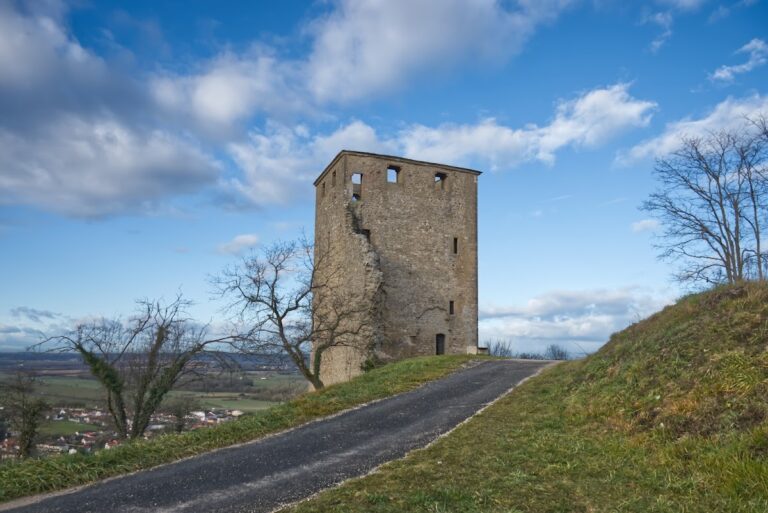
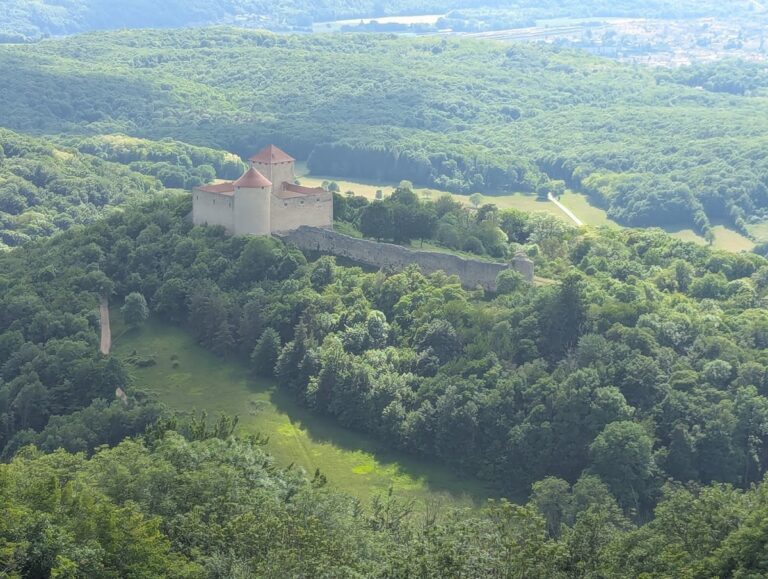
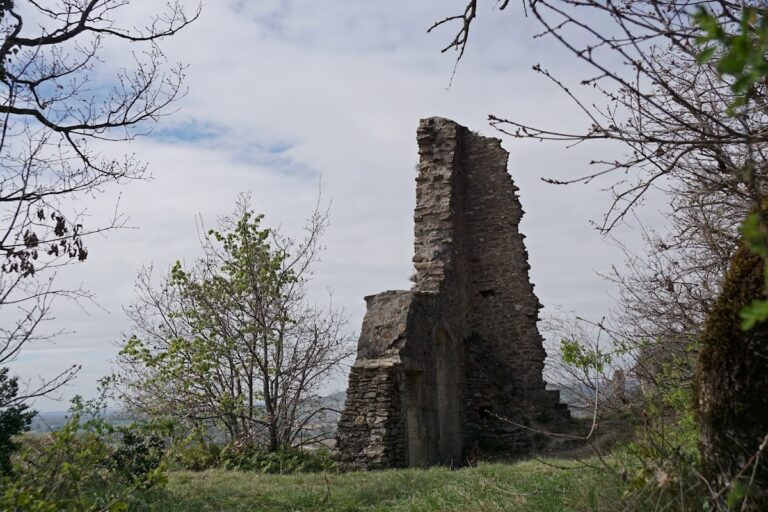
The ruins stand on a promontory about 460 metres above sea level, approximately 2 kilometres southeast of central Ambérieu-en-Bugey. They overlook the Albarine valley and the village of Saint-Germain, above the former fortified settlement now called Vieux Saint-Germain and the Maison-forte de Saint-Germain, also known as the Tour de Gy. The castle was arranged in an upper enclosure and a lower enclosure. Surviving elements include the pointed entrance gate, the southwest bastion, the principal wall of the upper court, two open-backed towers of the lower court, and the western wall and solid tower of the old borough.
Entrances and lower enclosure
Pointed gate
The ogival, or pointed-arch, gate was built in 1325 when the outer face of the castle wall was thickened. Its arch is notably open, and the vault still shows the channels that held the wooden beams used to close the doors. The entrance connected with a very steep, winding path from Vieux Saint-Germain to the upper court. It was intended for noble pedestrians and mounted riders.
Eastern towers
The two towers on the eastern wall have horseshoe-shaped plans. Their form follows a Roman defensive tradition: if attackers captured the outer parts of the towers, defenders in the upper court could still fire into them. After the castle was dismantled, the northeast tower was reused as a small barn, and traces of its later annexes remain.
The southeast tower retains evidence of three storeys in the form of floors and beam supports. On the first floor, the joists rested on a masonry ledge that remains visible. Together, the surviving tower fabric and the reused northeast structure show how parts of the lower enclosure continued to serve practical purposes after the castle’s military function ended.
Upper court and dividing rampart
Central rampart
A massive rampart separated the lower-court area from the upper-court area. Buildings stood against its central section on the upper-court side. The wall has been restored by Les Amis de Saint-Germain et son Château and contains two large arrow slits, narrow openings through which defenders could use bows or other projectile weapons. These openings were blocked on the upper-court side.
Chapel remains
At the northern end of the rampart are the remains of the chapel, set at the base of a small tower. A vaulted niche contains a tall, narrow window that may also have functioned as an arrow slit. The chapel’s position within the fortified complex connects the medieval defenses with the earlier religious use represented by the Merovingian chapel.
Great tower and keep
At the southern end, the remains of the great tower indicate that the keep, the castle’s principal fortified tower, had a slightly rectangular base measuring about 10 by 11 metres. Its walls were approximately 2 metres thick. The principal rampart rested against the sloping hill below Vieux Saint-Germain and ended in a solid tower that protected a gate. The threshold of that gate remains visible.
Painted representation
One of five frescoes preserved at the Château de la Tour-des-Échelles depicts Château de Saint-Germain. The restored scene presents the Tour des Échelles in a perspective aligned with the tower of Saint-Denis and the castles of Saint-Germain and Les Allymes. It provides a visual representation of the castle within the network of fortified sites associated with the surrounding territory.
Nearby sites