Royal Abbey of St. Medard: A Frankish Benedictine Monastery in Soissons


Site at a Glance
- Rating
- 4.2
- Popularity
- Very Low
- Country
- France
- Primary era
- Medieval
- External website
- Open
- Eras represented
- Medieval
- Civilizations
- Carolingian
- Site type
- Religious
- Remains
- Fortified Monastery
On this page12 sections
History
The Royal Abbey of St. Medard is a Catholic Benedictine monastery in Soissons, France, founded around 557 by Clotaire I, king of the Franks, to house the relics of Saint Medard. Established during the Merovingian period, the dynasty of Frankish kings that preceded the Carolingians, it grew into one of the most influential religious and seigneurial centers of the Frankish Empire.
Merovingian foundation
Clotaire established the monastery on his estate at Crouy, near the villa of Syagrius and just outside the contemporary boundaries of Soissons. A foundation tradition says that Saint Medard’s bier stopped at Crouy and could not be moved until the king donated the estate for a monastery. The saint’s remains were first placed in a wooden mausoleum.
Clotaire died before the church was completed. His son Sigebert I finished and decorated it, and both kings were later buried there near Saint Medard’s tomb. The abbey developed around this early basilica, becoming a royal foundation closely connected with the Frankish ruling house.
Carolingian power and royal ceremonies
In November 751, Childeric III, the last Merovingian king, was deposed at the abbey. Pippin the Short was then crowned king of the Franks there by the bishops of Gaul, beginning the Carolingian dynasty. The ceremony placed Saint Medard at the center of a major change in Frankish kingship.
Under the Carolingians, particularly during the reigns of Charlemagne and Louis the Pious, the abbey became one of the most powerful religious foundations and seigneurial domains in the empire. At the beginning of the ninth century, more than 400 religious lived in its monastic city. Its jurisdiction extended over other abbeys, priories, provostships, about 220 parishes, villages, farms, manors, and fiefs, including the lordship of Vic-sur-Aisne.
Royal and imperial patronage brought the abbey extensive privileges. It possessed the right to mint coins and was exempt from financial and military contributions imposed on other imperial abbeys. Its abbots ranked among the foremost lords in France. The foundation also maintained an important intellectual life. The Saint Medard Gospel Book was produced in its scriptorium, the monastery’s writing and book-production workshop, during the final years of Charlemagne’s reign at the palace school of Aachen. A cartulary, a book of institutional records and documents, dates from approximately 1201 to 1300.
Hilduin and the ninth-century abbey
Pope Leo III stayed at Saint Medard in 804 after celebrating Christmas with Charlemagne at Quierzy. In 825, Louis the Pious appointed the bishop of Soissons and Count Ruotfrid as missi dominici, royal or imperial envoys responsible for inspecting administration and enforcing the ruler’s authority in a region. Hilduin, the emperor’s cousin and archchaplain, was appointed to govern Saint-Denis, Saint Medard, and Saint-Germain-des-Prés. He served as abbot of Saint Medard from 822 to 830.
In 826, Hilduin obtained or brought relics of Saint Sebastian and Saint Gregory the Great to the abbey. Relics, bodily remains or associated objects honored in Christian worship, belonging to Saint Gildard and Saint Remigius were also transferred there. The arrival of Saint Sebastian’s relics increased the abbey’s importance and drew pilgrims from across Europe.
Hilduin also rebuilt the church. It was consecrated on 27 August 841 in the presence of Charles the Bald and 72 prelates. Charles took part in carrying Saint Medard’s body into the new church. The monastery therefore combined royal burial, episcopal ceremony, relic worship, and political authority in a single institution.
Conflict and fortification
Saint Medard again became the setting for a decisive Carolingian confrontation in 833. On 13 November, a synod convened by Lothair I and presided over by Ebon, archbishop of Reims, deposed Louis the Pious for the second time. Louis was forced to make a public confession, surrender his arms, wear a hair shirt, abdicate, and renounce the world. He was imprisoned and subjected to public penance at the abbey.
The monastery suffered repeated attacks later in the century. In 884, the Normans invaded the Soissonnais and pillaged the abbey. In 886, forces commanded by Sigfried entered the monastic city, sacking and burning its churches, palaces, and monasteries. Attacks attributed to the Magyars also caused damage. In 888, Eudes led an expedition against the Vikings and built a fortified enclosure with towers around Saint Medard, while strengthening other possessions of the abbey, including the castle of Vic-sur-Aisne.
Medieval rebuilding and decline
The abbey adopted the Benedictine rule, followed by monks whose communal worship, discipline, and regulated daily life were shaped by the Rule of Saint Benedict. It remained a major political, spiritual, and economic center through the Carolingian and later medieval periods. Its wealth included about 220 fiefs in the twelfth century, although its decline accelerated as royal power became increasingly centered on Paris.
During the eleventh century, the abbey was rebuilt after the Viking and Magyar destructions. Around 1079, Arnould, bishop of Soissons and later abbot of Saint Medard, supplied monks for the foundations of Saint-Sauveur and Notre-Dame at Vertus, established by Thibaud of Champagne. The project was completed in 1081, with the monk Sophrone as the first abbot of Saint-Sauveur.
After the Council of Soissons in 1121, Peter Abelard was confined at Saint Medard after being accused of heresy. In 1131, Pope Innocent II reconsecrated the rebuilt church and granted indulgences to visitors, which became known as Saint Medard’s pardons. Construction and rebuilding continued during the twelfth and thirteenth centuries.
Destruction and modern protection
The abbey was destroyed in 1567 during the Wars of Religion, the civil and religious conflicts that divided France between Catholics and Protestants. It was partly restored in the 1630s but never regained its former importance. During the French Revolution, the monastery was dissolved, and in 1793 the remaining buildings were razed to the level of the crypt.
The crypt was classified as a French historic monument in 1875, and the surviving chapel received the same protection on 14 February 1921. Repairs were carried out on the southern chapel during the 1970s. Archaeological excavations later uncovered the sarcophagus of Abbot Albéric de Braine. His body was transferred in late 2020 to a conservation workshop in Grenoble for restoration.
The abbey’s long history is also reflected in its officeholders. Carloman, son of Charles the Bald, was lay abbot from 860 to 870, while Herbert II of Vermandois held the office from 907 to 943 and his son Herbert the Elder from 946 to approximately 980 to 984. Odilo, a monk who died around 920, wrote accounts of relic translations at the monastery. Other notable figures included Enguerrand, the abbey’s provost who later became bishop of Laon, Arnould of Palmèle, Milon de Bazoches, and Cardinal de Bernis, commendatory abbot from 1756. A commendatory abbot held the title or revenues of an abbey without necessarily directing its monastic community.
Remains
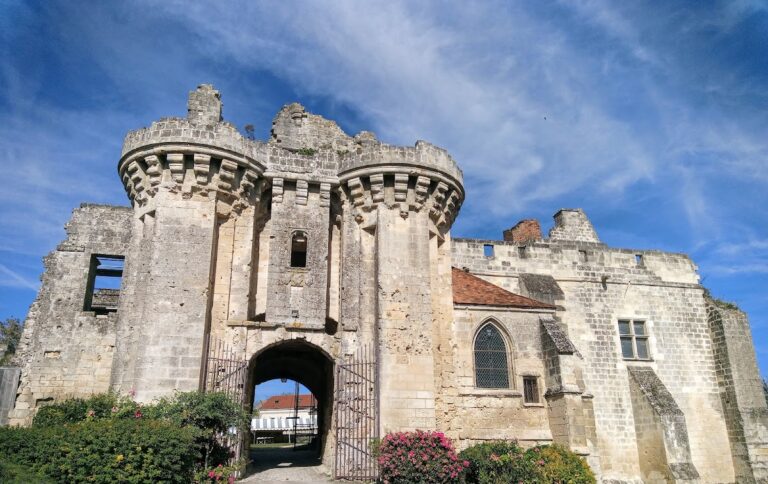
The surviving remains represent a large monastic complex built in four principal phases associated with the sixth, ninth, twelfth, and a later period. The final phase has been assigned either to the fourteenth or sixteenth century. The complex once included the basilica, a royal palace, an abbatial palace, several churches and chapels, cloisters, schools, courtyards, gardens, and vineyards. Today, the principal surviving elements are the crypt, the southern chapel, ruins, the principal gate, and one tower of the surrounding wall.
The basilica and monastic city
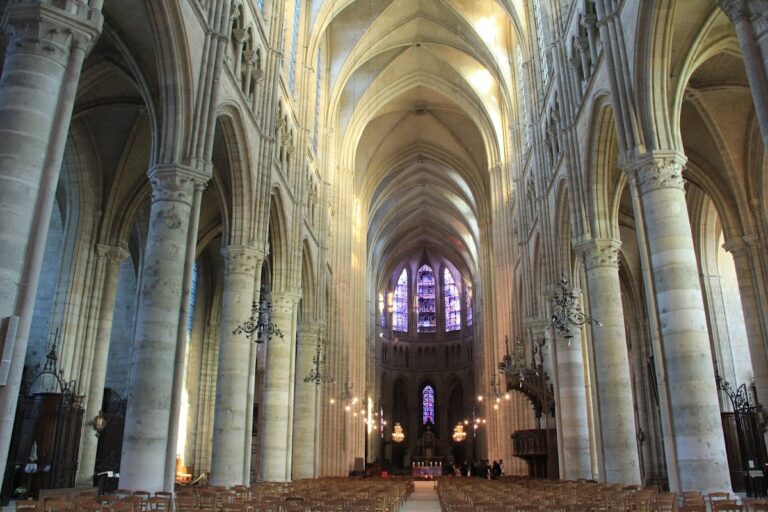
The principal church was a long basilica with three naves and vaulted side aisles. Two square towers stood at the eastern end of the transept. At the west, a monumental porch opened into the nave and was flanked by two additional square towers, forming an imposing western façade. These elements belonged to a complex whose churches, chapels, palaces, cloisters, and working spaces together formed the substantial monastic city described in the abbey’s medieval history.
The surviving crypt
The crypt is the principal surviving part of Saint Medard. Extending beneath the eastern high altar, it is 30 metres wide and was designed as an integral part of the abbey rather than added later as a separate structure. Its form is closely comparable to the crypt of Saint Willibrord at Echternach.
The construction date remains uncertain. Eugène Lefèvre-Pontalis placed it around 826 to 841, while Werner Jacobsen dated it to the first half of the eleventh century. Its existence is securely attested by 1079. The crypt’s position beneath the high altar connected its space directly with the central liturgical and relic-focused area of the church.
The southern chapel and enclosure
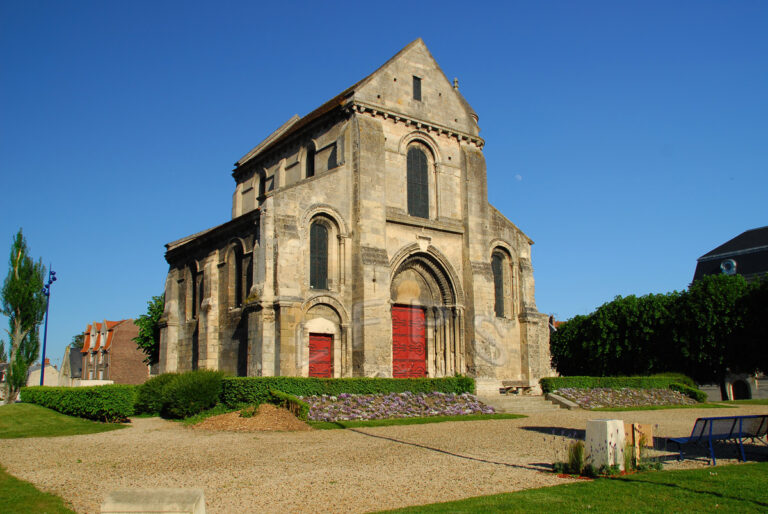
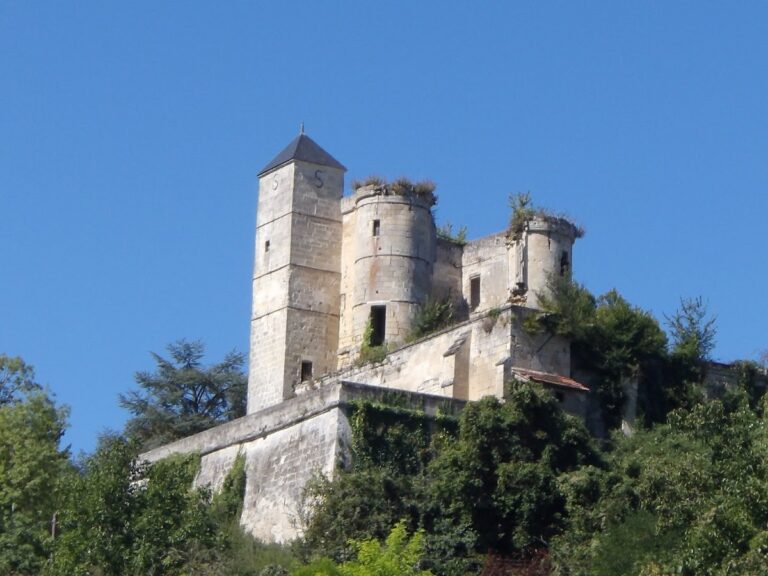
The complex had three chapels belonging to the twelfth century, of which the southern chapel survives. Repairs in the 1970s helped preserve this remaining chapel. Other surviving components include ruins, the principal gate, and one tower from the surrounding wall, giving physical form to parts of the abbey’s later enclosure.
Manuscript and burial remains
The Saint Medard Gospel Book contains the four Gospels and a Gospel lectionary. Its unusually large portraits of the evangelists, extensive resources, and high-quality colors reflect the scale and sophistication of Carolingian manuscript illumination, the richly decorated book tradition that developed under the Carolingian rulers from the late eighth century onward.
Excavations uncovered the sarcophagus of Abbot Albéric de Braine. His body was removed in late 2020 for conservation, while the sarcophagus provides archaeological evidence of the abbey’s burial history. The abbey’s heraldic arms showed a red shield bearing a gold crozier and a gold tournament lance with a silver pennon charged with a black eagle, flanked by two gold fleurs-de-lis.
Nearby sites