Church of the Immaculate Conception of the Blessed Virgin Mary in Cologne: A Franciscan Monastery Church


Site at a Glance
- Rating
- 4.7
- Popularity
- Low
- Country
- Germany
- Primary era
- Medieval
- External website
- Open
- Eras represented
- Medieval, Early Modern, Modern
- Civilizations
- Holy Roman Empire
- Site type
- Religious
- Remains
- Church
On this page12 sections
History
The Church of the Immaculate Conception of the Blessed Virgin Mary in Germany is a Roman Catholic Gothic basilica in Cologne, built by the Franciscans as the church of their monastery. Construction began in 1245, and the building became the principal monastery of the Cologne Franciscan Province. Its history reflects the religious, educational, civic, and social work associated with the Franciscan community and, later, the Kolping movement.
The Franciscan foundation
The Franciscans, a Catholic mendicant order founded by Francis of Assisi in 1210, settled in Cologne in 1222. From 1239, the Cologne monastery belonged to the Cologne Franciscan Province and served as the residence of its provincial minister. In 1245, work began on the monastery church and an adjoining four-wing complex. The early Gothic choir was completed between 1245 and about 1260, and Bishop Heinrich of Lützelburg consecrated the finished part in 1260 under the dedication of the Holy Cross. The three-aisled nave was completed during the fourteenth century.
Around 1260, the convent established a general study center for the education of Franciscan friars. From 1307, the influential Franciscan theologian and philosopher Johannes Duns Scotus taught there. His thought shaped medieval scholastic theology, and he was later buried in the church. The study center helped give the monastery an importance that extended beyond Cologne’s local religious life.
Religious and civic life
The church served a large community of priests, especially while the study center was active. Between five and ten side altars stood in the building, many endowed by guilds and confraternities. These groups held services, meetings, and festivals in and around the church. The church also housed many relics, meaning objects or physical remains preserved and venerated for their association with saints or sacred events. They included a relic of the True Cross, a purported body of one of the children murdered at Bethlehem, and relics connected with Barbara, Clare of Assisi, and Anthony of Padua.
After the Franciscan order divided in 1517, the Cologne friars belonged to the Conventual branch. Unlike the Observants, the Conventuals followed a less austere institutional form of religious life. This change formed part of the church’s later religious setting, while guilds, confraternities, and the monastery continued to shape its use.
Seventeenth- and eighteenth-century changes
A monastery fire in 1619 led to extensive interior work between 1621 and 1643. The rood screen, a partition separating the choir from the nave and usually carrying a cross, was removed. The high altar was moved westward into the nave, and the choir stalls were placed behind it in the apse, the semicircular end of the choir.
During the 1720s, Guardian Georg Richermo directed another redesign and embellished the interior with elaborate liturgical vessels and vestments. In 1728, he had the market stalls removed from the tree-planted square in front of the church and monastery. The square was enclosed by an iron railing, and a new church portal was installed in 1731. The 1727 renovation also removed most of the tomb slabs that had been set into the church walls and floor.
Suppression and nineteenth-century revival
French revolutionary troops occupied Cologne from 1794, and the church was used as a storage building. Its condition deteriorated, while the monastery was suppressed in 1802 during secularization, the transfer of church property to secular authorities. Napoleonic authorities abolished the Cologne monastery in 1804 and expelled the Franciscans. From 1808, the municipal poor administration used the building as an institutional and hospital church.
In 1846, ownership passed to the Cologne Cathedral Chapter, and the church became an annex church of Cologne Cathedral. On 3 May 1850, Archbishop Johannes von Geissel formally took possession of it and designated it as the diocesan church for confirmations and ordinations. A restoration and Neo-Gothic reorganization directed by the cathedral builders Ernst Friedrich Zwirner and Richard Voigtel continued until 1866. Johann Heinrich Richartz supported the rescue with a donation of 42,000 thalers. He later established the Wallraf-Richartz Museum on the former monastery site.
The Cologne Catholic Journeymen’s Association began using the church as its association church in 1849. Adolph Kolping, a nineteenth-century German Catholic priest and social reformer who founded the Catholic journeymen’s association movement, became rector in 1862. He organized extensive fundraising for the interior restoration, creating the church’s lasting connection with the Kolping movement and the later Kolpingwerk social association.
War damage and modern religious use
In 1889, Auxiliary Bishop Baudri acquired a late Gothic winged altarpiece, an altar structure with hinged panels, and donated it to the church for use behind the high altar. Made around 1480 in Lower Saxony, it had been removed from St. Nicholas Church in Alfeld in 1888. The Franciscans returned to Cologne in 1929 and resumed pastoral work at the church and the neighboring Columbakapelle. They have lived nearby again since 1958.
Bombing during the night of 30 to 31 May 1942 destroyed the organ, the vaults, and parts of the south aisle. The Kolpingwerk completed rebuilding in 1958, and an interior reorganization based on the building’s thirteenth-century appearance continued until 1975. The church was comprehensively restored in 2009 and 2010, including the entire roof and ridge turret. The work also introduced a large glass crucifix above the altar and a bust of Adolph Kolping beside his tomb.
Johannes Duns Scotus and Adolph Kolping are buried in the church. Both were beatified by Pope John Paul II, who prayed at their tombs on 15 November 1980 during his first apostolic journey to Germany. The church remains associated with the Archdiocese of Cologne, the Cologne-Mitte pastoral area, the Franciscan community, and the Kolpingwerk, and continues to function as an active filial church.
The monastery buildings were demolished in stages after secularization. The remaining structures were removed in 1855, and the Wallraf-Richartz Museum was built on the former monastery site in 1861. After wartime destruction, the museum was rebuilt from 1953 to 1957 and now houses the Museum of Applied Art.
Remains
Church layout and Gothic construction
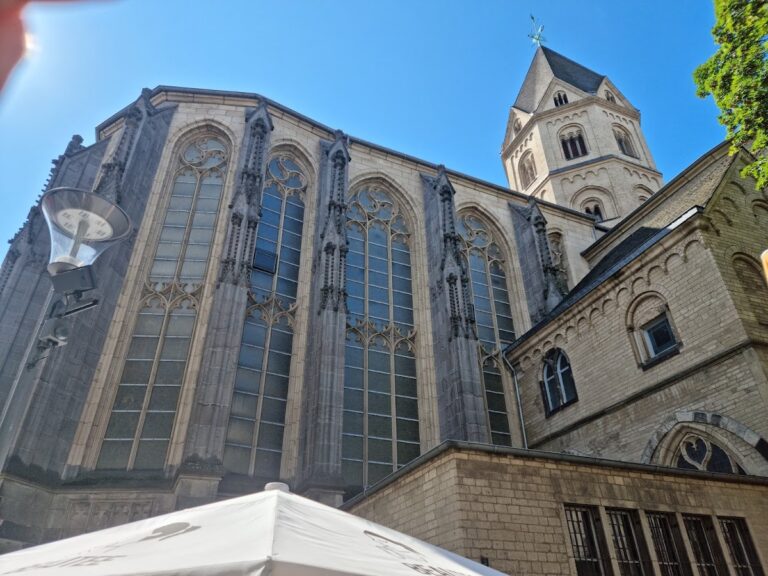
The surviving church is a long stone basilica in the austere manner associated with a Franciscan monastery church. Its interior measures approximately 58.4 meters in length, 32 meters in width, and 21.3 meters in height. Three aisles extend through eight bays, which are covered by rib vaults, supported ceilings formed by intersecting stone ribs. The building has no transept. The nave is less richly detailed than the choir, a contrast understood as a progressively stronger expression of Franciscan simplicity.
The original plan appears to have called for a three-aisled hall church with a crossing and a short transept, a form used at the time in Hesse and Westphalia but unusual around Cologne. That plan was abandoned during construction. The early Gothic choir is one bay deep and has the same height and width as the central nave. Its two-light tracery windows, windows divided by patterned stonework, are set between vertical vault supports and exterior buttresses.
Facade and ridge turret
The west facade is dominated by a tracery window with eight lights extending across the wall between two buttresses. Below it stood the original stepped portal, divided by a central vertical mullion. The church’s mendicant character is also expressed in its lack of a conventional bell tower. Instead, a ridge turret rises from the roof. It was installed in 1438 and renewed in 1713. The present turret contains two bells cast by Feldmann and Marschel in Münster in 1952 and 1954, replacing bells from 1754 and 1853 that were destroyed during the Second World War.
Glazing and monastery remains
The church once possessed richly colored glass donated by Archbishop Friedrich of Westerburg and the counts of Holland, Cleves, Berg, and Jülich. Hail destroyed the windows in 1637. Simpler glazing followed, and from 1709 the windows were fitted with ordinary glass.
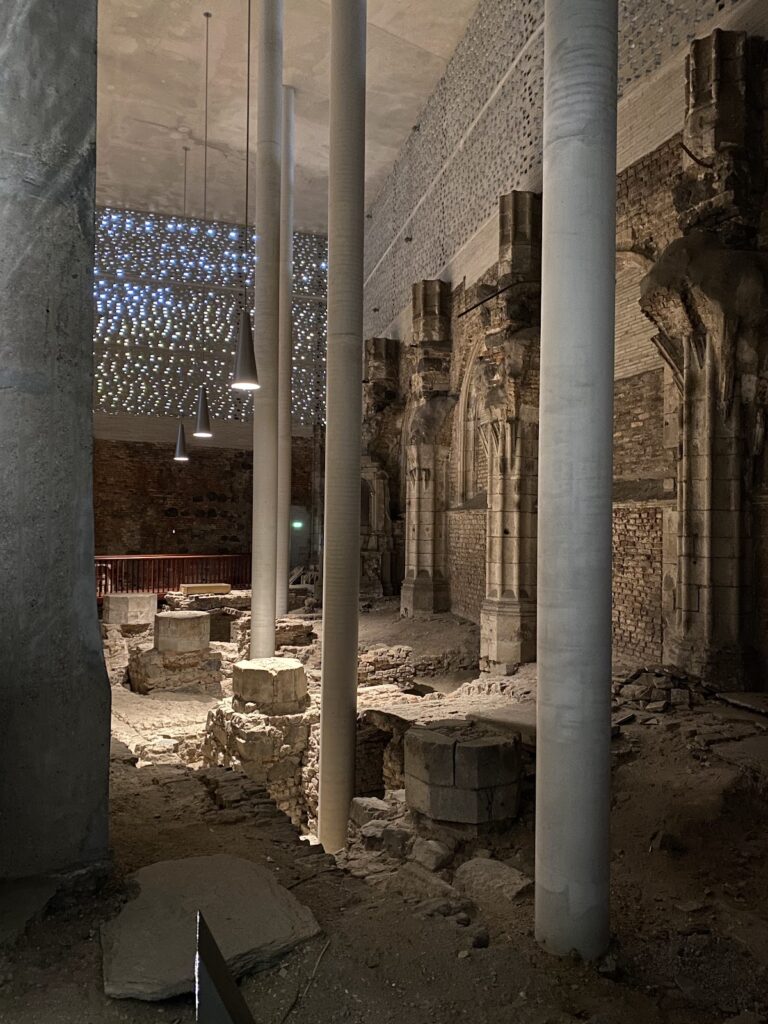
The four-wing monastery was attached to the north side of the east-facing church and surrounded an inner courtyard with a cloister. Tracery from the west wing survives in the wall of the Museum of Applied Art. Fragments of decorative wall paintings also remain inside the church, preserving parts of the former monastery setting.
Altarpiece and burials
The late Gothic winged altarpiece acquired in 1889 was made around 1480 in Lower Saxony. Sculptural decoration fills its interior, while its exterior carries painted scenes. The panels show four episodes from the life of the Virgin Mary and four scenes from the legend of Saint Nicholas. The Cologne painter Batzem restored the panels using surviving original paint.
At the center, the Virgin and Child appear beneath an elaborate canopy surrounded by angels and accompanied by saints. Other scenes show episodes from the life of Christ, extending from the Annunciation to the Resurrection. The church, cloister, and monastery cemetery received the burials of numerous aristocrats and benefactors from the thirteenth century onward, giving it the local designation “knights’ church.” Johannes Duns Scotus and Adolph Kolping remain buried inside. Both are represented on the west portal doors created by Paul Nagel in 2006, and Kolping is also commemorated by a bust beside his tomb.
Organs and Kolping monument
Before the monastery was suppressed, the church had two organs. The older instrument is first mentioned in connection with a repair in 1577. The second was built in 1727 by Jean Nollet of Luxembourg, renewed in 1747 by Balthasar König of Cologne, and placed on the gallery in the western nave bay. It had two manuals and 34 stops before wartime damage destroyed it in 1942.
A new organ by Romanus Seifert and Son of Kevelaer was inaugurated in 1997. It has 44 stops distributed over three manuals and a pedal, mechanical action, electrically operated stop action, and a swell division equipped with Barker machines. Its couplers are II/I, III/I, III/II, I/P, II/P, and III/P, and its combination system provides 768 settings.
In front of the west facade, on Kolpingplatz, stands a monument to Adolph Kolping by Johann Baptist Schreiner, unveiled in 1903. It depicts Kolping as the “father of journeymen,” linking the church’s physical setting with the social movement that has continued to use it.