Alcázar de los Reyes Cristianos: A Royal Fortress in Córdoba, Spain


Site at a Glance
- Rating
- 4.5
- Popularity
- Very High
- Country
- Spain
- Primary era
- Medieval
- External website
- Open
- Eras represented
- Classical, Medieval, Early Modern
- Civilizations
- Almohad, Crown of Castile, Roman, Spanish, Umayyad
- Site type
- Military
- Remains
- Castle
On this page26 sections
History
The Alcázar de los Reyes Cristianos in Córdoba, Spain, is a royal fortress built by Christian Castilian rulers in 1328 on a strategic site beside the Guadalquivir River. Its military architecture incorporates Mudéjar forms, a style combining Christian European traditions with Islamic architectural and artistic elements. The complex occupies an area used successively for Roman defenses, a late antique fortress, the Umayyad palace of Córdoba, and an Almohad fortress-palace.
Roman and Late Antique Foundations
The earliest identified remains belong to a Roman castellum, a fortified military installation, although Roman and late antique defenses preceded it. The southern Roman wall found in the Courtyard of the Women was built during the first century, after Emperor Augustus refounded Corduba as the capital of Roman Baetica. A fish mosaic south of the wall indicates that this area formed part of a port district rather than a customs house.
During the third and fourth centuries, the district changed or disappeared as an urban area and developed into an industrial zone. At the same time, the defenses were strengthened because the flow of the Guadalquivir increased. In the fifth century, a large late antique castellum was built against the earlier Roman wall. It helped protect the Roman bridge and river port. The clad columns and blocked doorways visible in the Courtyard of the Women and the Mudéjar Courtyard are associated with this fortified phase.
The Umayyad and Almohad Alcázars
Under the Emirate of Córdoba, the Umayyad Alcázar became a royal residence and the seat of government for Al-Andalus. The palace complex contained baths, gardens, administrative buildings, private residences, water installations, and an extensive library. During the Caliphate of Córdoba, the court moved to Madinat al-Zahra, the palace-city established by Abd al-Rahman III, but the Alcázar returned to use as a royal residence after the caliphate collapsed.
The complex’s gardens expanded during the reign of Abd al-Rahman II. An aqueduct carried water from the Guadalquivir to the fortress, while water-lifting installations and mills were associated with the river. The gardens’ supply is also identified with the Aqua Fontis Aureae, an aqueduct that brought water from the Sierra Morena.
During the Almohad period, probably under Caliph Abu Yaqub Yusuf in 1171 and 1172, the earlier Umayyad palace rooms were demolished. A new fortress-palace was then built, with substantial walls, a large sewer, and a major access arch. The arch, discovered behind the Baroque Door in February 2023, confirmed the importance of the Almohad building phase within the enclosure.
The Castilian Fortress
Castilian forces conquered Córdoba in 1236. The former Andalusian Alcázar was divided among King Ferdinand III, Bishop Lope de Fitero, nobles, and the Order of Calatrava. A Chapel of Saint Eustace was established within the complex, although its original location is now unknown.
In 1313, Augustinian monks received permission to settle inside the royal Alcázar because of attacks from the Nasrid Kingdom of Granada, the Muslim dynasty that ruled the Emirate of Granada from 1230 to 1492. In 1328, Alfonso XI of Castile bought part of their land, gave them another site for the Church of Saint Augustine, and began construction of the present fortress. The works apparently continued until 1350.
The Christian builders reused parts of the Almohad fortress, including the principal access, the cross-shaped courtyard, and the baths. Islamic forms remained visible in parts of the new complex through Mudéjar design. The baths traditionally linked with Alfonso XI and Leonor de Guzmán were probably reused Almohad baths. No written evidence confirms that Alfonso built them for his mistress, although their association with Leonor gave rise to their present name, the Baths of Doña Leonor.
The Alcázar became a Castilian royal residence and was drawn into the First Castilian Civil War. During that conflict, Pedro I attacked the fortress, which was defended by his half-brother, the future Enrique II of Trastámara. After becoming king, Enrique II strengthened the walls and added new albarrana towers, defensive towers projecting beyond the fortification wall and linked to it by a bridge or similar connection.
Henry IV of Castile celebrated his marriage to Juana of Avis at the Alcázar in 1455, after refurbishing the royal rooms. During the later war over Henry’s succession, Alonso de Aguilar briefly seized the castle and supported Alfonso of Castile, Henry’s brother.
The Catholic Monarchs and the Granada Campaign
Isabella I of Castile and Ferdinand II of Aragon, known as the Catholic Monarchs, were the last monarchs to reside in the Alcázar. They occupied it for eight years, carried out numerous reforms, and used it as a headquarters for the campaign against the Nasrid Kingdom of Granada. From Córdoba, they also planned the conquest of the Canary Islands.
Isabella gave birth at the Alcázar on 29 June 1482 to María of Aragon, who later became queen of Portugal. In August of the same year, Abenchara, the wife of the Canarian king Fernando Guanarteme, was captured and brought to the fortress. She was placed in the custody of Juan de Frías, the governor, and gave birth there one month later to Catalina Fernández Guanarteme. Her husband joined her on 15 August 1483.
Boabdil, the Christian Spanish name commonly used for Abu Abdallah Muhammad XII, the last Nasrid ruler of Granada, was captured after the Battle of Lucena in April 1483 and imprisoned in the Alcázar. He was released in August after accepting Castilian vassalage, surrendering his son Ahmed as a hostage, and paying 12,000 gold doblas.
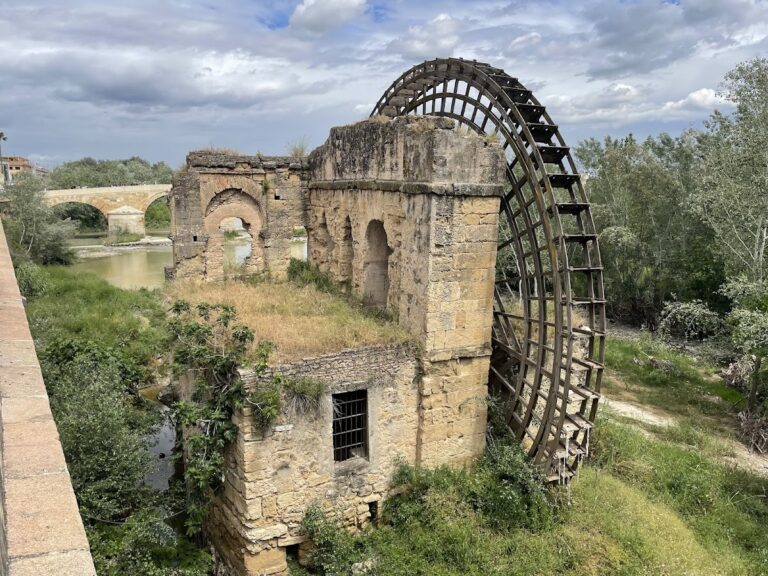
Isabella also ordered the Albolafia waterwheel to stop because its noise disturbed her sleep. The decision contributed to the deterioration of the gardens. In 1486 or 1487, Christopher Columbus sought financial support for his planned maritime expedition from the Catholic Monarchs at the Tower of Homage.
Inquisition, Prison, and Military Use
After the conquest of Granada in 1492, the Catholic Monarchs transferred the Alcázar to ecclesiastical authorities. The former palace became a tribunal and headquarters of the Spanish Inquisition, a royal and ecclesiastical institution that investigated and prosecuted religious dissent and heresy. Its new function ended the complex’s palatial role. Prison cells and other facilities were added, and a tribunal operated there for approximately three centuries.
In 1504, the inquisitor Diego Rodríguez de Lucero ordered 107 people to be burned at an auto-da-fé, a public ceremony associated with inquisitorial judgments and punishments. Public hostility later led citizens to invade the Alcázar and release more than 400 prisoners, while Lucero fled toward Seville.
Napoleon Bonaparte’s troops used the Alcázar as a garrison in 1810. After the Inquisition was abolished by the Cádiz Cortes in 1812, the complex became a municipal prison. In 1820, the municipal architect Pedro de Lara remodeled it for that purpose, including the blocking of the Mudéjar Courtyard’s arches to create additional cells.
In 1931, during the Second Spanish Republic, the Alcázar was declared a Historic-Artistic Monument and became a military barracks. After the Spanish Civil War, many Republican prisoners were held there. The construction of the Fátima prison in 1941 allowed the Alcázar to continue as a military administration facility rather than a prison.
Restoration and Present Status
Mayor Antonio Cruz Conde began the recovery of the complex for public use in 1951, with support from the Royal Academy of Córdoba. Restoration during the 1950s uncovered blocked entrances and the baths, created gardens, repaired the walls, added battlements, and improved paving, fountains, and pools. The first restoration phase was inaugurated on 26 October 1958, and the monument opened to the public in 1960.
Archaeological remains in the Courtyard of the Women were recovered between 2015 and 2016, when a raised walkway and two lifts were installed. The Tower of the Inquisition was restored between September 2019 and March 2020. Work on the western wall and southern facade created a renewed entrance through the Baroque Door, opened on 29 September 2023.
The Alcázar belongs to the Municipality of Córdoba and is used for municipal events, including civil marriage ceremonies and exhibitions. It forms part of the Historic Centre of Córdoba, inscribed on the UNESCO World Heritage List in 1984 and extended in 1994. Its gardens continue to receive water through the aqueduct identified as the Roman Aqua Fontis Aureae, which brings water from the Sierra Morena.
Remains
The surviving complex has a nearly square military plan enclosed by four corner towers. Its walls contain medieval and later fabric, while courtyards, baths, mosaics, archaeological layers, and gardens reveal the site’s succession of Roman, Islamic, Christian, inquisitorial, and modern uses. The layout combines a fortified enclosure with interior ceremonial, residential, administrative, and garden spaces.
Corner Towers and Central Gallery
Tower of Homage
The octagonal Tower of Homage stands at the northeast corner. It was formerly called the Clock Tower because it once contained a clock, which was removed in the early twentieth century. Its interior includes Gothic elements, including an ogival ceiling. The tower’s present name refers to the oaths formerly sworn there to protect the Alcázar.
Tower of the Lions
The square Tower of the Lions at the northwest corner is the oldest surviving tower and dates from the thirteenth century. Lion-shaped gargoyles at its top gave it its name. The tower has two levels, with a reception area on the ground floor and probably the Chapel of Saint Eustace on the upper floor, where the Catholic Monarchs worshipped. Its modern entrance, opened in 1662, bears a shield of Philip II transferred from Córdoba’s former city hall.
Tower of the Inquisition
The circular Tower of the Inquisition occupies the southwest corner. Reconstructed during the reign of Enrique IV, it housed the Inquisition tribunal’s archives for centuries. It was also known as the Tower of the Gardens.
Tower of the Dove
The square Tower of the Dove forms the southeastern corner. The original tower was demolished in the mid-nineteenth century, and the present structure is a reconstruction from the second half of the twentieth century. It was also known as the Tower of the Watch.
Central Gallery
The central gallery is entered through the doorway beneath the Tower of the Lions and leads to that tower and the interior of the Tower of Homage. Two female marble busts, possibly representing Juno and Flora, are displayed there on loan from the Prado Museum to the Municipality of Córdoba since 1925. The gallery also contains a 1895 bust of the Roman philosopher Seneca by Mateo Inurria.
Another major object in the gallery is the Roman Sarcophagus of the Gates of Hades. Made from Carrara marble in Italy and probably commissioned by a noble Cordoban family, the third-century sarcophagus was transported to Hispania and found in the Huerta de San Rafael district in 1958. Its reliefs depict the Gates of Hades, the deceased family, and the winged horse Pegasus.
Halls and Roman Mosaics
Hall of Mosaics
The Hall of Mosaics is the principal rectangular room. Built in the eighteenth century over or near earlier bath installations, it served during the Inquisition as a chapel where autos-da-fé were conducted. After 1812 it became the prison chapel.
Eight of the twelve Roman mosaics discovered during works in Corredera Square in 1958 and 1959 were transferred to the former chapel during the Alcázar’s restoration. The mosaics came from a Roman domus and date from the second and third centuries. Their scenes include Polyphemus and Galatea, Medusa, and Eros and Psyche, giving the room its present name.
During the inquisitorial period, the Hall of Mosaics and adjoining rooms contained Antonio del Castillo’s Calvary of the Inquisition, dated 1650, together with representations of Saint Peter of Verona and the martyrdom of Pedro Arbués.
Reception Hall
The square Reception Hall, also called the Ocean Hall, stands beside the Hall of Mosaics. A Roman mosaic dedicated to the god Oceanus is embedded in one wall. The room also holds seventeenth-century choir stalls from the former chapter choir, decorated with representations of former Cordoban parishes, an eighteenth-century writing cabinet, and a bust of Gonzalo Fernández de Córdoba by Federico Amutio y Amil.
Baths and Courtyards
Baths of Doña Leonor
The Baths of Doña Leonor comprise four rooms arranged as a changing room, a cold room, a temperate room, and a hot room. Star-shaped skylights with eight points illuminate the spaces. A boiler and furnace beneath the Tower of Homage supplied hot water.
Construction of the Hall of Mosaics over the baths deprived them of natural light. The Inquisition later used the rooms as torture chambers. A plan drawn by Gaspar de la Peña in 1662 and preserved in the National Historical Archive identified this part of the complex as the zone of the vaults.
Mudéjar Courtyard
The Mudéjar Courtyard, also called the Courtyard of the Moriscos or the Cross-Shaped Courtyard, lies on the western side of the Alcázar. Arcaded galleries surround its square plan except on the west, where a wall connects the Towers of the Lions and the Inquisition and provides access to the gardens. A central fountain and two ponds occupy the courtyard.
The courtyard preserves its original arrangement particularly well. During the mid-twentieth-century restoration, the removal of sand covering the former prisoners’ courtyard revealed the original structure about one metre below ground. A wall with plinths bears the arms of the Crown of Castile.
Courtyard of the Women
The Courtyard of the Women, or Eastern Courtyard, occupies the eastern side of the complex. Its name comes from the women’s section of the former prison. The demolition of prison rooms for a proposed congress palace exposed archaeological remains and halted that project.
Excavations between 2002 and 2004 revealed the first-century Roman wall, a water-themed mosaic outside it, third-century industrial buildings, and the fifth-century castellum. The excavated layers also include Umayyad and Almohad phases. The Umayyad pavement stood at 95.40 metres above sea level, later buttresses were added under Abd al-Rahman II, and Almohad deposits raised the levels from 95.40 to 98 metres. Almohad walls survive to heights of up to six metres, while a sewer runs through the courtyard as the principal organizing feature of that phase.
Almohad Access Arch
A large Almohad arch from the last third of the twelfth century was found behind the Baroque Door in February 2023. The door and other contemporary structures had concealed it. Its position and construction belong to the Almohad rebuilding of the fortress-palace.
Gardens and Waterworks
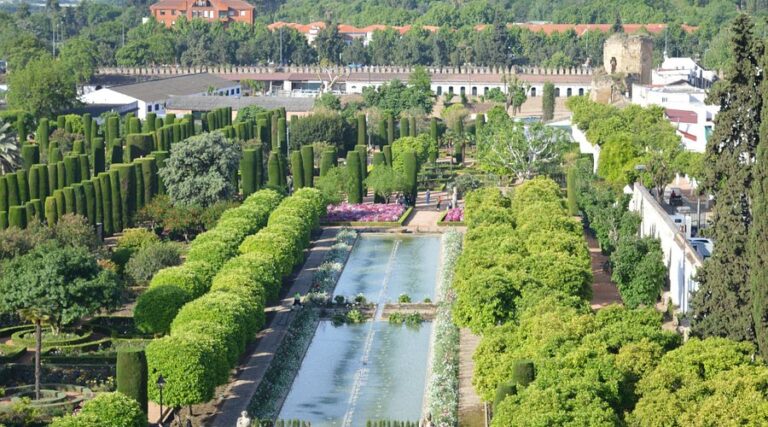
The gardens cover approximately 55,000 square metres and contain palms, cypresses, orange trees, lemon trees, fountains, and pools. They occupy three levels known as the Higher Garden, Middle Garden, and Lower Garden, reflecting the site’s long association with controlled water and cultivated spaces.
Higher and Middle Gardens
The Higher Garden lies between the Tower of the Lions and the eastern facade of the Royal Stables. Its present arrangement was created in the mid-twentieth century. The Middle Garden was laid out in the nineteenth century over the former Garden of the Inquisitors. It has a more intimate arrangement, with orange trees, lemon trees, and acanthus.
Lower Garden
The Lower Garden is the largest of the three. It was laid out in the mid-twentieth century over the former orchard and follows a completely orthogonal plan. Its pools, fountains, and planted areas form part of the modern arrangement of the historic water gardens.
Promenade of Kings
The Promenade of Kings is bordered by cylindrical cypresses and divided by two narrow ponds. Sculptures of Alfonso XI, Enrique II, Enrique III, Enrique IV, and the Catholic Monarchs stand on pedestals among the hedges. A sculpture of Christopher Columbus with Isabella and Ferdinand commemorates Columbus’s audience with the monarchs at the Alcázar.
A twentieth-century Roman-style mosaic occupies a pool beside a poem by Martial commemorating Julius Caesar’s planting of a plane tree. The modern tree associated with the poem stands alongside the mosaic.