Rocca Silvana: A Medieval Aldobrandeschi Fortress in Italy


Site at a Glance
- Rating
- 4.3
- Popularity
- Very Low
- Country
- Italy
- Primary era
- Medieval
- External website
- Open
- Eras represented
- Medieval, Early Modern
- Civilizations
- Grand Duchy of Tuscany
- Site type
- Military
- Remains
- Fortified Town
On this page13 sections
History
Rocca Silvana is a medieval fortified site in Italy near Selvena, a hamlet of Castell’Azzara in Tuscany. Developed under the Aldobrandeschi family during the medieval period, it controlled a settlement that prospered alongside nearby cinnabar mines and later became a contested stronghold of southern Tuscany.
From Abbey Property to Aldobrandeschi Fortress
The site was first recorded in 883, when documents of the Abbey of San Salvatore al Monte Amiata referred to it as Silbina. It remained associated with the abbey until about 1080, after which the Aldobrandeschi, a powerful medieval noble family whose possessions included parts of southern Tuscany, took control of the fortress.
From the twelfth century, the settlement grew substantially as economic prosperity increased and cinnabar was extracted from nearby mines. Cinnabar is a mercury-bearing mineral that was historically the principal ore used to produce mercury. One of the mines, the Miniera del Morone, lay directly west of the fortress.
Inheritance, Siege, and Expansion
On 22 October 1208, Ildebrandino VIII of the Aldobrandeschi bequeathed the fortress to his wife, Adalasia. After the family division of 1216, Rocca Silvana passed to the branch led by Guglielmo. Orvietan rule is recorded in 1223, but the fortress soon returned to Aldobrandeschi control.
Frederick II, the medieval Holy Roman Emperor and king of Sicily, besieged Rocca Silvana several times during the thirteenth century. The attacks took place in 1233, from June 1240 to June 1241 under the commander Pandolfo di Fasanella, and again in 1250. The fortress was not captured. After the Aldobrandeschi division of 1274, it passed to the Santa Fiora branch, which made it one of the family’s principal seats and greatly expanded the site.
Sienese, Orsini, and Tuscan Rule
The Aldobrandeschi retained Rocca Silvana until 1339, when Iacobo and Pietro Aldobrandeschi, sons of the late Bonifazio, submitted to the Republic of Siena. Siena was an independent city-state that extended its authority across parts of southern Tuscany. Ninety-seven inhabitants confirmed the submission by oath five years later, and the site came under Sienese jurisdiction around the middle of the fourteenth century.
In the early fifteenth century, the Orsini of Pitigliano incorporated the fortification into their county. The Orsini were a major Italian noble family with extensive territorial interests in central Italy, and from 1417 Rocca Silvana belonged to the County of Pitigliano, an Orsini-ruled lordship in southern Tuscany. Later conflicts also involved the Baschi of Baschi and Montemerano and the Orsini branch of Sovana. Following the marriage of Cecilia Aldobrandeschi to Bosio Sforza in 1439, the site passed into their possession.
Decline and Archaeological Recovery
Rocca Silvana later became involved in the conflict between Siena and Florence. Florence prevailed and incorporated the territory into the Duchy of Tuscany. By the middle of the seventeenth century, the fortress formed part of the Grand Duchy of Tuscany together with the former territories of the County of Pitigliano. The Grand Duchy was the hereditary state that ruled much of Tuscany from the sixteenth century until Italian unification.
During the seventeenth century, the fortress lost its military purpose as its structures were converted into civilian houses. It was then gradually abandoned and entered a long period of decline. Today it is one of the few uninhabited fortified sites associated with the Aldobrandeschi. Excavation campaigns and restoration interventions during the final years of the twentieth century recovered substantial ruins that reveal the former importance of the settlement.
Remains
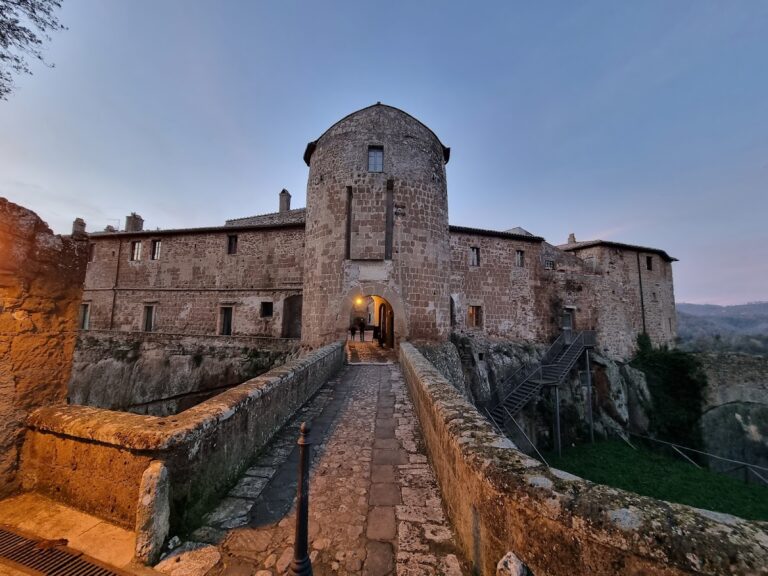
Rocca Silvana stands at about 573 metres on Monte Civitella, south of Monte Amiata and approximately two kilometres southwest of, and below, Selvena. The site lies about three kilometres east of the Fiora River, while the Fosso della Canala runs through the valley directly below it. Its layout consisted of two concentric defensive walls. The outer circuit enclosed the inhabited houses, and the inner circuit protected the feudal palace.
Defensive Walls and Upper Fortress
Towers and Defensive Circuits
Two towers formed part of the fortification. The eastern tower is pentagonal and served as the cassero, the principal fortified keep. Both towers date from the late eleventh or early twelfth century and were probably linked by a wall. The eastern tower was substantially enlarged after Pandolfo di Fasanella’s attack in 1241. A defensive wall built during the second half of the twelfth century separated the fortress from the inhabited lower settlements.
Palace and Water Systems
The upper area contains the quadrangular seigneurial palace, arranged over two levels. A building constructed during the second half of the twelfth century had dimensions corresponding to those of the later Aldobrandeschi palace. After the family division of 1274, the Santa Fiora branch transformed and enlarged a single-storey building into the Palazzo degli Aldobrandeschi.
Near the palace are the remains of a cistern used to collect and distribute water. Another cistern stood near the ancient cassero. Together with the surviving wall structures, these elements form part of the imposing ruins of the upper fortress.
Lower Boroughs and Religious Buildings
Borgo Ovest
The fortified lower settlement included the western borough, Borgo Ovest. It was established from the beginning of the thirteenth century and formed the earlier of the two lower residential areas.
Borgo Est and the Town Gate
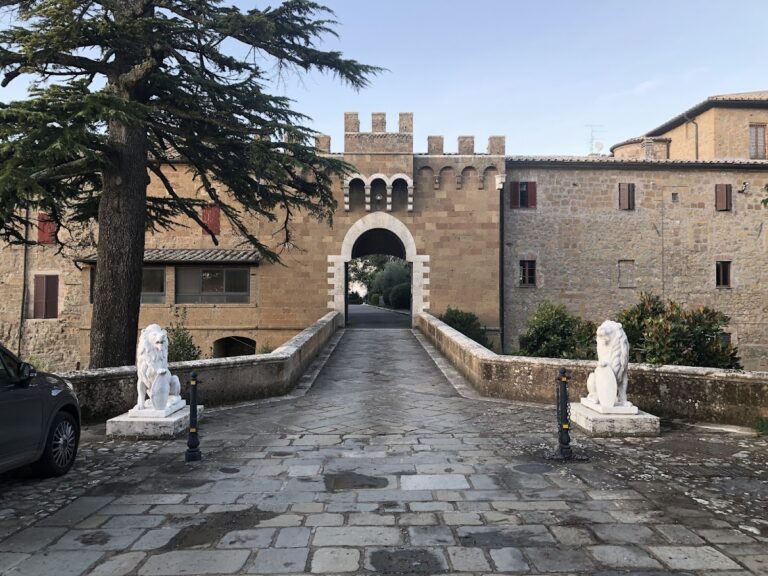
The eastern borough, Borgo Est, developed later. Both boroughs reached their greatest extent at the beginning of the fourteenth century, and the settlement’s only town gate was built during the extensive remodelling carried out by the Santa Fiora branch. Wall structures belonging to several buildings survive in the lower settlement.
Church of San Nicola di Bari
The Church of San Nicola di Bari stood in Borgo Est. Countess Tomasia, also identified as Tommasa Aldobrandeschi, initiated its construction in 1238. It served as a pieve, a rural parish with authority over dependent churches, until the fifteenth century. Only visible fragments of its historic walls remain.
A new pieve, the Church of San Nicola da Tolentino, was inaugurated in Selvena in 1838.
Nearby sites