Rocca di Mondavio: A Renaissance Fortress in Italy
Site at a Glance
- Rating
- 4.6
- Popularity
- Medium
- Country
- Italy
- Primary era
- Medieval
- External website
- Open
- Eras represented
- Medieval
- Civilizations
- Duchy of Urbino
- Site type
- Military
- Remains
- Fort
On this page11 sections
History
Rocca di Mondavio is a Renaissance fortress in Mondavio, Italy, in the Marche region. Commissioned by Giovanni della Rovere, it was built between 1482 and 1492 as part of a wider programme of fortification within the Duchy of Urbino. Its design is associated with Francesco di Giorgio Martini, a Sienese architect, engineer, and architectural theorist known for adapting fortresses to the growing use of artillery.
Construction under the della Rovere
The fortress formed part of Giovanni della Rovere’s effort to strengthen several strongholds in the duchy. Francesco di Giorgio Martini probably designed Rocca di Mondavio during the later phase of his career. The work remained incomplete after Martini returned to Siena, and the deaths of both the architect and Giovanni della Rovere in 1501 brought the original building campaign to an end.
Rocca di Mondavio was conceived for warfare in a period when older mechanical weapons, such as catapults and trebuchets, existed alongside firearms. Its brick construction and defensive arrangement were intended to withstand both forms of attack. Unlike many of Martini’s other fortresses, it was never attacked or besieged.
From ducal fortress to prison and museum
When Francesco Maria II della Rovere, the last duke of Urbino, died in 1631, the duchy returned to the Papal States. By that time the fortress no longer served a defensive purpose and was converted into a papal prison. This use continued after Italian unification and lasted until the 1940s.
Repeated renovations have left the fortress in an excellent state of conservation. Its municipality is the current owner, and the complex now functions as a museum devoted to historical reconstruction and Renaissance life. Since 2000, the dry moat has also contained full-size reconstructions of war machines based on Francesco di Giorgio Martini’s drawings and developed from them.
Remains
Fortification layout
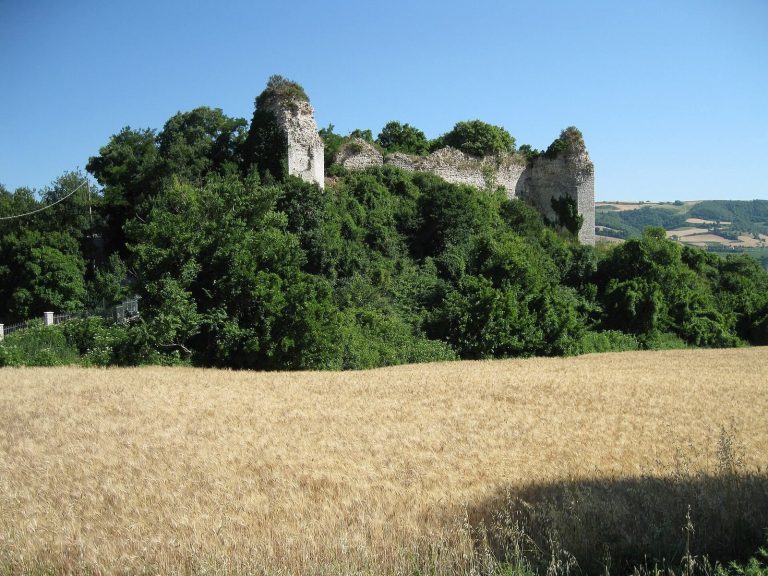
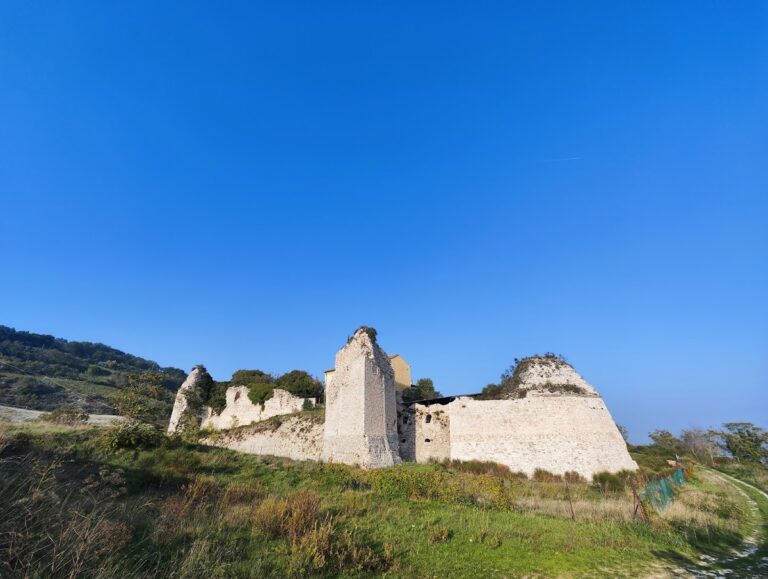
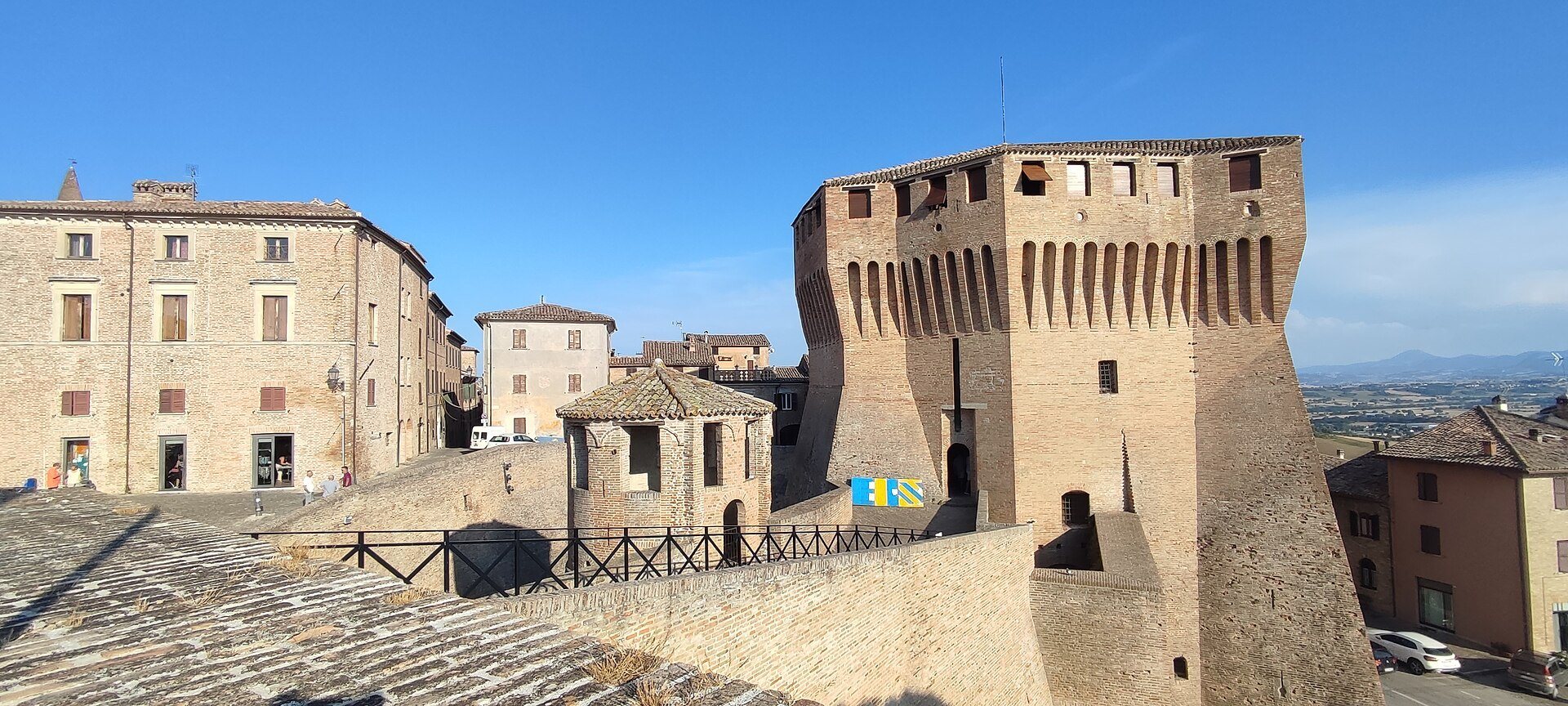
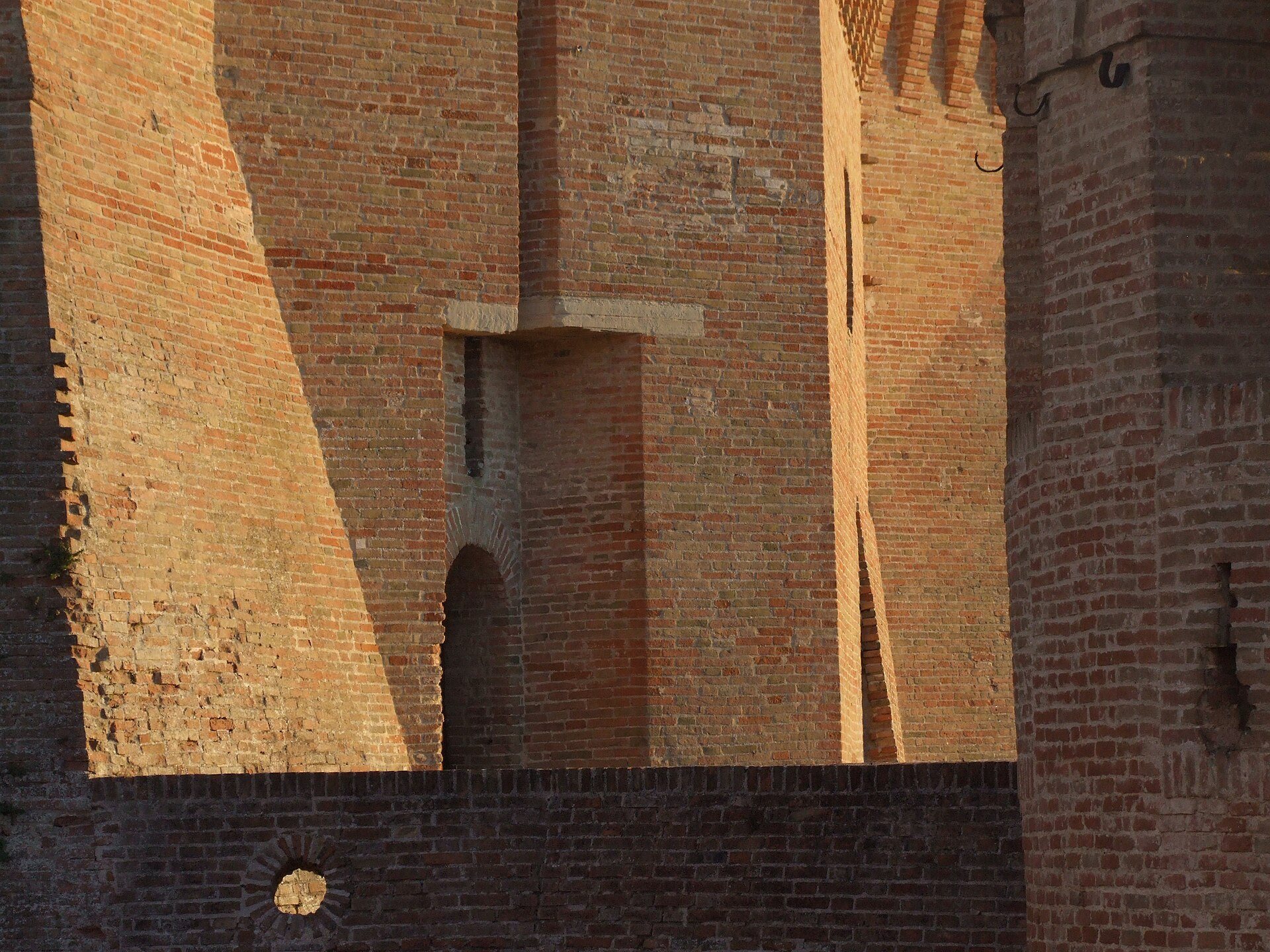
Built of brick, the fortress is organized around a dominant central tower and a sequence of defended approaches. A dry moat surrounds the structure. Its defensive equipment includes a covered passage, projecting machicolations, which are openings through which defenders could attack people below, and numerous gun loops designed for firearms.
The mastio
The mastio, or principal fortress tower, dominates the complex through its scale and unusual geometry. It has eight complex, irregular faces, recessed elevations, and sharply defined edges. Viewed from the base upward, these surfaces create a helical, screw-like visual effect. The interior spaces largely follow the original arrangement, although they now accommodate exhibition and museum areas.
The entrance defenses
A passageway leads toward the mastio and is guarded by a small tower. It continues to a massive semicircular tower, which is linked by a bridge to two entrance ravelins. A ravelin is an outer defensive work placed in front of an entrance or wall, and one of the two at Mondavio remains visible. From above, the passageway and semicircular tower together form the shape of a crossbow.
The western tower plan
A further rounded tower was planned for the western side but was never constructed. Architectural treatises associated with Martini indicate that this projected structure would have contained residential rooms. These rooms were otherwise not part of the fortress, whose surviving spaces are now used mainly for exhibitions and historical interpretation.
Museum interiors and military reconstructions
Historical-reenactment museum
The historical-reenactment museum occupies four of the mastio’s five floors. It reconstructs scenes from Renaissance life within spaces that correspond largely to the fortress’s original structures. Another exhibition area is an armory containing armor, artillery, and other military instruments.
War machines in the moat
The moat park contains life-size reconstructions of catapults, trebuchets, bombards, and other siege engines. These displays draw on Martini’s original drawings and relate to the fortress’s conception as a military structure capable of confronting both mechanical projectile weapons and early firearms.