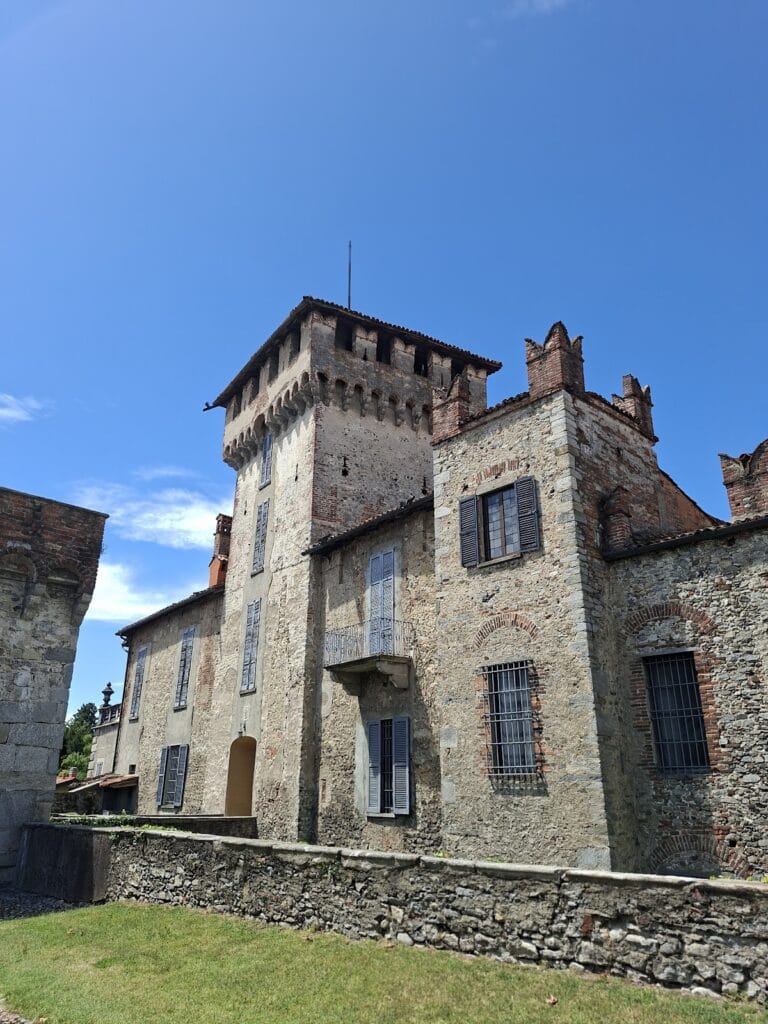
Rocca Borromea: The Former Fortress of Arona


Site at a Glance
- Rating
- 4.6
- Popularity
- Medium
- Country
- Italy
- Primary era
- Medieval
- External website
- Open
- Eras represented
- Bronze Age, Iron Age, Medieval, Early Modern
- Civilizations
- Duchy of Milan, Holy Roman Empire, Lombard
- Site type
- Military
- Remains
- Castle
On this page15 sections
History
Rocca Borromea is a former fortress in Arona, Italy, built under Lombard control shortly before AD 1000 as a defensive stronghold above Lake Maggiore. Together with Rocca Borromea di Angera, it formed one of the lake’s principal strategic control points, probably helping to regulate movement from the Alpine region toward Milan and Pavia. Neolithic objects preserved in the Archaeological Museum of Arona indicate earlier human presence, while the earliest known construction traces probably belong to the Late Bronze Age or the beginning of the Iron Age.
Early medieval stronghold
The fortress was initially used exclusively for defense. It later passed into episcopal ownership and, by the eleventh or twelfth century, had become principally a refuge. At the end of the twelfth century, Arona entered Milanese political influence. The fortress was then strengthened against attacks by cities allied with Frederick Barbarossa, the German king and Holy Roman Emperor whose campaigns in northern Italy provoked opposition from several Italian cities.
During the thirteenth-century struggle between the Torriani and the Visconti for control of the region, Ottone Visconti captured the fortress. Torriani forces subsequently destroyed it, and it was rebuilt or restored to Visconti control during the same century. The Visconti dynasty ruled Milan and expanded its power across much of northern Italy, while the Torriani, also known as the Della Torre family, were its principal Milanese rivals.
The Borromeo lordship
In 1439, Philip Maria Visconti, Duke of Milan, transferred Arona and its fortress as a fief to Vitaliano I Borromeo. Vitaliano became Count of Arona on 26 May 1445 and, with the duke’s approval, undertook works to embellish and consolidate the fortress and the town. During his tenure, the port of Arona was built below the stronghold and linked to it by a secret road. His son Philip I Borromeo later commissioned additional towers and a new circuit of walls.
The fortress temporarily left Borromeo control between 1495 and 1500 before being definitively returned to Frederick I Borromeo in 1512. It was repeatedly besieged by Spanish forces during the sixteenth-century struggle between France and Spain for control of Italy. French forces also made unsuccessful attempts to capture it for 27 days in 1525 and again in 1644. In 1573, the fortress was occupied after a dispute between Saint Charles Borromeo and the Spanish governor of Milan, then returned to the Borromeo family several years later.
Saint Charles Borromeo, a sixteenth-century Milanese cardinal and major Catholic reformer, was born at the fortress on 2 October 1538. From the seventeenth century, pilgrims visited the room associated with his birth. The fortress church was consecrated to Saint Justina on 30 August 1665 by Cardinal Frederick II Borromeo, Patriarch of Jerusalem, whose family held a particular devotion to the saint.
Attacks, explosions, and Austrian occupation
Under Borromeo ownership, the stronghold withstood attacks by Austrian, Spanish, and French forces. Lightning struck it at least seven times during the early sixteenth century, eventually causing the powder magazine to explode. Further explosions occurred in 1673 without additional major damage. On 20 July 1689, however, an explosion killed the entire garrison and damaged the town of Arona.
Austrian forces occupied the fortress from 1706 to 1743. After the Treaty of Worms was signed on 13 September 1743, the boundary between Piedmont and Austrian-controlled Lombardy was placed on Lake Maggiore, and the fortress came under the Kingdom of Sardinia. The Borromeo family retained its feudal rights until their abolition in 1797.
Abandonment and demolition
By the eighteenth century, the fortress had entered a state of abandonment despite its considerable size. Plans proposed magnificent gardens, four terraces linked by stairways, a Baroque temple above the complex, and an artificial grotto. These projects remained unfinished because the planned funds were redirected to military purposes.
Restoration works in 1798, undertaken in preparation for Napoleon Bonaparte’s Italian campaign, included roof repairs and a new drawbridge. The fortress was captured by French forces, taken by the Austrians in 1799, and recaptured by the French in June 1800. After Napoleon’s victory at the Battle of Marengo, the French army ordered the destruction of Austrian-held fortifications. Demolition at Rocca Borromea took place from 23 June 1800 to 22 March 1801. Explosives were used, but the work lasted nine months because of the fortress’s strength and disputes over payment. Stone from the site was reused as ballast in the construction of Napoleon’s Simplon Road.
From military site to public park
From 1801, the former fortress land was used for agriculture, particularly for raising cattle and pigs. On 30 October 1807, Eugène de Beauharnais returned it to Gilbert Borromeo on the express condition that the site not be altered. Eugène de Beauharnais was a French statesman and viceroy of the Kingdom of Italy during the Napoleonic period.
The site was entrusted to the municipality of Arona in 1970 and became a public garden. After an agreement with the Borromeo family ended, the ruins were closed in 2002 because they were considered dangerous. In 2011, the family entrusted the site to the city of Arona for a 16-year term. Safety works followed, and the park reopened to the public in September of that year. Conservation and restoration continue to preserve the surviving remains, while tortoises, donkeys, goats, and ducks have been reintroduced into the park.
Remains
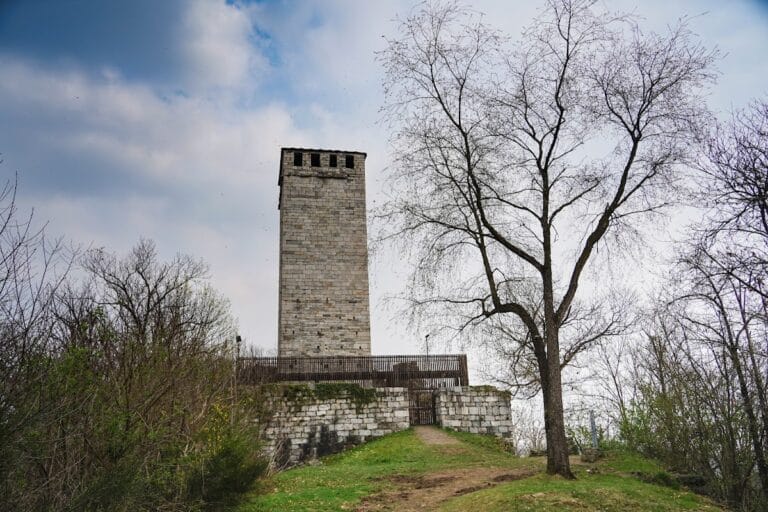
The surviving ruins occupy elevated ground above Lake Maggiore within a public park. The former fortress was arranged as a substantial fortified complex with three enclosing walls, a keep, a palace, a tower, and military parade grounds. Later Borromeo building campaigns added towers and another defensive circuit. Portions of all three enclosures survive, together with the keep, the Oratory of Saint Ambrose, the Hall of Arms, the half-rampart of Saint Charles, several towers, and the Sally Port, a small protected exit through a fortification.
Walls and defensive structures
Fortified enclosures and keep
The three fortified enclosures formed the principal defensive framework of Rocca Borromea. Their masonry was built as part of a strongly fortified structure, and the robustness of the walls made demolition by explosives a prolonged operation in 1800–1801. Surviving portions of the enclosures and the keep, the fortress’s principal fortified tower, remain within the park alongside the later defensive additions.
Surviving towers
The surviving towers include the Tower of the Innocents, the Lower Tower, the Drum Tower, and the Mozza Tower. They belong to the wider system of towers and wall circuits developed during the fortress’s successive phases of strengthening. Their remaining fabric forms part of the fragmentary military complex preserved in the public park.
Half-rampart and Sally Port
The half-rampart of Saint Charles and the Sally Port are among the surviving defensive features. The Sally Port provided a protected exit through the fortification, while the half-rampart formed part of the defensive works associated with the fortress. Both remain linked to the surviving wall structures and other military remains.
Religious and residential remains
Oratory of Saint Ambrose and fortress church
The Oratory of Saint Ambrose survives among the remains of the fortress. The complex also included a fortress church consecrated to Saint Justina in 1665. Its dedication reflects the particular devotion of the Borromeo family to the saint and preserves a religious element within the former military site.
Hall of Arms and Chamber of the Three Lakes
The Hall of Arms remains within the ruined complex. Between it and the Sally Port are fragmentary remains of the Chamber of the Three Lakes, the room associated with the birth of Saint Charles Borromeo on 2 October 1538. A reconstruction of that chamber is housed in the Church of Saint Charles on the heights of Arona, while the original survives in a fragmentary state at Rocca Borromea.
Landscape and surviving fabric
The proposed eighteenth-century arrangement would have connected four terraces by stairways and incorporated formal gardens, a Baroque temple, and an artificial grotto. The surviving site instead preserves parts of the earlier fortified layout, including its walls, towers, religious buildings, and military spaces. Stone removed during the demolition was reused as road ballast, while the remaining fabric continues to undergo conservation and restoration within the public park above Lake Maggiore.
Nearby sites