St. Peter and St. Paul’s Church, Brebbia: A Lombard Romanesque Parish Church


Site at a Glance
- Rating
- 4.3
- Popularity
- Very Low
- Country
- Italy
- Primary era
- Medieval
- Eras represented
- Medieval, Early Modern
- Civilizations
- Holy Roman Empire
- Site type
- Religious
- Remains
- Church
On this page14 sections
History
St. Peter and St. Paul’s Church, in Italy, is the Catholic parish and principal religious building of Brebbia. Built in the Lombard Romanesque tradition during the eleventh or twelfth century, with completion given as 1100, it follows the Ambrosian rite, the Catholic liturgical tradition associated with the Archdiocese of Milan and Saint Ambrose. Formerly known as the Church of Saint Mary, it is dedicated to Saints Peter and Paul and is regarded as one of the best-preserved Romanesque buildings in the Province of Varese.
From Roman sanctuary to Christian church
The church stands on, or close to, the site of an ancient temple dedicated to Minerva, the Roman goddess associated with wisdom and strategic warfare. A Roman inscription set into the north exterior wall preserves her name and provides a physical link between the earlier pagan sanctuary and the later Christian building.
Christianization of the site is traditionally attributed to Saint Julius of Orta and his brother Giuliano. Said to have come from the island of Aegina in the late fourth century, the two were associated with evangelization around Lake Orta and Lake Maggiore. According to the tradition, Julius destroyed the temple of Minerva and founded the first church at Brebbia, then called Santa Maria. Another tradition relates that he miraculously reattached a carpenter’s severed thumb during the church’s construction.
Archaeological investigations in the 1960s, combined with documentary research, identified a smaller seventh-century church between the bell tower and the present building. The current church replaced this earlier Christian structure, and population growth helped encourage its construction. The date of the Romanesque building remains uncertain within the eleventh- and twelfth-century period. Its completion is given as 1100, while Giulio di Orta has been proposed as its architect or as the principal guiding figure in a regional architectural comparison. That attribution remains hypothetical.
Medieval status and patronage
After several invasions affected Brebbia during the fifth century, the church acquired the rank of pieve. A pieve was an important medieval church serving surrounding communities and subordinate churches. In this role, it became a centre for the archpriests of Insubria. The church lost that status in 1567, when the administrative centre of the pieve was transferred to Besozzo.
The Besozzi family, which rose to power in the twelfth century, helped finance the church’s construction and other monuments in the area. This patronage strengthened the family’s local position and brought it favourable treatment in Catholic ecclesiastical affairs. Its golden flying-eagle coat of arms was later incorporated into the church’s Crucifixion fresco.
Alterations and preservation
The building changed substantially over time. In the seventeenth century, the original timber-trussed roof over the central nave was replaced by vaulting. The alteration destabilized the church and led to further structural measures, including tie-rods and metal plates added in 1939. Restoration after 1939 uncovered older frescoes that had been concealed during sixteenth-century restoration work.
The church was declared a national monument in 1844. Later restoration, particularly the work of 1963 and 1964, revealed additional paintings and clarified the extent to which earlier decorative campaigns had been covered, damaged, or altered.
Remains
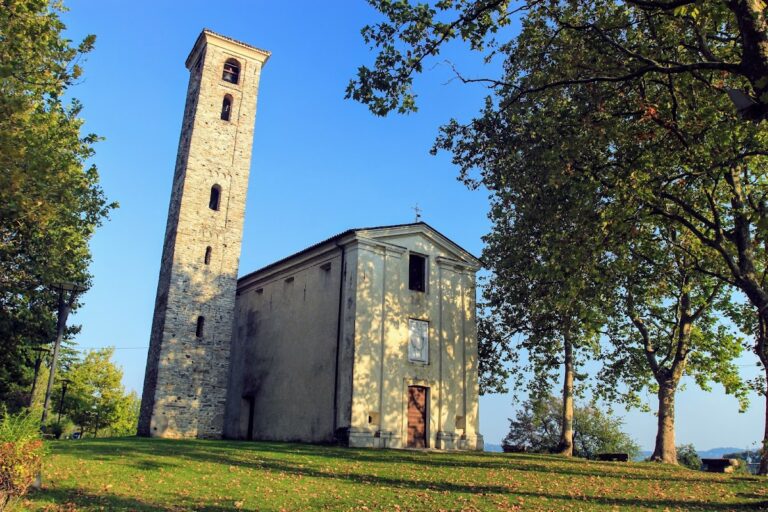
St. Peter and St. Paul’s Church is a Lombard Romanesque building constructed from large blocks of serizzo, granite, and Angera stone arranged in regular horizontal courses. Its plan has three naves divided into three bays, transept arms projecting from the side naves, and a single eastern apse at the end of the central nave. The central nave is twice as wide as the lateral naves, and this three-part organization is expressed on the facade. The surviving structure combines massive stonework with later changes to its roofs, vaults, plaster, and painted decoration.
Exterior structure
Facade and entrances
The facade originally had a simple gabled, or hut-shaped, outline. The raising of the central nave in the seventeenth century created the present arrangement of sloping roofs and three roof levels, while plaster conceals the raised portion. An attic-like moulding runs along the base of the exterior walls. The facade has a central oculus, two single-lancet windows in its lateral sections, and two doorways consisting of a large central entrance and a smaller adjoining opening. The windows have splayed openings. On the south side, a richly decorated portal stands between two single-lancet windows and serves as the principal entrance.
Transept and eastern apse
The transept contains two low single-lancet windows and a central oculus. Its north wall is plain and has no windows. At the east end, the apse is enclosed by the transept and divided into three sections by two half-pedestals. Each section contains a single splayed lancet window with an arch and surrounds made from Angera stone. The central window is larger and more elaborate than the other two.
The north exterior wall also contains a weathered stone bearing a partially legible Roman inscription that includes the name Minerva. Set into the later Christian building, the stone provides a tangible marker of the transition from the earlier sanctuary to the church.
Interior and apse decoration
Naves and transept
Inside, square pillars divide the three naves. The pillars vary in form, and semi-columns rising from their capitals support the seventeenth-century vaults. A broad cross-vault covers the centre of the transept, the only part of the church that was originally vaulted. This feature emphasizes the transept as a liturgical focal point within the building’s otherwise clearly organized nave-and-apse plan.
Eastern apse frescoes
The eastern apse has an ogival basin containing heavily layered and damaged frescoes, many dating from the fifteenth century or earlier. Differences in plaster thickness reveal successive painting campaigns, although the original compositions cannot always be identified securely. The upper right of the central window contains a Crucifixion with a partially legible Roman-numeral date interpreted as 1368. The Besozzi golden-eagle coat of arms appears beside the cross. Dark, sharply outlined figures are accompanied by decorative details in the vestments and in the rays around the aureoles of angels and saints.
Above the arch leading into the presbytery is a Gothic-style Crucifixion attributed to the Master of the Fissiraga Tomb. Mary and John stand beside Christ, while angels collect his blood in a chalice and other angels gather around the cross. To the left of the central apse window, another fresco shows the Madonna enthroned with the Child and Saint Peter. The throne incorporates Gothic turrets and pinnacles and resembles a sacred building. The painting is in precarious condition, with many graphic details lost.
Beneath the apse Crucifixion survives a fragmentary older fresco, probably from the late thirteenth or early fourteenth century. Saint Peter holds keys and a book, John the Baptist wears skins, and a symbol of the Angel of God appears in the composition. The thinner plaster indicates that this painting predates those above it. Beneath two saints in the lower band of the left arch, a fragment of Ambrose preserves part of the face, aureole, and three scourges.
The lower apse paintings are severely damaged, with a large fracture, extensive colour loss, and reworked decorative borders. They may date from the late fifteenth or early sixteenth century and may have shown paired saints, including Saint Stephen, Saint Victor, Saint Sebastian, Saint Anthony, and a bishop. Saint Sebastian holds two darts rather than being shown pierced by arrows.
The central apse basin is dominated by a large Christ in Majesty, an image of Christ presented as supreme ruler and judge. He raises his right hand in blessing and holds a book bearing the inscription “EGO SUM LUX MUNDI VIA VERITAS ET VITA.” Rows of angels surround him. Some hold thuribles, some carry banners of the Resurrection, and others play small organs, a tambourine, flute, harps, rebec, lute, and psaltery. Loss of the lowest angelic register makes the complete meaning of the composition difficult to assess.
Pairs of Apostles are arranged beneath the basin and beside the Crucifixion. Some sections were damaged during restoration, including the lower part of the figure beside the central window. The figures stand against a landscape background that may include wave-like reflections of a lake. The cycle probably dates from around 1500. Above the lateral apse windows are half-length male and female portraits in profile, wearing fifteenth-century headgear and framed by suspended white drapery. Faint painted outlines remain below the windows, while their colour has disappeared.
Southern nave paintings
Saints’ figures
Restoration in 1963 and 1964 revealed a group of saints’ figures in the southern nave. They were probably associated with the former altar of Saint Stephen. The figures had been partly destroyed and concealed behind a brick wall when the altar of the Immaculate Conception was installed in 1716. One surviving figure wears a dalmatic, identifying Saint Stephen, while another nearly complete figure may represent Paul.
Passion cycle
The southern wall beside the Saint Sebastian altar contains a thirteen-part fresco cycle of the Passion of Christ. It follows the events celebrated during Holy Week, from Christ’s entry into Jerusalem to the Harrowing of Hell. The scenes show the Triumphal Entry, Last Supper, Foot Washing, Agony in the Garden, Taking of Christ, Sanhedrin trial, Christ before Pilate, Flagellation, Journey to Calvary, Crucifixion, Lamentation, Resurrection, and Harrowing of Hell.
The cycle is in precarious condition because of moisture, damaged masonry, and thin plaster. Six upper paintings were detached in 1963 because of moisture damage. Five were restored and returned to their original positions, while the sixth is no longer visible. The lower paintings retain more of their surface but show colour loss, damp patches, and retouching.
Individual scenes preserve distinctive details. In the Foot Washing, John, rather than Peter, is identified as the apostle kneeling before Christ. The Taking of Christ includes Judas kissing Jesus and a soldier carrying a torch. In the scene before Pilate, Christ is bound beneath a canopy. The Flagellation shows him tied to a column between two torturers wearing fifteenth-century dress, while the Journey to Calvary remains relatively bright.
The Crucifixion occupies more than twice the space of the other scenes and includes the Lombard motif of an angel and a demon receiving the souls of the two robbers. The Lamentation is arranged like a bas-relief, and the Resurrection emphasizes Christ’s vertical figure. An inscription above the Harrowing of Hell is partly illegible, but it identifies a canon associated with Besozzo and names Abbondio of Milan as the painter.
Nearby sites