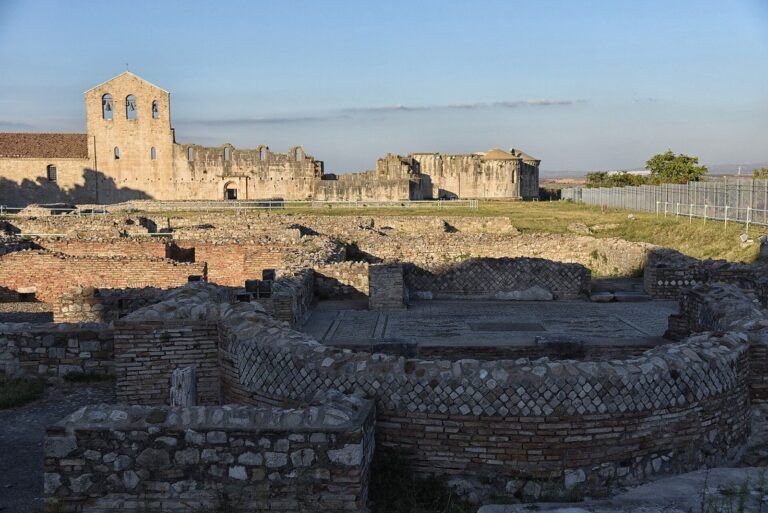
Riparo Ranaldi: A Prehistoric Rock Shelter in Italy
Site at a Glance
- Popularity
- Very Low
- Country
- Italy
- Primary era
- Stone Age
- Eras represented
- Stone Age
- Civilizations
- Unclassified
- Site type
- Civic
- Remains
- Rock Art
On this page13 sections
History
Riparo Ranaldi is a prehistoric rock shelter in Carpini, within the municipality of Filiano in Basilicata, Italy. Its paintings are usually assigned to the Mesolithic, a prehistoric period between the Paleolithic and Neolithic, although their date remains debated. The site is also classified more broadly as Paleolithic–Mesolithic or Neolithic.
Discovery and investigation
Local shepherds knew the shelter before archaeologist Francesco Ranaldi began investigating it in 1962, after resident Francesco Verrastro drew his attention to the site. Ranaldi’s work from 1962 to 1964 established its archaeological importance. The shelter was named for him in 1965 in recognition of his role in its discovery. It is also locally called Tuppo dei Sassi, a name linked to an incorrect location: the shelter is in Serra Pisconi.
The discovery became public in 1966. Franco Biancofiore had joined the research and published early findings in 1965, with particular attention to the paintings. In the summer of 1971, Ranaldi and Edoardo Borzatti von Lowenstern excavated at the invitation of Dinu Adamesteanu, then superintendent of antiquities in Basilicata. Their trench reached four metres and produced stone tools and manufacturing debris. Work ended when large sandstone blocks made further digging unsafe because moving them could destabilize the sediment above.
Dating and interpretations of the paintings
Studies of the painted panel have continued since the 1970s, without settling its date or meaning. The images are generally considered Mesolithic. Comparisons with schematic rock art in the Iberian Peninsula have also prompted the suggestion that some human figures could belong to the Copper Age, a later prehistoric period. The available interpretations therefore remain proposals rather than a single agreed account.
Biancofiore described a hunting scene centred on people and animals, and suggested the animals, which he identified as cattle, deer and wild dogs, might be captured for domestication. He also proposed that the shelter had a ritual purpose. Ranaldi instead saw a successful hunt, with people leading animals on leashes and a deity or sorcerer ensuring the outcome. In 1990, Borzatti and Inglis suggested that the panel combined two painting episodes; they considered that deer and plant forms might represent a wooded landscape.
Affuso proposed magical or religious meanings and interpreted the large figure at the panel’s upper right as a Mother Goddess, meaning a proposed female deity understood in maternal terms. In 2018, Arcà and Bozzarelli identified male figures and five simplified deer. They associated a large, many-lobed figure, which they described as wearing a broad-brimmed hat, with ceremonial activity.
Remains
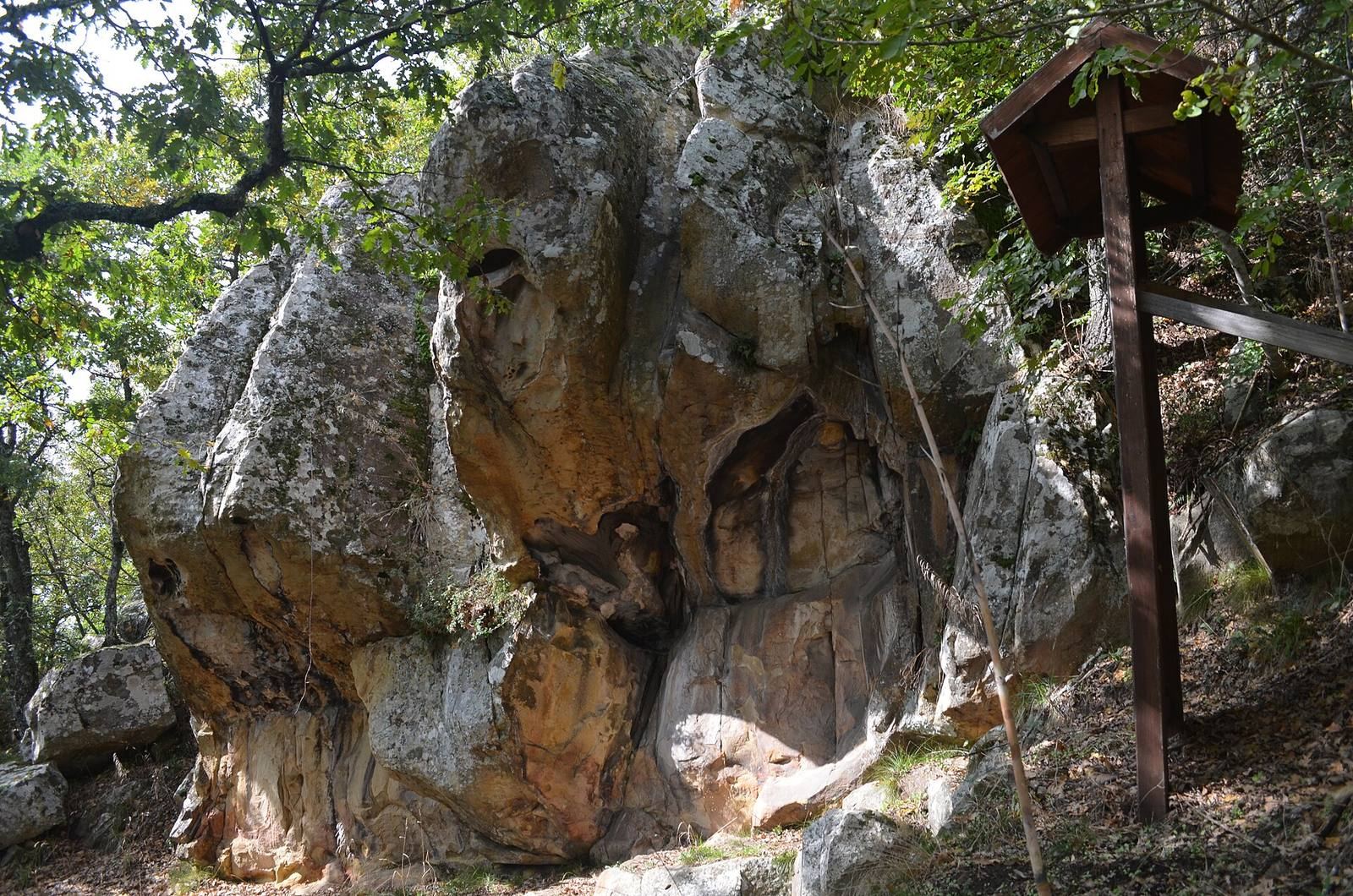
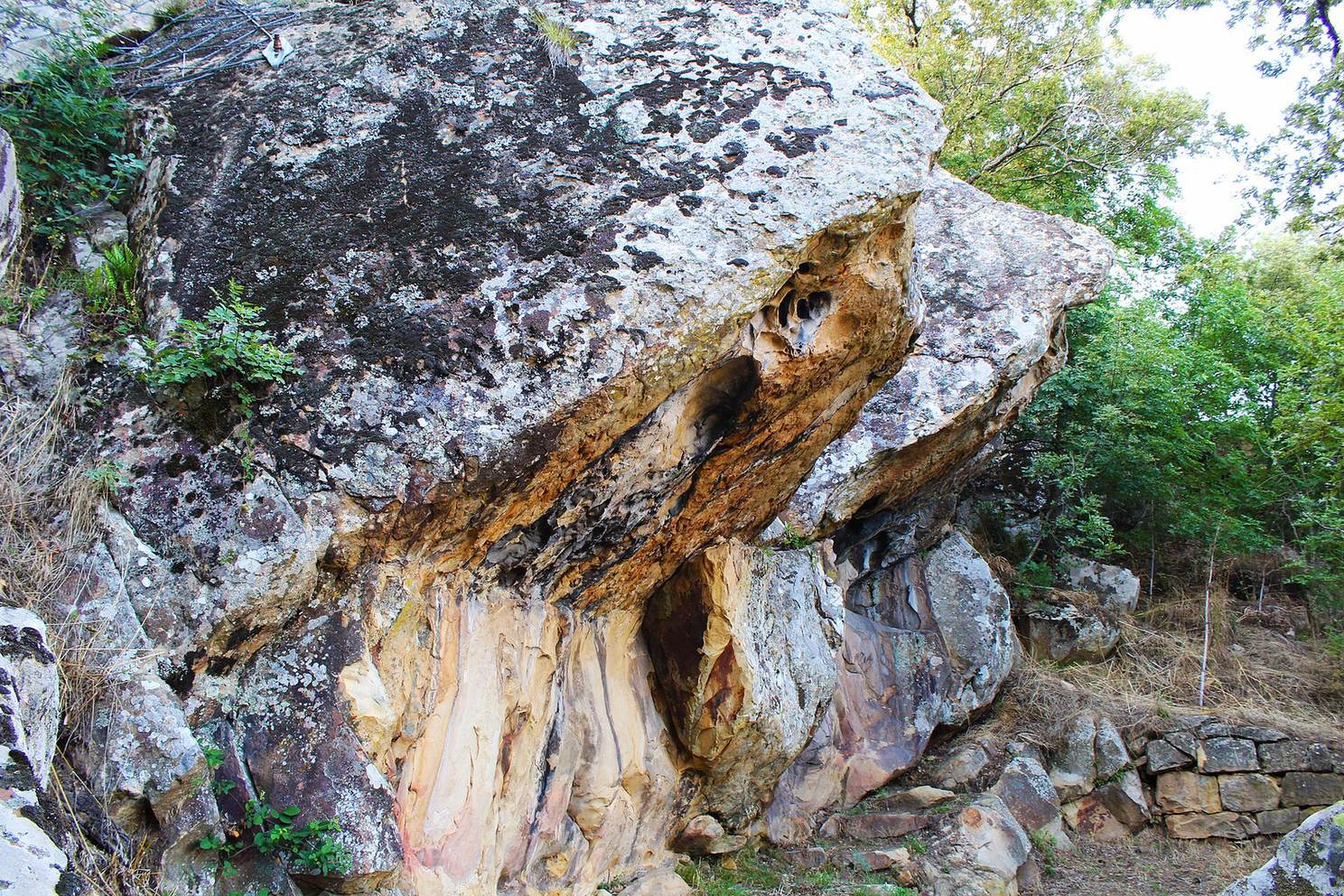
The site consists of a natural sandstone shelter and nearby rock features in the wooded Serra Pisconi area of the Lucanian Apennines, at about 879 metres above sea level. The shelter’s overhang, painted surfaces and excavated deposits preserve evidence of both natural change and human activity.
The shelter and painted panel
Shelter form
The shelter is about six metres high and has a half-arch profile. Fracturing and collapse of the sandstone created a projecting overhang that remains in place and has provided a usable space beneath it. The main paintings occupy a smooth, compact wall; smaller traces also occur on what was once the shelter’s ceiling. Rainwater has formed a mineral-rich crust on the rock, while favorable climatic conditions helped preserve the images.
Painted figures
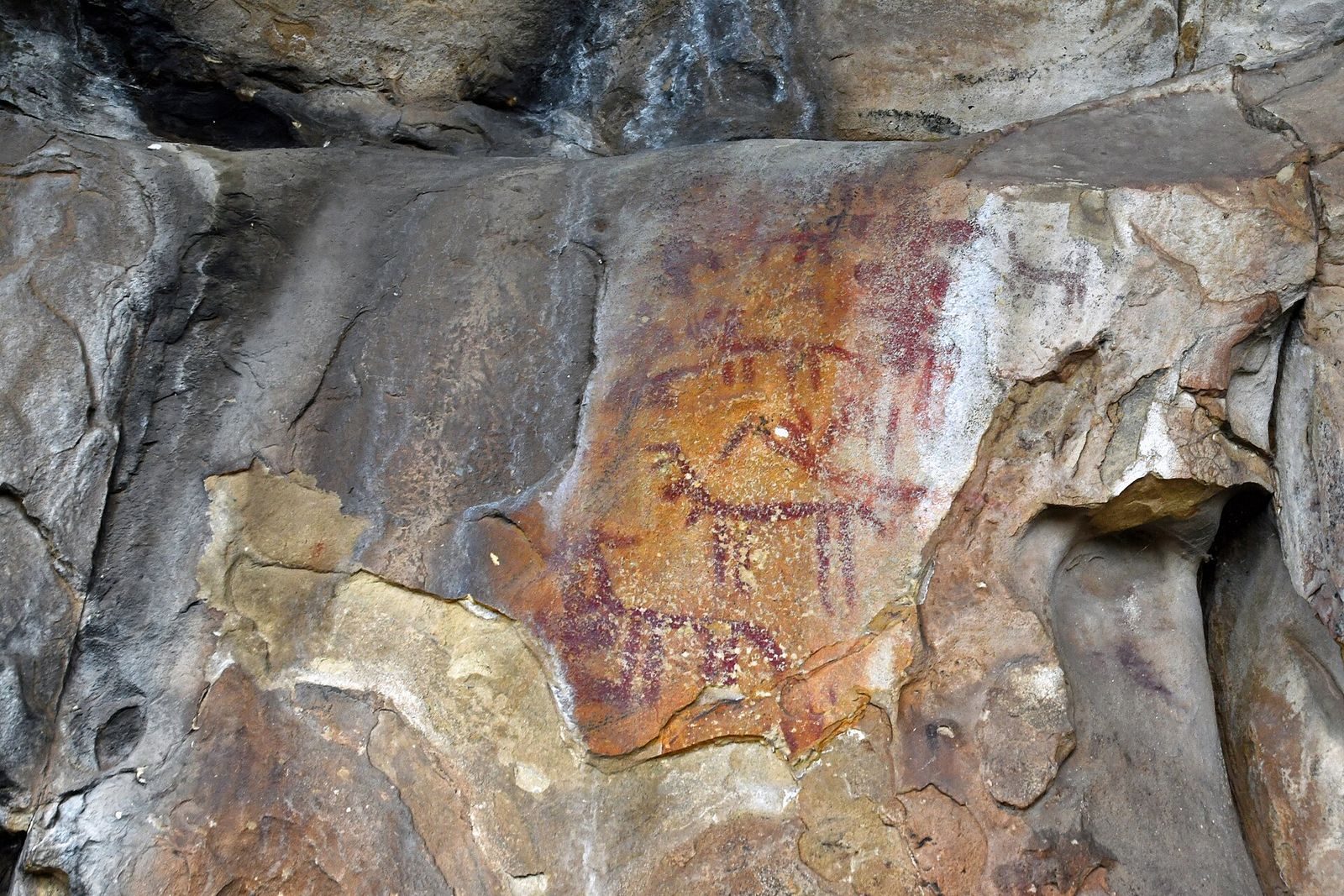
Red ochre paintings are concentrated within an area roughly 65 centimetres high and 52 centimetres wide. Fainter traces extend across the wall and have deteriorated. The pigment is mostly dark red, though some parts are lighter and faded, probably because preservation has varied. The figures, crowded together and sometimes overlapping, depict people and animals in simplified, symbolic outlines, probably made with the fingers.
Human figures have recognizable heads and limbs, though their bodies are rendered simply. The more numerous animals appear on four legs in profile, facing left. Some have branching or comb-like marks that may indicate deer antlers; others without such marks may represent wild dogs. Although individual forms are separated on the rock, they have been interpreted as remnants of a larger panel broken up by rockfall and weathering. On this interpretation, some images may also have disappeared.
Excavated deposits and finds
Sediment layers
The 1971 excavation distinguished seven sediment units. They included white sand created as the sandstone fractured through repeated temperature changes; compact gray-blue or green clay stained reddish by iron and showing water action; gray sand; sparse gravel produced by rock breakdown; fallen blocks in pale sediment; black sediment containing large stones; and dusty soil rich in stones. Taken together, the deposits indicate substantial climatic change over time.
Stone tools
The excavation recovered about 300 flint tools and fragments, mostly made from light-colored, poor-quality flint. Many are very small, and geometric forms are common. These characteristics led Borzatti to propose a Mesolithic date for the stone-tool assemblage.
Other sandstone features
Slab above the shelter
A triangular sandstone slab lies above the shelter. Its base measures 4.10 by 3.50 metres, and it is about 70 centimetres thick. A fissure around its base led Ranaldi to suggest that natural forces had shifted it from an upright position. When its lower face was uncovered during local work on a stone track for collecting firewood, the upper surface was covered with moss and lichens.
Ranaldi interpreted marks on the slab as a prehistoric hunting scene, including a person with spears and two deer. A study in 2002 concluded instead that the marks are fossil traces of activity by marine invertebrates, not images carved by people.
Sandstone boulder below the shelter
A roughly pyramidal sandstone boulder stands in dense woodland below the shelter. Its rounded upper surface bears incisions with a gray patina, alongside patches of lichen and moss. On the southwest face, one circular-looking mark measures about 70 centimetres across, though depressions and fractures interrupt its outline. A separate group of lines and curves spans about 36 centimetres. Ranaldi considered this second group more abstract than symbolic.
Suggested readings of the lines include an axe or dagger, as well as a human figure. Under the latter interpretation, a rectangular shape represents the head and neck, with the arms only suggested. A nearby circle might depict a hut or enclosure, while two parallel lines could mark its entrance.