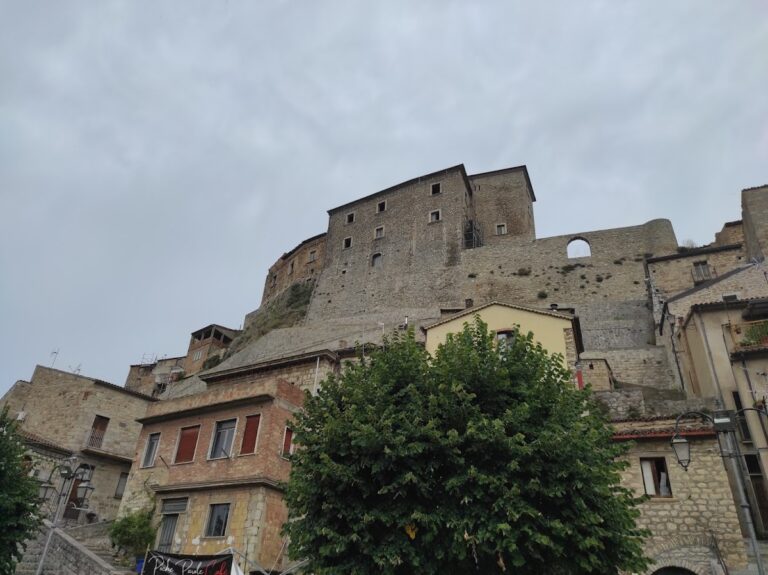
Venosa Cathedral: A Renaissance and Late-Gothic Co-Cathedral in Italy


Site at a Glance
- Rating
- 4.4
- Popularity
- Low
- Country
- Italy
- Primary era
- Medieval
- External website
- Open
- Eras represented
- Medieval, Early Modern
- Civilizations
- Kingdom of Naples, Spanish
- Site type
- Religious
- Remains
- Cathedral
On this page10 sections
History
Ducal foundation and construction
Venosa Cathedral, also known as the Cathedral of Saint Andrew, is a Roman Catholic church in Venosa, Italy. It is a Renaissance monument with predominantly late-Gothic architecture, built between 1470 and 1502 during the urban transformation directed by Duke Pirro del Balzo.
After receiving permission from the bishop to demolish the old cathedral and construct a castle at the city’s most vulnerable point, Pirro del Balzo planned a new cathedral for Venosa. The castle and cathedral project required the destruction of the adjoining square, shops, houses, and the Church of San Basilio. The new building was completed in 1502, but its consecration took place on 12 March 1531.
An inscription on the facade refers to Cola di Conza and places his presence at the erection of the monument in 1512. The cathedral initially served as the episcopal seat of the Diocese of Venosa.
Bell tower and later ecclesiastical role
The bell tower was built in stages over more than a century. Bishop Rodolfo di Tussignagno ordered its construction in 1589, Andrea Perbenedetti continued the work in 1614, and the tower was completed in 1714.
Since 1986, the church has been a co-cathedral of the Diocese of Melfi-Rapolla-Venosa. A co-cathedral is a cathedral that shares the seat or title of a diocese with another cathedral.
The burial of Maria Donata Orsini
The crypt holds the tomb of Maria Donata Orsini, wife of Pirro del Balzo. Her dowry brought Venosa to Pirro del Balzo in 1453. Maria Donata died in Venosa in 1485, aged 54, and was first buried in the Church of Santa Maria della Pace outside the city walls.
About a century later, her descendants moved her remains and marble monument to the cathedral. When the tomb was opened, friars reportedly found her body and clothing intact. Worshippers were then permitted to touch her remains in the hope of receiving miraculous cures.
Remains
Exterior and tower
The cathedral rises to a stated height of 42 metres and combines late-Gothic vertical forms with Renaissance elements. Its lower section is composed of three stacked parallelepipeds, geometric volumes with six parallelogram faces. The lowest has a square base measuring 8.20 metres on each side and reaches 23.30 metres in height.
Above this lower structure are two superimposed octagonal prisms supporting a pyramidal spire 10 metres high. The facade is faced with worked stone. Its portal has an architrave, the horizontal member above an opening, bearing the inscription connected with Cola di Conza and the work of 1512.
Interior arrangement
The interior is arranged on two levels and contains three naves, the main longitudinal spaces of the church. Pointed arches divide the naves. The central nave reaches the transept, the crosswise section of the church, through two large arches, while the view beyond ends at a lunette-shaped apse, a curved half-moon-like terminating space.
Chapel of the Sacrament
Several chapels occupy the side naves. The Chapel of the Sacrament, in the right-hand nave, dates from 1520. Its arch is decorated with putti, small childlike figures used as artistic motifs, together with candelabra and festoons.
Paintings and surviving artwork
The church contains The Martyrdom of Saint Felix by Carlo Maratta, Christ and Mary Magdalene by Nicola Marangelli, and The Communion of the Apostles by an unidentified painter. The Adoration of the Magi by Simone da Firenze survives only as a small fragment.
Crypt and tomb monument
The crypt, a chamber within or beneath a church used for burials or the preservation of sacred remains, contains the marble tomb monument of Maria Donata Orsini. Its presence preserves the memory of the noblewoman whose marriage connection brought Venosa to Pirro del Balzo and whose remains were later transferred into the cathedral.