Rietberg Castle: A Medieval Hill Castle in Switzerland


Site at a Glance
- Rating
- 4.7
- Popularity
- Very Low
- Country
- Switzerland
- Primary era
- Medieval
- External website
- Open
- Eras represented
- Medieval, Early Modern, Modern
- Civilizations
- Holy Roman Empire
- Site type
- Military
- Remains
- Castle
On this page15 sections
History
Rietberg Castle is a medieval hill castle above Pratval in Switzerland, with its oldest surviving core probably built around 1225 during the first half of the thirteenth century. It became the seat of the Lords of Rietberg and later a residence administered for the Bishop of Chur. The complex is now privately owned and protected as a Swiss heritage site of national significance.
The Lords of Rietberg
The Lords of Rietberg were recorded in 1286 as vassals of the Lords of Sax-Misox. They later became ministeriales, medieval service nobles with administrative, military, or judicial duties for a superior lord, in this case the Bishop of Chur. Their castle and estates were linked with territories in Domleschg, Schams, Chur, and Oberhalbstein. Members of the family also represented the Bishop of Chur in Oberhalbstein and Oberengadin.
In 1320, Johann von Rietberg arranged for his wife, Berta von Rhäzüns, to hold the castle until her death. He subsequently transferred Rietberg, another fortress, and his fiefs to his relatives, the Lords of Landenberg. After Johann died in 1349, Hermann von Landenberg could not enforce his inheritance claim and renounced it in favor of the Bishop of Chur in 1352. The Lords of Rhäzüns and Lumerins continued to claim the castle and its estates, and the dispute ended in 1388 after the bishop paid them.
Episcopal administration and changing ownership
The Bishop of Chur appointed castellans to administer Rietberg. Eglolf von Juvalt is recorded there in 1384. The bishop also repeatedly mortgaged the castle, its estates, and the office of vogt, an official responsible for managing territory or an estate on behalf of a higher lord. These arrangements involved wealthy families and cathedral institutions, including Jakob von Castelmur in 1398, Conradin Rambach and the cathedral chapter in 1409, Bartolomäus Planta in 1426, Hans Wellenberg in 1447, and Hans Ringg in 1450. Ringg’s claim passed to his son Wilhelm in 1483.
After further transfers, Rietberg passed to Anton von Travers around 1530 and to Hercules von Salis-Soglio in 1554. In 1617, the estate was divided between the Salis family and Pompeius Planta, who was related to the Salis family by marriage.
Rietberg during the Bündner Wirren
Rietberg became involved in the Bündner Wirren, seventeenth-century conflicts in Graubünden that brought Catholic and Protestant factions into conflict alongside competing French, Spanish, and Habsburg interests. Pompeius Planta, a Graubünden aristocrat and Catholic political leader, occupied the castle as a prominent member of the pro-Habsburg faction in the Three Leagues, the political federation that governed much of Graubünden before the modern Swiss canton was created.
In 1618, Jörg Jenatsch became a leader of the opposing anti-Habsburg faction. Jenatsch was then a cleric and military-political leader of the anti-Habsburg Protestant side. The court at Thusis outlawed several pro-Habsburg leaders, including Pompeius Planta and his brother Rudolf Planta. Armed groups attacked and arrested other members of the faction, and their estates were burned.
In 1620, Catholic forces killed between 500 and 600 Protestants in the Valtellina valley. Planta returned to Rietberg, where anti-Habsburg troops led by Jenatsch assembled on 24 February 1621. They attacked the castle the following morning, and Jenatsch killed Planta with an axe as Planta attempted to escape. A later tradition says that Planta hid in a chimney and was found by a dog.
Jenatsch later converted to Catholicism. On 24 January 1639, an unknown attacker dressed as a bear killed him during Carnival in Chur. The attacker may have been a son of Pompeius Planta or an assassin hired by local aristocrats. A legend identifies the weapon as the axe used to kill Planta. The killing of Planta later became the subject of Conrad Ferdinand Meyer’s novella Jürg Jenatsch.
From divided estate to private ownership
In 1664, the Salis share was sold to Colonel Christoph von Rosenroll of Thusis for 9,000 gulden. His son sold the half-share to the Buol family in 1670. In 1758, the Buol-Schauenstein family acquired the Planta share, ending the division of ownership.
Johann von Buol-Schauenstein sold the castle to his brother, Karl Rudolf, Prince-Bishop of Chur, in 1798. Karl Rudolf planned to establish a seminary there, but the French invasion of Switzerland and the abolition of the Prince-Bishops’ authority under the Helvetic Republic prevented the project. Ownership changed repeatedly during the nineteenth century, including transfers to Countess Emilie von Travers, the Cadonau family, Colonel von Bergamin, and Christian Casparis. The Casparis family acquired the castle in 1822, and marriage transferred it in 1917 to the Planta-Casparis family. The Bürge and Hämmerle families now own it privately.
Remains
Castle setting and defensive core
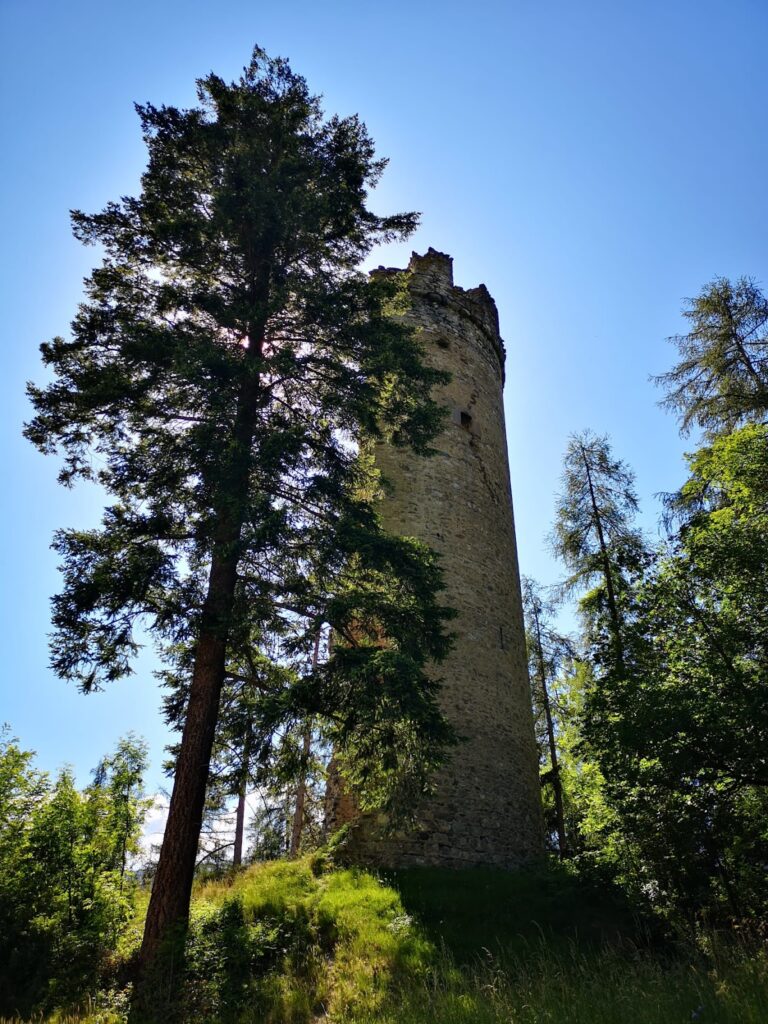
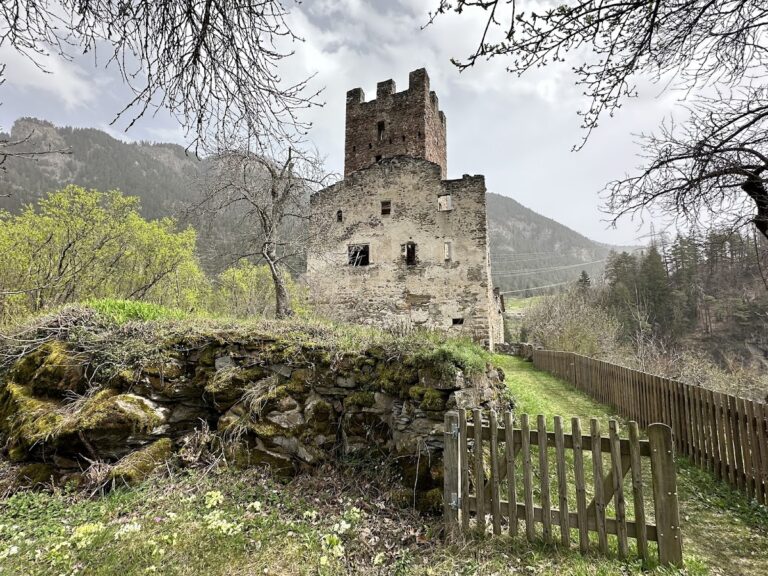
Rietberg Castle stands at about 723 meters above sea level above Pratval, at the edge of the Rietbach gorge and near the boundary with Rodels. The complex developed around a rectangular central tower. Its base has walls up to 2.5 meters thick and encloses the foundations of a probable earlier tower from the twelfth century. The present castle largely reflects seventeenth-century rebuilding, while medieval masonry survives within later structures.
Central tower
The tower’s original high entrance was probably on the north side of the third story. Above the fourth story stood a substantial defensive platform made from heavy beams. Larger windows and doors were opened during the post-medieval period. Late-seventeenth-century remodeling added the characteristic bull’s-eye windows, small round or oval openings used here as architectural features. The crenellated crown, a defensive parapet with alternating raised sections and openings, was infilled on three sides during the eighteenth century. The current roof dates from the twentieth century.
Ring wall and entrance
A crenellated ring wall was added during the seventeenth century. The later wall on the south side has an entrance gate dated 1792. A neck ditch on the northeast side was later covered by earth fill. The surviving enclosure forms part of the defensive framework around the tower, residential buildings, courtyard, and associated structures.
Residential buildings and courtyard
Residential wings
Two residential buildings with medieval foundations flank the tower on the north. They were completely rebuilt during the seventeenth and eighteenth centuries, although parts of their masonry may remain, particularly in the northern outer wall. A building phase is marked by the date 1601 on the Planta and Jecklin alliance coat of arms in the first residential story. The vaulted cellars and a living room on the third story probably belong to the same period.
Cistern and round tower
A medieval cistern lies in the courtyard northeast of the central tower. An underground passage from the residential wing provides access to it. During the seventeenth century, a round Baroque tower was built over the cistern, making it a distinct feature of the courtyard. Former stables, residential wings, the central tower, ring-wall remains, and other medieval masonry incorporated into later buildings complete the surviving complex.
Later use and surviving habitat
Adapted buildings
The former knight’s hall was renovated in 2018 and now provides guest accommodation. Former tenant houses and converted stables are inhabited, while the former knight’s hall and a woodshed are rented as holiday apartments. These uses occupy buildings that preserve the castle’s later residential and agricultural adaptations.
Bat roost
The second-highest story of the central tower contains a room about five meters high with heavy beams. During the warm season, it shelters a colony of about 350 greater mouse-eared bats, a large European insect-eating species, as recorded in 2021. The number varies from approximately 50 to several hundred animals. The bats use the former doorway to the defensive platform to enter and leave the tower, departing in late autumn for an unknown wintering place.
Nearby sites