Richmond Castle: A Norman Fortress in North Yorkshire


Site at a Glance
- Rating
- 4.6
- Popularity
- Medium
- Country
- United Kingdom
- Primary era
- Medieval
- External website
- Open
- Eras represented
- Medieval
- Civilizations
- English, Norman
- Site type
- Military
- Remains
- Castle
On this page16 sections
History
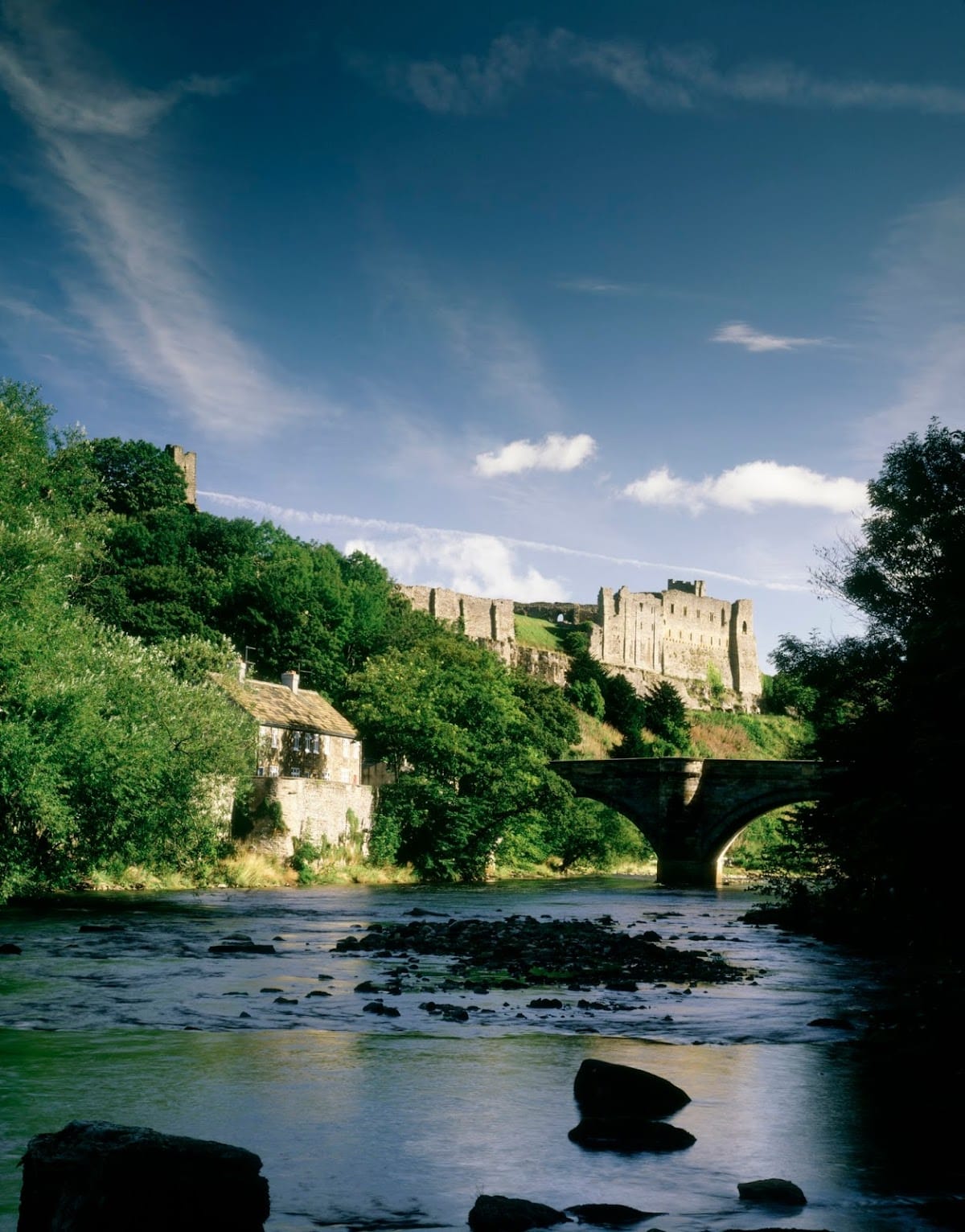
Richmond Castle is a Norman fortification in the United Kingdom, standing at Richmond in North Yorkshire above the River Swale. Construction began in 1071, after the Norman Conquest, as part of the military and political reorganisation that followed rebellion in the north of England. Its early name, Riche Mount, meant “the strong hill.”
Foundation and the Honour of Richmond
William the Conqueror distributed lands in North Yorkshire after the rebellion at York and the Harrying of the North, his campaign to suppress resistance in the region. Alan Rufus of Brittany received the borough of Richmond and began building the castle to deter further rebellion and establish a personal power base.
Alan Rufus’s estates formed the Honour of Richmond, a large feudal territory whose holder controlled lands and revenues across several counties. It eventually covered parts of eight counties and became one of the most extensive Norman estates in England. Breton dukes held the castle as Earls of Richmond, although English kings repeatedly confiscated the earldom and its properties.
Expansion under the Breton dynasty and the Crown
The Domesday Book of 1086 lists a castlery at Richmond. During the twelfth century, Alan Rufus’s great-nephew Conan IV of Brittany expanded the castle and built its keep, the principal fortified tower of a castle. Henry II seized the Earldom of Richmond in 1158 and probably completed the keep, while also strengthening the wider fortress with additional towers and a barbican, a defended outer entrance protecting access to a gate.
On 5 June 1216, during the First Barons’ War, King John ordered that Richmond Castle should be slighted if it could not be held against the rebels. The conflict, fought from 1215 to 1217, pitted John against rebellious barons supported by French forces. Slighting meant deliberately damaging a fortification so that it could no longer be effectively defended.
Henry III and Edward I later provided further expenditure for the castle. Edward I also improved the interior of the keep. By the end of the fourteenth century, Richmond Castle had ceased to function as a fortress and received no major subsequent military improvements.
Ruination and nineteenth-century revival
A survey in 1538 described the castle as partly ruined, and it was derelict by 1540. Interest in antiquities, the growth of tourism, and paintings by William Turner and other artists helped encourage repairs to the keep during the early nineteenth century. Turner, a major British landscape painter, contributed to wider interest in historic scenery and ruins through his work.
In 1855 the castle became the headquarters of the North Yorkshire Militia. A barracks block was built in the great courtyard, and Robert Baden-Powell lived at the castle from 1908 to 1910 while commanding the Northern Territorial Army. The barracks were demolished in 1931.
The castle in the First World War
During the First World War, Richmond Castle served as a base for the Non-Combatant Corps, a unit for conscientious objectors who accepted non-fighting military duties. The castle also housed men who refused military discipline and any participation in the war.
The Richmond Sixteen were sent from the castle to France, prosecuted under Field Regulations, and sentenced to death. Their sentences were commuted to ten years’ hard labour, and they were released in 1919. Their association with the castle remains part of its twentieth-century history.
Protection and local traditions
Richmond Castle is in the care of English Heritage. It is a Scheduled Monument and a Grade I listed building, designations that reflect its national historical and archaeological importance and provide legal protection against unauthorised alteration.
Local tradition links the castle with two supernatural stories. One legend says that King Arthur and his knights sleep in a cave beneath the castle and were discovered by a potter named Thompson. Another tells of a drummer boy who became lost in an underground tunnel, with ghostly drumming said to be heard around the castle.
Remains
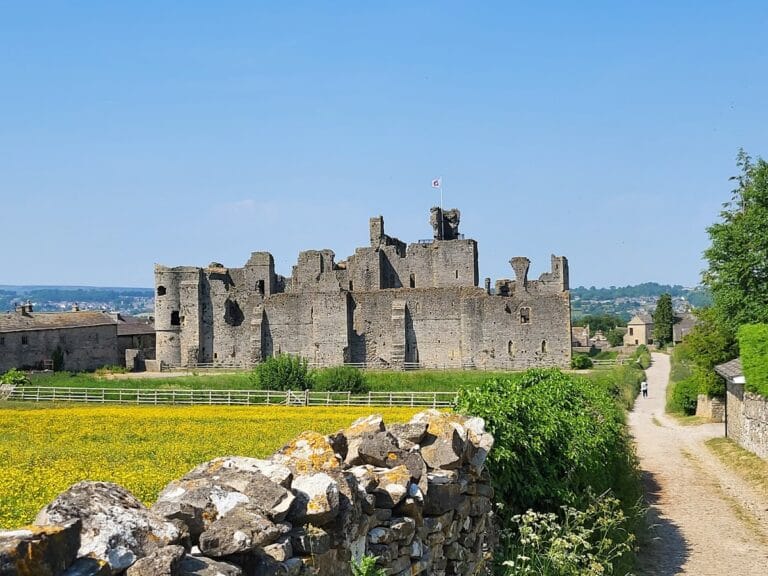
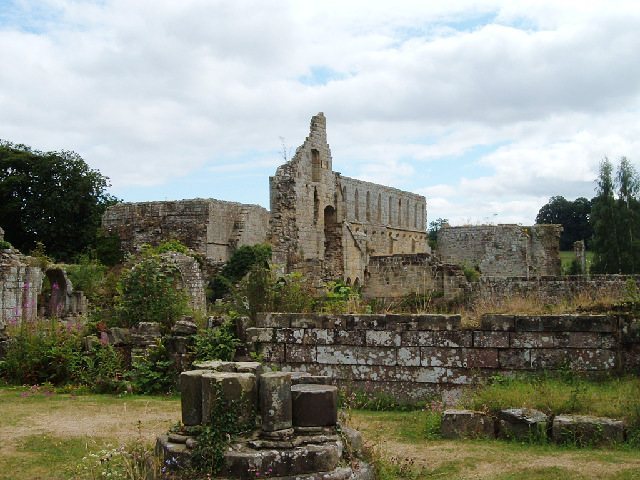
Richmond Castle survives as a partial ruin with four principal parts: a triangular main enclosure, an outer enclosure to the east, a keep at the northern corner of the main enclosure, and a smaller enclosure around the keep. Holy Trinity Church, north of the main enclosure, served as the castle chapel. Built mainly from honey-coloured sandstone, the castle is regarded as one of the best-preserved early Norman castles in England.
Keep and principal entrance
The keep
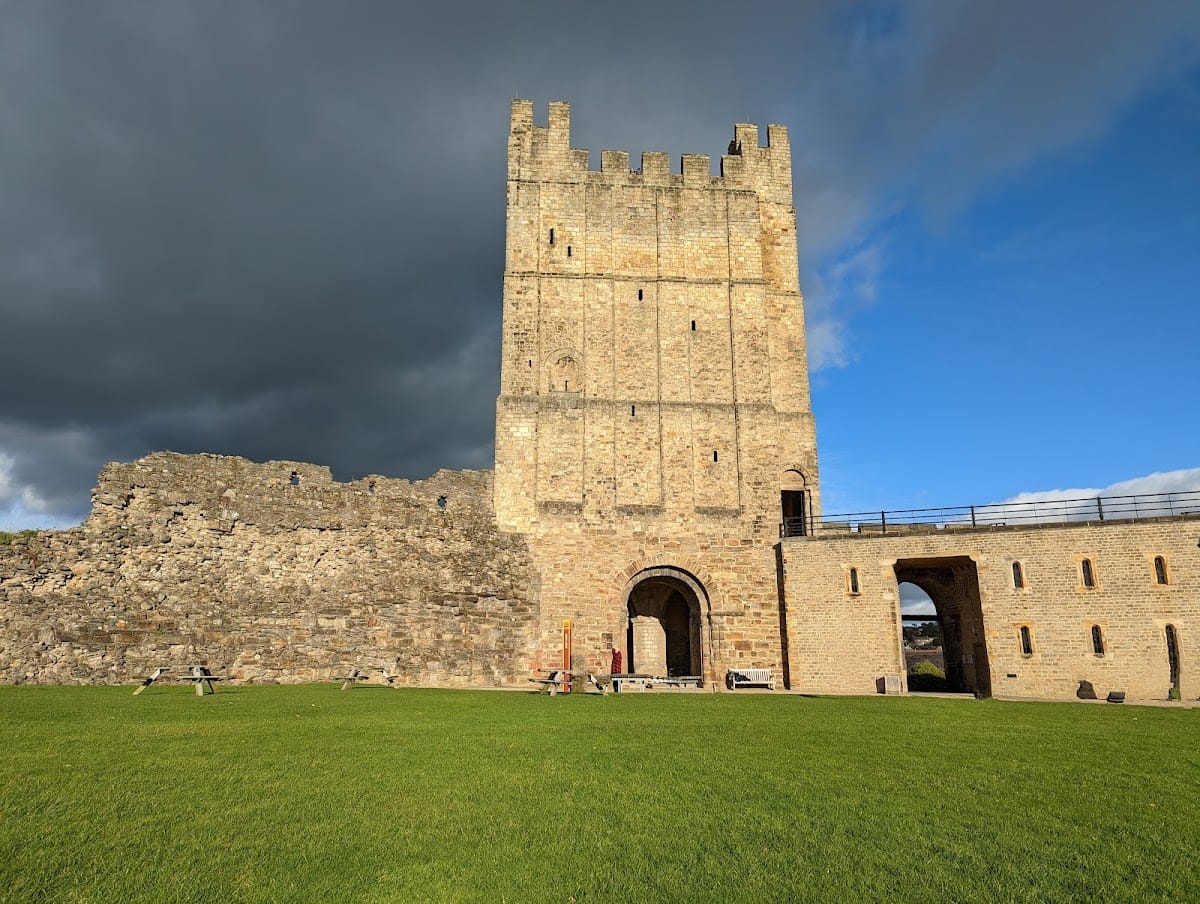
The keep rises approximately 100 feet, or 30 metres, and its walls are about 11 feet, or 3.4 metres, thick. The twelfth-century tower has a restored roof and restored floors. Its position at the northern corner of the main enclosure allowed it to dominate the castle’s internal arrangements and the approach to the principal entrance.
The original gate and later entrance
The original main gate contained an eleventh-century arch. When the twelfth-century keep was built in front of the gate, the arch was blocked and incorporated into the keep’s basement. It was reopened in the nineteenth century. The principal entrance was later moved beside the keep, where the tower overlooked and helped protect it.
Enclosures and defensive works
Main enclosure and barbican
The triangular main enclosure formed the central area of the castle, while a smaller enclosure surrounded the keep. The main wall circuit included a barbican in front of the principal gate. This created a sealed entrance space where visitors and wagons could be checked before they entered the castle proper.
The Cockpit
On the river side, the Cockpit formed a separate enclosure or bailey. It may have functioned as a garden and was overlooked by a balcony. A drawing from 1674 also suggests a longer balcony overlooking the river side of Scolland’s Hall.
Great hall and prison evidence
Scolland’s Hall
Scolland’s Hall is the castle’s great hall and is identified as a particularly notable example of Norman architecture. Its position within the castle’s historic complex is also associated with the balcony overlooking the river side of the building.
Cell block graffiti
The cell block contains approximately 2,300 examples of graffiti made by prisoners from the mid-nineteenth century to the 1970s. Some of the most historically important inscriptions were made by the Richmond Sixteen during the First World War, preserving a direct connection between the surviving prison spaces and the men’s wartime experiences.