Rhuddlan Castle: Edward I’s Fortress in Wales


Site at a Glance
- Rating
- 4.5
- Popularity
- Medium
- Country
- United Kingdom
- Primary era
- Medieval
- External website
- Open
- Eras represented
- Medieval
- Civilizations
- English, Norman
- Site type
- Military
- Remains
- Castle
On this page17 sections
History
Rhuddlan Castle is a medieval fortress in Rhuddlan, United Kingdom, built for Edward I of England between 1277 and about 1285 during the English conquest and administrative incorporation of Wales. Positioned beside the River Clwyd, it controlled an important crossing and became a base for military operations, a royal residence, and the place where Edward issued the Statute of Rhuddlan in 1284.
Early fortifications and Welsh rule
The site’s history reaches back before the stone castle. In the early tenth century, Edward the Elder of Wessex established a burh, an Anglo-Saxon fortified settlement protected by earthworks and timber, near the mouth of the River Clwyd. Its precise position remains uncertain. It may have occupied earthworks southeast of the modern town, while coastal erosion may also have affected the original site.
Around 1015, the Welsh ruler Llywelyn ap Seisyll probably established a palace known as Twthill at the earlier fortification. His son, Gruffydd ap Llywelyn, used Rhuddlan as a base for raids against Anglo-Saxon settlements at Oswestry and Wrexham. Earl Harold Godwinson captured Rhuddlan in 1063 and burned the palace.
During the Norman conquest of northern Wales, Robert of Tilleul built a motte, a raised earthwork mound supporting a fortified residence, on the site of the burned palace in 1073. He later became known as Robert of Rhuddlan. Under Robert and his cousin Hugh d’Avranches, Earl of Chester, a small English settlement developed under the castle’s protection.
Rhuddlan changed hands repeatedly during the following two centuries. Gruffydd ap Cynan, king of Gwynedd, unsuccessfully attacked it in 1075. Owain Gwynedd captured the settlement around 1140 and again in 1167 after a three-month siege. From 1175 to 1194, it served as the centre of the rule of Owain’s son, Dafydd ab Owain.
English conquest and the new castle
Except for a brief English occupation under King John between 1211 and 1213, Rhuddlan remained under Llywelyn ab Iorwerth, prince of Gwynedd. Henry III captured it during his campaign of 1241, renewed its wooden defenses, and established nearby Dyserth Castle and Deganwy Castle as English bases against Gwynedd. Llywelyn ap Gruffydd recaptured Rhuddlan in 1267.
Edward I reached Rhuddlan on or around 22 August 1277 during his first campaign against Gwynedd and moved his headquarters there on 12 September. Following the Treaty of Aberconwy, Llywelyn ap Gruffydd paid homage to Edward at Rhuddlan in November of that year. Edward then began a new stone castle northwest of the earlier Norman motte. Its construction formed part of a wider programme of English fortification and settlement in Wales.
Master Bertram prepared the initial plans, but James of Saint George, a Savoyard master mason, soon took over and probably produced the final designs. Work proceeded alongside construction at Flint Castle and continued rapidly through the early 1280s. The project cost more than £9,200. Although still unfinished, the castle resisted an attack by Dafydd ap Llywelyn in March 1282 and then served as a base for Edward’s final campaign to conquer Wales. Between 1280 and 1282, an additional system of earthwork and timber defenses was created around it.
Edward established a new borough north of the castle, separate from the older Norman town and Dominican friary. Ditches, earthworks, and a timber palisade protected the borough, while its thirteenth-century street plan continued to shape the modern town.
The Statute of Rhuddlan
Rhuddlan became an important centre of English government after the defeat of Llywelyn ap Gruffydd. In 1282, Edward’s daughter Elizabeth was born at the castle. The following year, Edward made a promise at Rhuddlan concerning his successor, Edward II, who was later born at Caernarfon. The promise held that the Welsh would receive a prince born in Wales who did not speak English.
In 1284, Edward issued the Statute of Rhuddlan at the castle. This legal and administrative settlement transferred the lands of the former Welsh princes to the English Crown and extended English royal government across much of Wales. It introduced institutions including sheriffs, constables, and bailiffs, together with English common law. Welsh law continued to operate locally until the Laws in Wales Acts of 1535 and 1542 made English common law exclusive.
Revolt, decline, and military reuse
The castle was unsuccessfully attacked during the Welsh rising led by Madog ap Llywelyn in 1294. King Richard II stopped at Rhuddlan in 1399 while travelling to Flint, where his rival Henry IV captured him. In 1400, forces led by Owain Glyndŵr, the Welsh nobleman who headed a major revolt against English rule, attacked the castle. It held out, although the town suffered heavy damage. Another attack during the Welsh rising of 1405 was also repelled.
After the Wars of the Roses, the fifteenth-century dynastic conflicts between the houses of Lancaster and York, Rhuddlan lost much of its strategic and administrative importance. The castle deteriorated during the late fifteenth and early sixteenth centuries. It was later garrisoned by Royalist troops during the English Civil War and surrendered to Parliamentary forces under General Thomas Mytton after a siege in July 1646. Parliament partially demolished it in 1648 to prevent further military use.
The castle was restored in 1944 and is now managed by Cadw, the Welsh Government’s historic-environment service. It is protected as both a Grade I listed building, a designation for exceptional architectural or historic interest, and a Scheduled Monument. Since 2024, Cadw has used the Welsh-language form Castell Rhuddlan in English-language presentation as part of an effort to standardise names in both languages.
A local legend links the castle with Erilda, a daughter of a Welsh king who was promised to Movern, a prince of southern Wales, to secure peace between their kingdoms. In the story, a demon disguised as a prince led Erilda to her father at Rhuddlan, later abducted her, and caused her death after she discovered its identity.
Remains
Rhuddlan Castle stands on a rise on the east bank of the River Clwyd, at the last ford before the river reached its mouth at the Irish Sea. In the medieval period, the Clwyd formed a natural boundary between the uplands of northern Wales and the Anglo-Saxon or English region of Cheshire. The castle is a concentric fortress, meaning that an inner defensive enclosure is surrounded by a separate outer wall. Four different types of stone were used in its construction.
Earlier earthworks
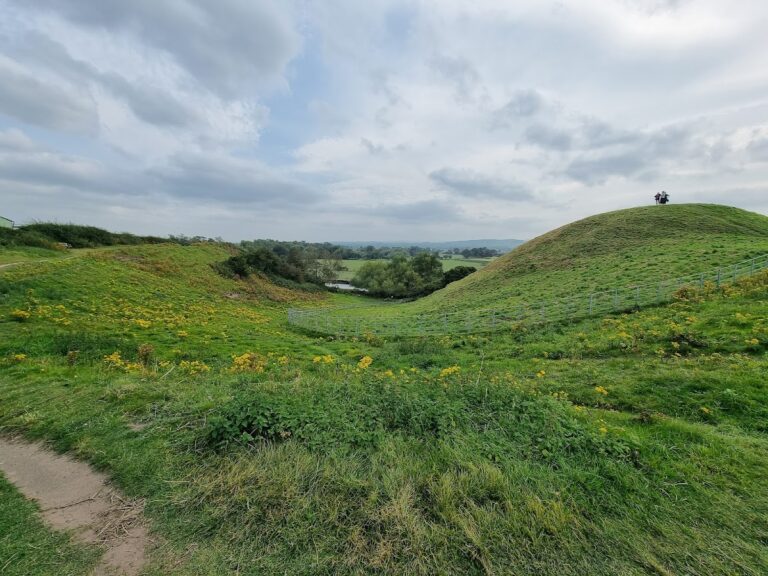
Twthill
The earlier Norman motte, known as Twthill, lies southeast of Edward I’s castle. Its mound measures about 80 metres across at the base and rises approximately 5 metres, reaching about 12 metres on the river side. The earlier fortifications and buildings were still made of timber and half-timbering in 1241. Twthill preserves the physical setting of the earlier fortified site that preceded the stone castle.
Inner and outer defenses
Inner ward
The diamond-shaped inner ward is arranged symmetrically. Its lower outer ring wall closely surrounds the inner defenses, except along the steep southwest side facing the river. The River Clwyd protected this side, while a stone-lined dry moat defended the other approaches.
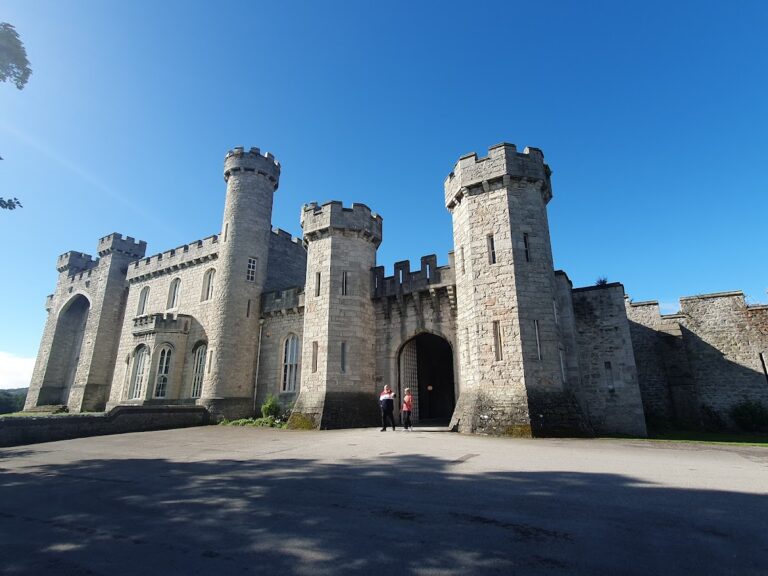
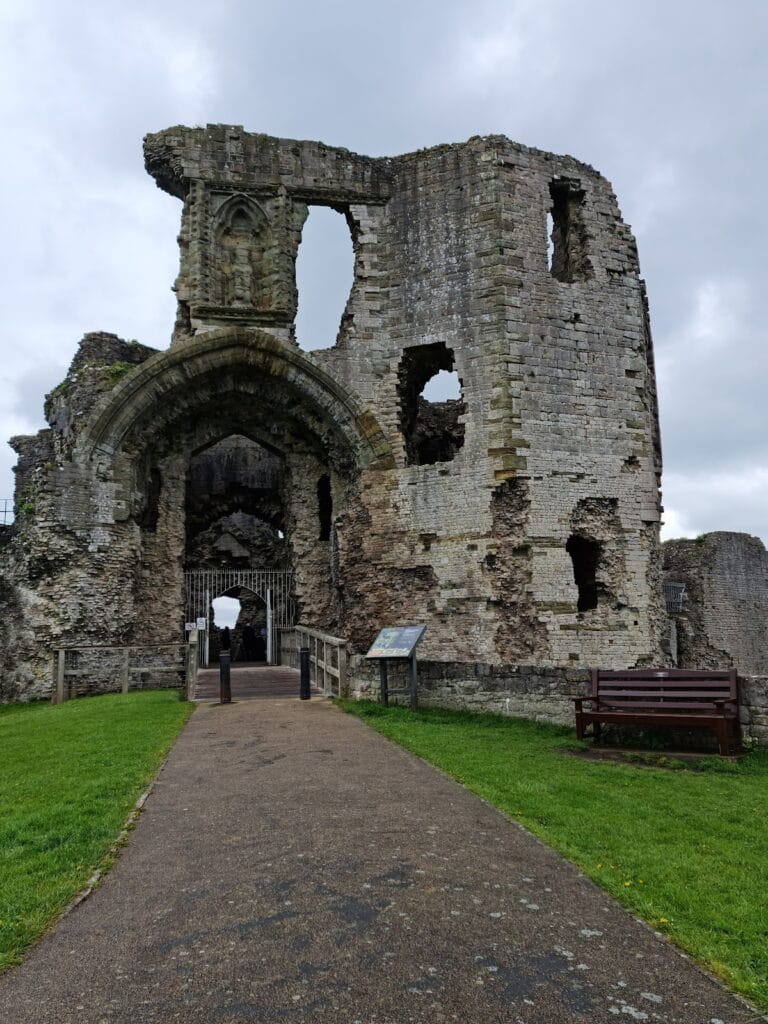
The inner ward includes defensive walls, a north tower, a south tower, and twin-towered gatehouses at the east and west corners. The gatehouses had two gateways and a portcullis but were relatively lightly defended compared with some later castles built for Edward I. The six towers of the inner ring wall rose four storeys. Each had a circular ground floor above which were three octagonal residential storeys. The south tower and western gatehouse remain comparatively well preserved, while the north tower is heavily damaged and most of the eastern gatehouse has been destroyed.
Outer ring wall
The outer ring wall is lower than the inner defenses and contains four small towers on its northwest side. These towers originally had entrances leading down to the bottom of the moat. The entrances were closed after the arrangement proved a weakness during the Welsh attack of 1282.
River defenses and landing place
A landing place on the south side enabled ships to reach and supply the castle during a siege. The river was straightened, dredged, and diverted for more than 3.5 kilometres so that seagoing vessels could travel inland through a man-made channel. Gillot’s Tower, a massive four-storey square tower, guarded the landing place.
Entrances and internal buildings
Castle entrances
The castle originally had four entrances and later had three. The main entrance lay on the northwest, where the outer gate was flanked by two small square towers. The southeast entrance, known as Friary Gate, led toward the Dominican friary and was closed around 1300. Other entrances opened on the west toward the river and on the southwest toward the landing place.
Inner ward buildings
The inner ward contained a great hall, kitchens, private apartments, and a chapel built against the inner ring wall. These buildings were probably constructed mainly with timber frames, and parts of their foundations survive within the castle.
Outer bailey
The outer bailey, an enclosed castle yard, contained service buildings such as a granary, stables, a smithy, and other workshops. Two towers have also been associated with names recorded by the eighteenth-century antiquarian Thomas Pennant, “Grain Tower” and “The King’s Tower.”
Medieval borough
The borough established north of the castle was enclosed by earthworks, ditches, and a timber palisade. Its thirteenth-century street layout remains visible in the modern town, preserving part of the planned settlement associated with Edward I’s castle-building programme.