Seedorf Reformed Church: A Medieval Parish Church in Switzerland
Site at a Glance
- Popularity
- Very Low
- Country
- Switzerland
- Primary era
- Medieval
- Eras represented
- Medieval, Early Modern, Modern
- Civilizations
- Holy Roman Empire, Swiss
- Site type
- Religious
- Remains
- Church
On this page19 sections
History
Seedorf Reformed Church is the Reformed village church in Seedorf, Switzerland. Its oldest parts date to the 12th century, when a Romanesque church, built in a medieval European style, stood on an earlier burial ground. The parish became closely connected with Frienisberg Abbey and later with the city of Bern.
Early parish and Frienisberg Abbey
A parish priest named Meffried of Seedorf appears in Frienisberg Abbey’s foundation charter of 1131. About forty years later, the charter mentions another priest, Burchard of Seedorf. These references point to a church at Seedorf before the abbey was founded. The parish included Lobsigen, Baggwil, and several hamlets, and around 1131 it formed part of an estate held by Count Udelhard of Saugern, the abbey’s founder. Udelhard probably inherited the estate from his mother, Chunizza of Burgundy, daughter of Regina of Oltigen.
In 1267, Udelhard’s grandsons, Rudolf, Sigmund, and Heinrich, Counts of Thierstein, sold the estate, its court, and the church patronage rights to the abbey for 300 marks of gold and silver. Church patronage rights gave the holder authority to present a priest and related powers over the church. Seedorf’s church was incorporated into the abbey in 1320. Frienisberg was a Cistercian monastery, belonging to a monastic order that grew from the Benedictine tradition.
Bernese administration and the parish
In 1380, Otto of Münsingen, abbot of Frienisberg, sold Seedorf’s church patronage rights to Bern. An agreement made in 1386 placed the parish villages under the judicial and tax authority of the Aarberg bailiwick, a territory administered by a bailiff. After the Reformation and the abbey’s secularization in 1528, Bern took control of the parish’s property, court rights, and church patronage. The Frienisberg bailiwick administered them until 1798. Seedorf and Meikirch together formed the “monastery court” within the lower court of Zollikofen.
Under Bern’s new constitution, Seedorf was divided into civic, church, and resident municipalities. The church continued to oversee the school until 1833. In 1856, a state school commission that included pastors and the teacher was reorganized as a school inspectorate, ending the pastors’ school duties. The present parish comprises Baggwil, Frienisberg, Frieswil, Lobsigen, Ruchwil, Dampfwil, Seedorf, Aspi, and Wiler.
Alterations and modern history
The church underwent several building campaigns, including work on its western side in the 14th century, the addition of a tower in 1640, and a major reshaping in the early 18th century in the Baroque style, a later European architectural style. The tower’s curved-gable roof was replaced in 1862. In 1924, painter Ernst Linck was commissioned to color the interior walls.
A major renovation in 1976–1977 aimed to recover the church’s earlier appearance and brought blocked Romanesque windows and medieval wall-painting fragments to light. The heraldic stained-glass panels donated by members of Bern’s government in 1716 had emphasized the church’s importance alongside Frienisberg as a bailiff’s seat. Protected as monuments, the panels were removed by the parish assembly in 2017 without the consent of the cantonal heritage authority. The assembly acted in protest against cuts to pastoral positions.
Remains
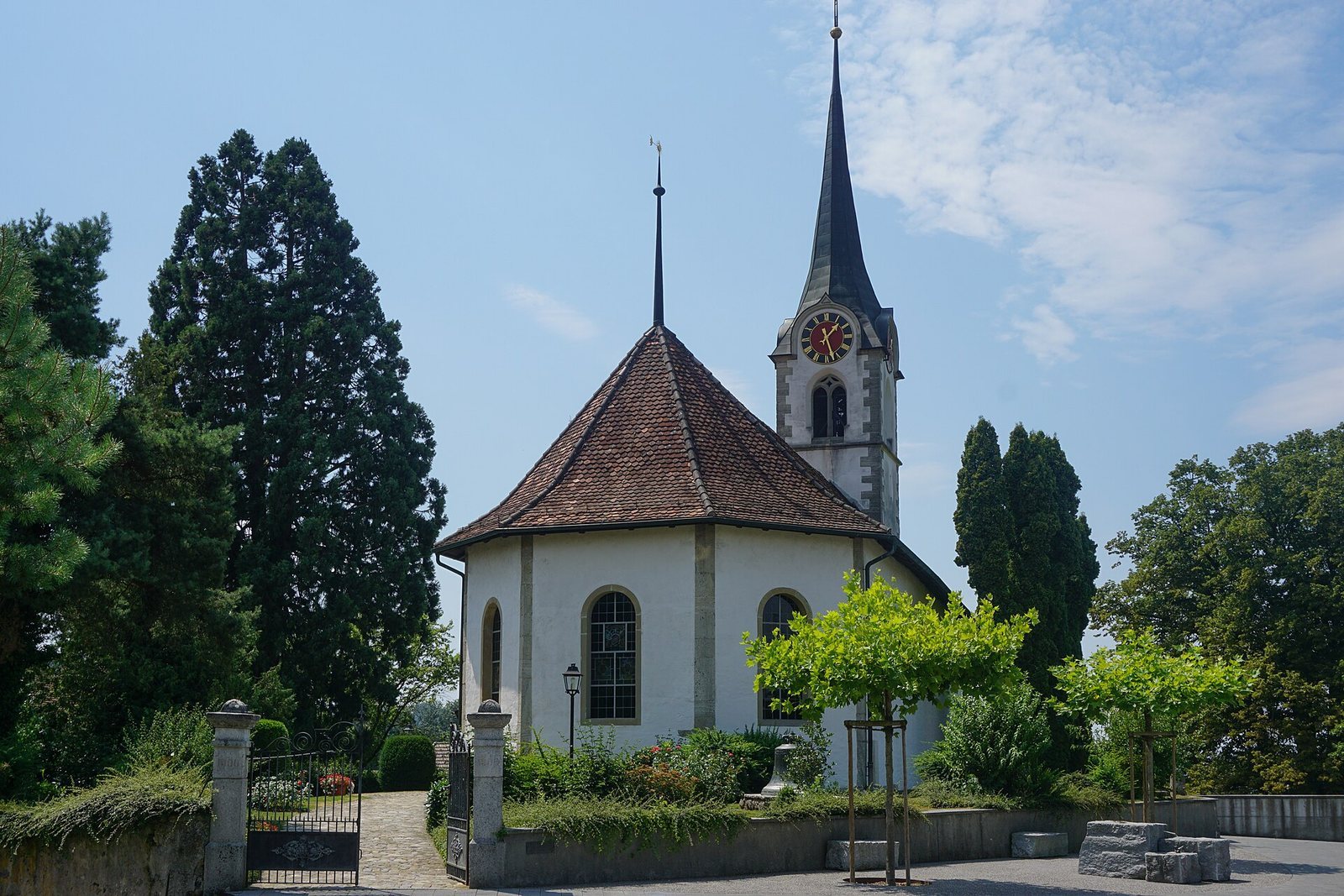
The church stands on raised ground held by retaining walls, as part of an ensemble that includes the rectory of 1547, the parish barn of 1613, and the old town hall of 1880. Its surviving fabric combines the medieval church plan with later changes to the entrances, windows, choir, and tower.
Plan, entrances, and tower
Medieval church and entrances
The first Romanesque church probably replaced a smaller building. Its nave, the main body of the church, measured 17 by 8.7 metres and opened through a round arch into a square choir measuring 5.2 metres on each side. The choir was set back 1.6 metres from each side of the nave. The original main entrance was in the west front. During the 14th-century renewal, its portal shifted south of the center; the opening is now filled with masonry, but its pointed arch remains visible beside the tower. A round-arched portal in the middle of the south wall, probably also from the 14th century, measures 1.5 metres wide and 2.4 metres high. Above the entrance made in the south wall in the 16th century are two carved coats of arms showing the Bernese bear and the date 1584. Six Romanesque windows survive, two on the north side and four on the south.
Baroque remodelling
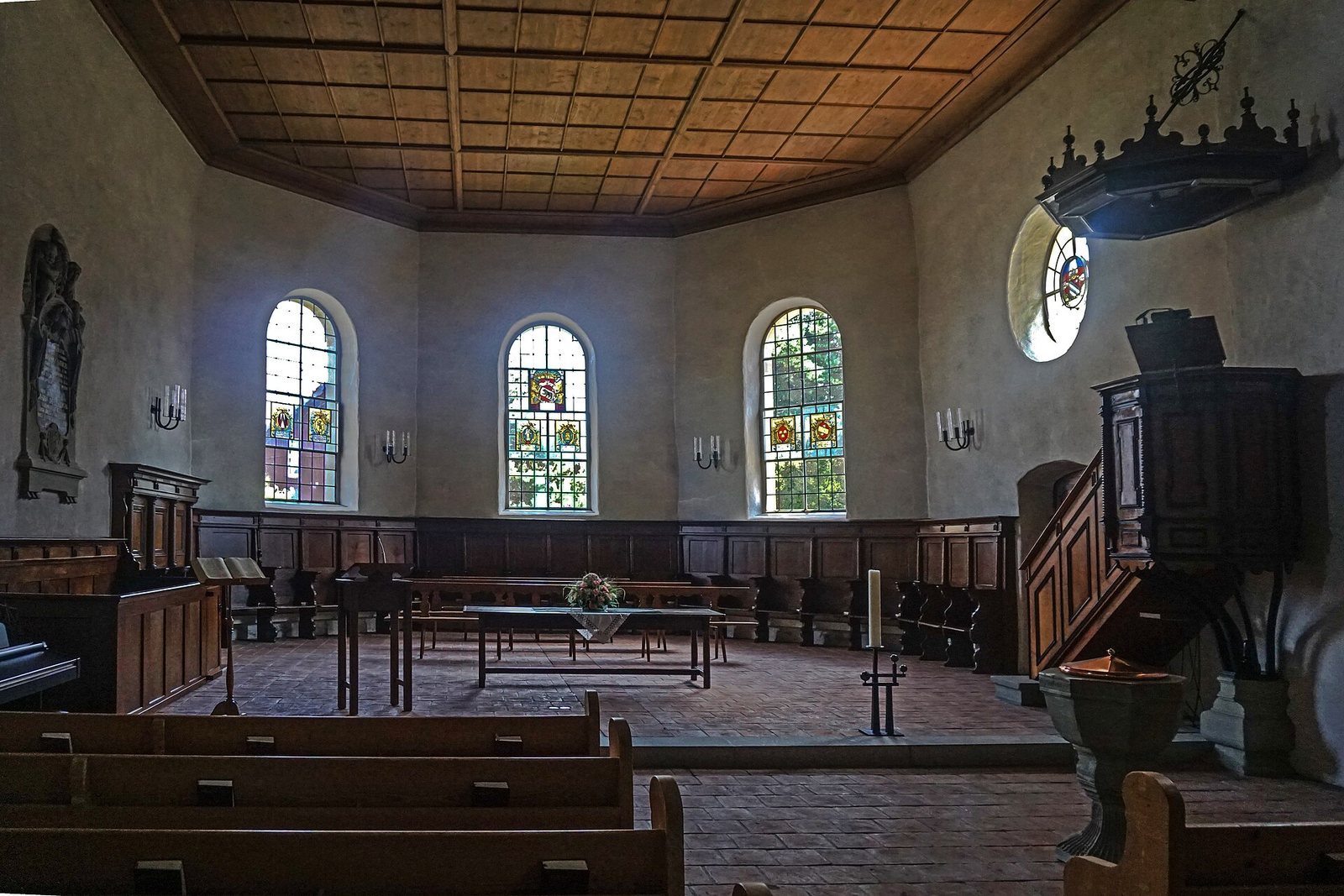
In the early 18th century, the Romanesque high windows above the main roofline were blocked and two large windows with shallow-curved arches were added. Another entrance was made on the south side beside the stairs to the pulpit, leading toward the choir, and round windows were cut above the two newer doors. The choir was reshaped as an octagon, with three tall windows, and brought to the same width and height as the nave. Builders opened the wall between the two spaces and removed the separating arch. The ceiling took on a many-sided form. Floral decoration survives around Romanesque windows and door surrounds.
West tower
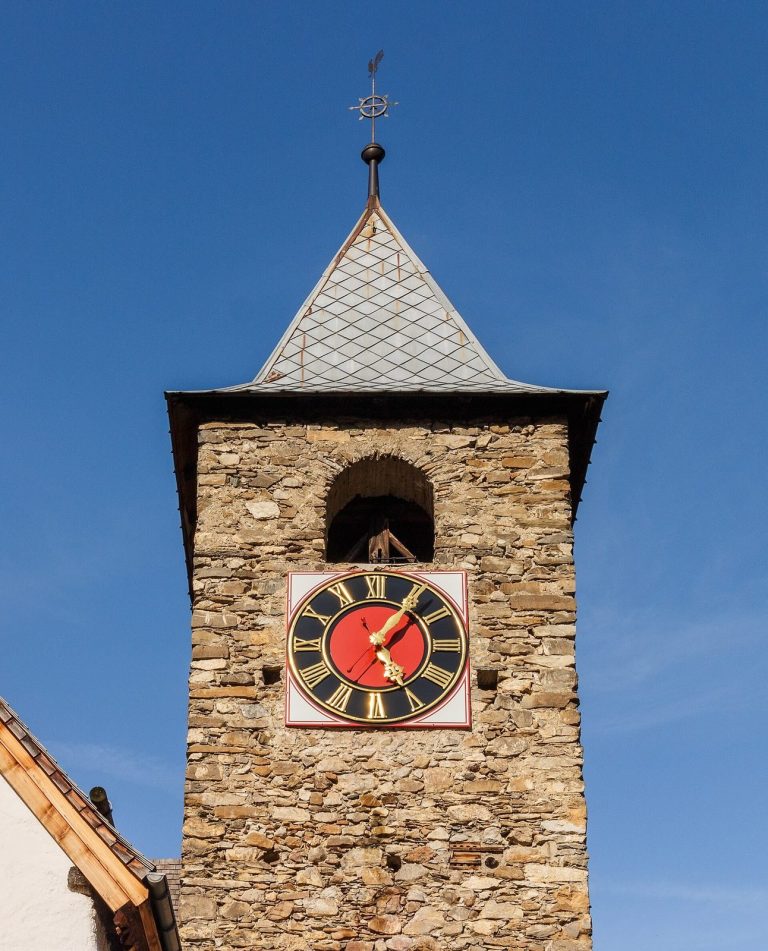
The 37-metre tower, built of shell sandstone in 1640, stands against the west wall of the nave. Its stone may have come from nearby Schallenberg at Allenwil. The tower’s Baroque curved-gable roof gave way in 1862 to the present helmet-shaped roof, topped by a cross and weather vane.
Burial evidence
Excavations beneath the nave in 1976–1977 revealed graves belonging to two earlier periods, though their precise dates remain unclear. A roughly hewn shell-sandstone sarcophagus found in a rock cutting near the old town hall in February 1858 is thought to date to the 7th or 8th century and is considered substantially older than the church. It is displayed beside the church tower. Other graves vaulted into the bedrock were repeatedly uncovered and destroyed.
Interior paintings, fittings, and memorials
Wall paintings
Work in 1976–1977 exposed medieval paintings beneath layers of plaster. A faint figure of Saint Christopher on the north wall is much older than the other paintings; traces of hair and a halo remain, along with parts of a garment patterned with diamonds and circles. On the south wall, a tree of life appears with nude figures, beside traces of other images and ornaments. Paintings from window recesses were mounted on panels and attached to the north wall. The restoration also exposed fragments of medieval wall paintings, painted the walls bright white, and removed Baroque decoration from the ceiling. The ceiling was boarded with wood in a manner customary in the 16th century.
Baptismal font and pulpit
A late-Gothic baptismal font dated 1582 stands beside the pulpit in the choir. Its biblical inscription reads, “In his mercy he saves us through the washing of rebirth.” The base carries the arms of the Mülinen family, Bern, Frienisberg Abbey, and the Cistercian Order. A modern brass cover protects the font. The pulpit dates to 1715 and shares Baroque features with the choir stalls.
Seating and memorial
Three raised seats for the church court stand beside five seats for baptismal sponsors. Together, the seats form a group known as the “godparents’ seating.” On the choir’s north wall, a memorial commissioned by the widow of Johann Rudolf von Steiger commemorates the last bailiff of Frienisberg, who died in 1758. Its inscribed black-marble tablet is framed in sandstone. Above it are a heraldic helmet and a curved arch decorated with two weeping figures and a vase-shaped finial; the Steiger family arms, bearing an ibex, appear below the inscription.
Heraldic stained glass
The heraldic panels were arranged across the church windows. The left window showed the arms of Albrecht von Erlach, a senior civic and military official who served as bailiff of Frienisberg from 1679 to 1685, and of Niklaus Tscharner, then another such official. In the middle window, Bern’s arms appeared above those of Burckhart Engel, bailiff from 1712 to 1718, and Gabriel Thormann, treasurer of German-speaking Bern, who lived from 1654 to 1716. The right window displayed the arms of Carolus von Büren, a senior official and baron of Vaumarcus who lived from 1636 to 1719, and Ludwig Lerber, bailiff from 1656 to 1662. A round window held the arms of David Hug, Seedorf’s Protestant minister.
Organ, bells, and clock
Organs
Seedorf received its first organ in 1836, on a newly built gallery. The Wahli brothers of Ferenberg built the instrument, which was said to have had twelve stops, controls that select groups of pipes. Before its arrival, singing groups from Seeland and eight musicians accompanied Sunday sermons. Goll built a replacement organ in 1925, probably reusing the earlier case; it remained in use until 1963. A Kuhn AG organ was installed on the gallery in 1964. It has two keyboards and a foot keyboard, 19 stops, and one extension serving its main and rear sections.
Bells
The two older bells were removed from the tower in 1950 and placed by the church’s north entrance. The larger was cast in 1723 by Johann Witzig of Biel, who recast a cracked predecessor; it bears the names of its donors. The smaller bell dates to the 15th century and carries the inscription, “O King of Glory, come to us with Hail Mary full of grace.” Excavations inside the church uncovered a matching casting pit and a second pit.
A voluntary collection in 1949 funded four electrically operated bells, cast by H. Rüetschi AG of Aarau on 24 February 1950 and raised into the tower on 6 May. Each is named for an Evangelist and bears a corresponding biblical text. The John bell weighs 1,600 kilograms and sounds D; its inscription speaks of recognizing Christ’s disciples by their love for one another. The Matthew bell weighs 1,050 kilograms, sounds F, and bears the words, “Yours is the kingdom and the power and the glory.” The Luke bell weighs 800 kilograms and sounds G; its text gives glory to God in the highest and peace on earth. The Mark bell weighs 400 kilograms, sounds A, and declares that heaven and earth will pass away, but Christ’s words will not.
Tower clock
The tower clock has four dials and retains its original 1899 state. It has operated without major repairs.