Ralsko Castle: A Gothic Fortress in Czechia



Site at a Glance
- Rating
- 4.8
- Popularity
- Low
- Country
- Czechia
- Primary era
- Medieval
- External website
- Open
- Eras represented
- Medieval
- Civilizations
- Holy Roman Empire, Kingdom of Bohemia
- Site type
- Military
- Remains
- Castle
On this page8 sections
History
Ralsko Castle is a Gothic stone fortress in Czechia, standing on Ralsko Hill near Mimoň. Archaeological interpretation places its construction around 1377, when Jan of Vartenberk replaced an earlier wooden fortification with a stone castle. The stronghold formed part of a system intended to protect and control trade routes, while the Vartenberk family also established a customs station at nearby Mimoň.
Origins and the Vartenberks
The castle’s exact foundation date is unknown. Traditions mention a knight named Teodor of Ralsko at a tournament in Magdeburg in 983 and a Heřman of Ralsko, possibly in 1175, who has been associated with the beginnings of the Markvartic family. These references may relate to a settlement or manor below the hill rather than to the castle itself.
In 1389, Jan Chudoba of Vartenberk acquired the Ralsko designation and was later also known as Jan of Ralsko. After 1400, during the reign of King Wenceslaus IV, he supported the interests of Emperor Sigismund and seized surrounding estates with Sigismund’s approval. This brought him into repeated conflict with the Hussites, a reform movement that challenged the authority of the established church and its political allies in Bohemia.
Hussite-era conflict
Following the Battle of Ústí, Jan Chudoba imprisoned Sigismund of Děčín of the Vartenberk family at Ralsko. Sigismund had shortly before changed sides and joined the Hussites. A Hussite garrison occupied Ralsko during the 1420s.
Jan Chudoba’s son, Jan Ralsko the Younger, was captured and executed in 1433 after failing to honor an agreement with Zittau during a campaign to capture Grabštejn. His death contributed to later wars between the Vartenberks and Lusatia. After the Hussite Wars, ownership of the castle changed rapidly. A Zittau army from Lusatia captured it in 1468, after which Ralsko housed robber knights and an illicit mint.
Abandonment and modern history
The Bibrštejn family acquired the estate in 1505 but stopped maintaining the castle. About a century later, Ralsko was described as abandoned. Treasure hunters repeatedly dug into the ruins, adding to the damage caused by neglect.
Ralsko Hill and its surroundings formed part of a Soviet military area from 1969 to 1990 and were inaccessible to the public. During that period, the castle’s lookout tower burned down. Ralsko has been protected as a cultural monument of the Czech Republic since 1965, and the upper hill, including the castle, lies within Ralsko Nature Reserve.
In 2006, Mimoň commissioned a reconstruction and conservation plan and later offered it to the town of Ralsko. The proposal called for conservation of the ruins and adaptation of a tower as a lookout platform while respecting heritage and nature-protection requirements. The state enterprise Military Forests and Estates of the Czech Republic later offered the land to the National Heritage Institute, which declined because of its financial situation. A proposed land exchange involving Ralsko and other municipalities was rejected, and the property went to tender in 2012.
Milan Baier won the tender with a bid several times higher than the minimum price of 120,000 Czech korunas. The Podralsko microregion feared that private ownership could restrict access, but a review found no irregularity. Baier said the castle would remain accessible and proposed a public lookout tower and other improvements in cooperation with Ralsko, Mimoň, and the microregion. By 2022, those plans had not been carried out, and the ruins continued to deteriorate.
Several legends remain associated with Ralsko. One tells of a sleeping army that will help the Czech nation in its hour of need. Another describes buried treasure guarded by a large dog, while a third concerns a knight punished by the White Lady.
Remains
Summit and fortifications
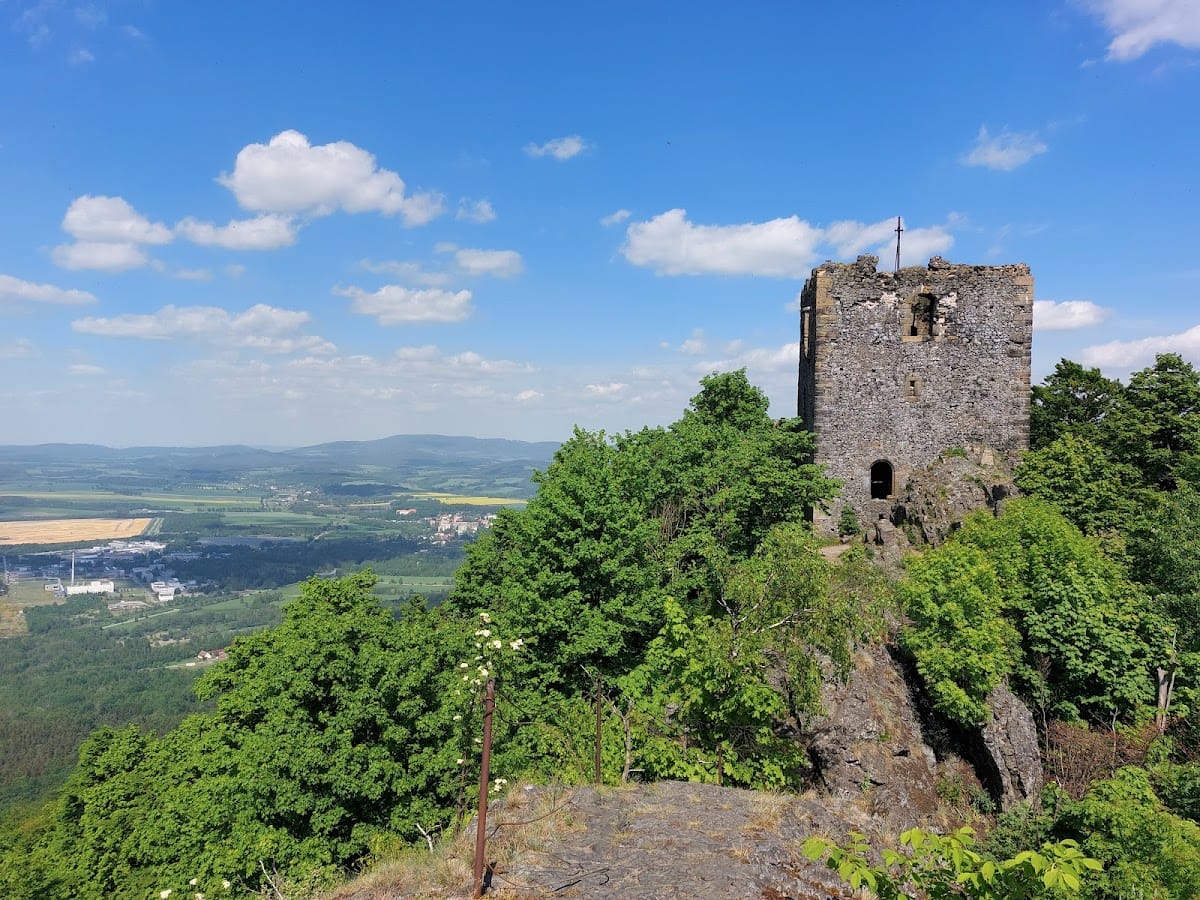
Ralsko is a Gothic stone ruin on a rocky summit within the forested Ralsko Hill. The southern part, including the principal prismatic tower, occupies a 355-square-metre parcel, while the northern part occupies a 421-square-metre parcel. Surviving masonry includes fortification walls, the ruins of two residential towers, the perimeter walls of the palace, and fragments of additional buildings.
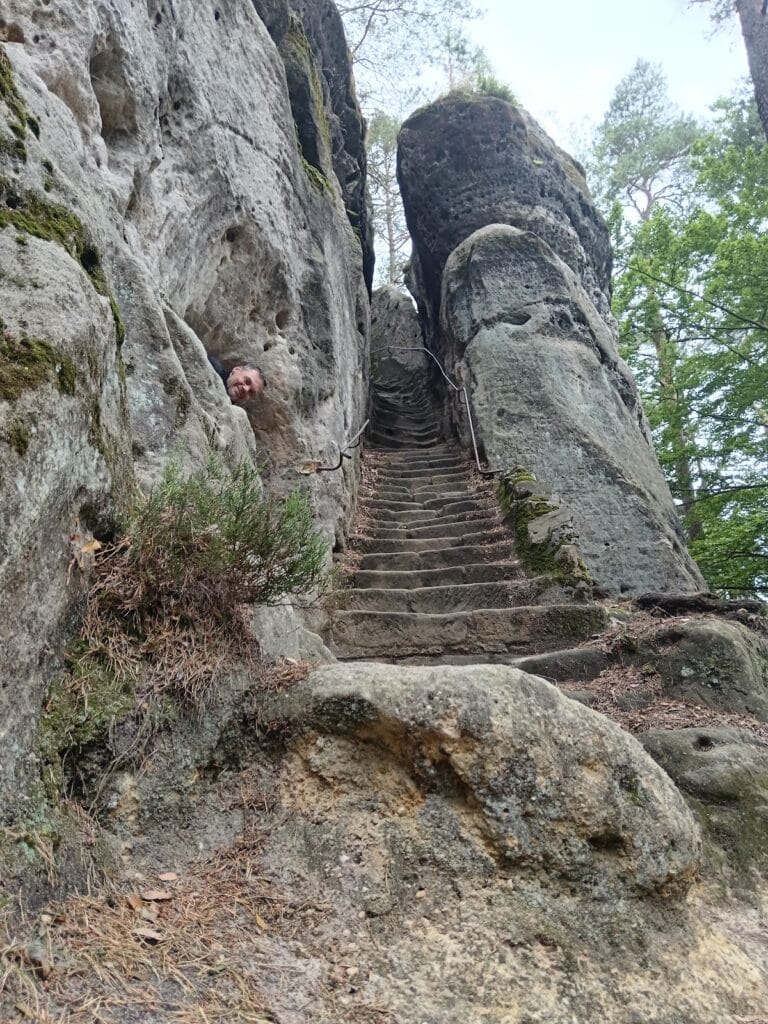
The approach was cut directly into the rock and guarded by two rock gates. It ended at an outer defensive platform on the summit edge, comparable to a zwinger, an area between defensive lines intended to expose attackers before they reached the main walls. Another gate stood before the lower castle, from which fortification walls continued beside a bastion, a projecting defensive structure.
Palace and principal towers
The outer ward ended in a two-storey tower that was connected to the palace in the upper part of the castle. The palace itself survives mainly through its perimeter masonry, while massive gable walls reach a stated thickness of 5.6 metres. A drawbridge linked the palace with the prismatic main tower, or donjon, the castle’s principal strong tower, which could serve both defensive and residential purposes.
The former lookout tower burned during the period of Soviet military use. A later proposal for a new publicly accessible lookout tower had not been realized by 2022. From the ruins, the surrounding terrain provides views towards Ještěd, Hazmburk, Říp, Bezděz, Hvozd, Luž, Jedlová, Klíč, and the lookout tower on Vrátenská Hill near Kokořín.
Archaeological extent
An archaeological survey conducted in 2014 before planned works showed that the original fortified complex extended substantially beyond the area represented by the surviving structures. The result broadened the known physical extent of Ralsko Castle and placed its remaining towers, walls, gates, and palace within a larger defensive complex.