Radziwiłł Palace in Balice: A Historic Polish Aristocratic Residence


Site at a Glance
- Rating
- 4.5
- Popularity
- Low
- Country
- Poland
- Primary era
- Modern
- External website
- Open
- Eras represented
- Classical, Modern
- Civilizations
- Habsburg, Kingdom of Poland, Polish–Lithuanian Commonwealth
- Site type
- Domestic
- Remains
- Elite Residence
On this page8 sections
History
Radziwiłł Palace in Balice is a historic residence in Poland whose development includes a sixteenth-century Renaissance manor and extensive remodeling carried out between 1887 and 1894. The estate passed through several prominent noble and patrician families before becoming the summer residence of Prince Dominik Radziwiłł.
From the Toporczyks to the Boners
The first building on the site was probably a manor erected by the Toporczyk family of Morawica. It was later taken over for debt by Severin Bethman, a councillor of Krakow. Through the marriage of Bethman’s daughter Sofia to Severin Boner, a burgrave responsible for administering a castle or fortified district and a banker, the Balice estate passed to the Boner family.
In 1519, Severin Boner commissioned a comfortable wooden manor at Winna Góra, together with a garden and vineyard. His son Jan subsequently built a masonry Renaissance manor on the same site. Jan Boner transferred the residence to his sister Sofia, the wife of Jan Firlej, and it then remained with the Firlej family for an extended period. A detailed view drawn by Matthias Gerung around 1536 preserves evidence of the manor’s Renaissance appearance.
Sixteenth- and Seventeenth-Century Residence
The residence was inhabited for a long period by Jan Łaski, a sixteenth-century Polish religious reformer and political figure. On 16 February 1574, Henry III of France, also known as Henry of Valois, stayed at Balice while travelling to Krakow.
After 1610, Balice was leased. The manor was probably damaged during the Swedish Deluge, the seventeenth-century Swedish invasion and war in the Polish-Lithuanian Commonwealth. At the end of that century, the estate passed to Chancellor Jan Szembek, who rebuilt the palace. By the middle of the eighteenth century, however, the residence had fallen into ruin.
Nineteenth-Century Renewal and the Radziwiłł Residence
Urszula Darowska renovated the palace at the beginning of the nineteenth century. In 1887, Prince Dominik Radziwiłł, who was then living in Paris, purchased the palace and estate from the Hungarian Homolacs family. He commissioned extensive remodeling between 1887 and 1894, following designs by Tadeusz Stryjeński.
The remodeled palace served as Dominik Radziwiłł’s summer residence, where he stayed with his wife, Dolores de Agramonte. In July 1912, it hosted Archduke Karl Franz Joseph and Archduchess Zita. After Dominik’s death, the property was inherited by Hieronim Mikołaj Radziwiłł, whose wife Renata was the daughter of Archduke Karl Stefan Habsburg of Żywiec.
Postwar Institutional Use
After 1945, the palace was transferred to the Jagiellonian University, Krakow’s historic university founded in 1364. From the beginning of the 1950s, the Institute of Animal Husbandry, a research institution concerned with animal breeding and related agricultural sciences, used the building as a conference center and hotel. The institute is identified as the present owner.
In 2005, the palace hosted a gathering of numerous presidents and prime ministers held in connection with the sixtieth anniversary of the liberation of the Auschwitz-Birkenau camp. The palace has been entered in the heritage register under number A-246 since 24 February 1971.
Remains
Palace
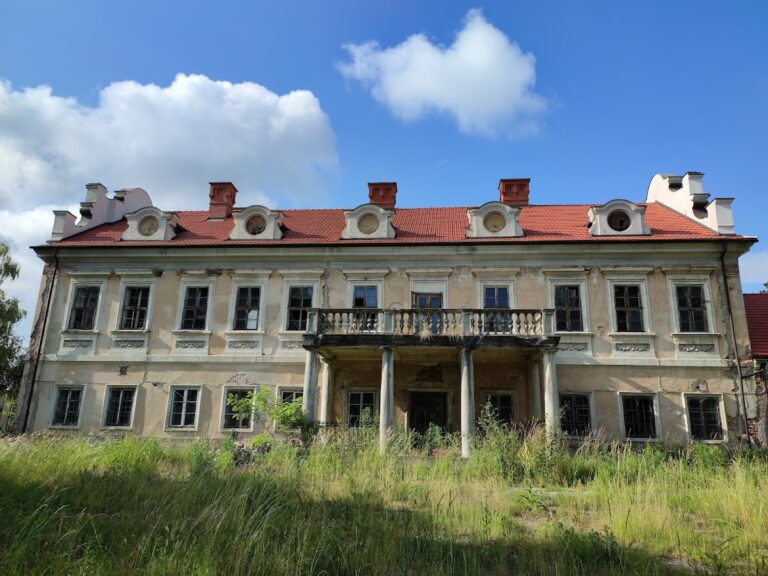
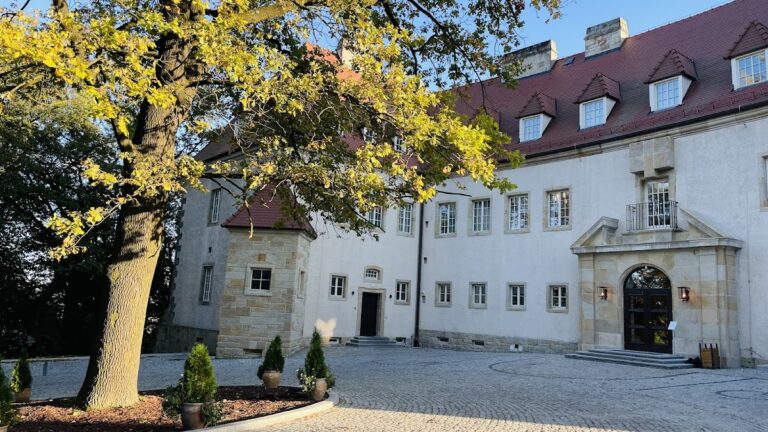
The palace is a historic residence whose building history combines a probable fifteenth-century manor, the Boner family’s sixteenth-century wooden and masonry phases, Jan Szembek’s later rebuilding, and the large-scale remodeling of 1887 to 1894. Its front elevation has a projecting bay crowned by a pediment, the usually triangular upper section of a facade or projecting bay. The pediment contains the Radziwiłł coat of arms.
Park and Grounds
A historic park surrounds the palace. Designed in the Italian-garden style, it developed from the sixteenth through the twentieth century and covers 5 hectares. The grounds also contain a gatekeeper’s lodge and a three-thorned honey locust recognized as a natural monument, meaning a legally protected individual natural feature valued for its natural or cultural importance.