Pušperk Castle: A Medieval Hilltop Fortress in Czechia


Site at a Glance
- Rating
- 4.6
- Popularity
- Very Low
- Country
- Czechia
- Primary era
- Medieval
- Eras represented
- Medieval
- Civilizations
- Holy Roman Empire, Kingdom of Bohemia
- Site type
- Military
- Remains
- Castle
On this page6 sections
History
Pušperk Castle is a ruined medieval hilltop fortress in Czechia, built around 1260 by Jaroš the Great of Sliwno, burgrave of Poděhusy, to protect a new trade route leading from Horažďovice through Klatovy, Poleň, and Horšovský Týn to Bavaria. Jaroš probably received the territory from King Ottokar II Přemysl, the thirteenth-century king of Bohemia, after serving him in the victorious Battle of Kressenbrunn, a 1260 conflict in which Ottokar defeated King Béla IV of Hungary.
Foundation and Early Lords
The castle was first called Fuchsberg, a name linked to Jaroš’s fox emblem. It was soon adapted into Czech forms, and by 1264 its lord used both Wuchsberg and Puschperk. After 1298, Jaroš’s widow Katharina sold the estate to the Hroznata family. Bušek Hroznata of Pušperk held it by 1339, followed by Racek Hroznata of Pušperk from 1355.
During the 1370s, Ctibor Tlam, the royal huntsman of the Dobříš forests, acquired the Pušperk estate together with the small town of Poleň. He later added the Únějovice estate. His son Jan Tlam built a smaller fortified noble residence at Únějovice, but the family could not retain Pušperk Castle.
Royal Grants and Political Conflict
In 1388, Sobieslaw of Rudoltitz donated property to the church at Poleň. Two years later, King Wenceslas IV granted Pušperk Castle to Renvald of Ústupenice. Renvald administered the estate unsuccessfully and eventually surrendered it to his principal creditor, the Prague Jew Jonas. After Jonas died, the estate returned to the Bohemian Crown.
Around 1400, Wenceslas IV sold the estate to the brothers Renvald and Bohunek of Ústupenice. Renvald became its sole owner in 1404 and was succeeded by his brother Svoješ, who died fighting the Hussites at the Battle of Vyšehrad in 1420. The battle formed part of the Hussite Wars, a series of conflicts connected with the religious reform movement associated with Jan Hus. The estate then passed to Hynek of Ústupenice.
Klatovy had become a center of the Taborites from 1419. This radical Hussite faction occupied the estate of the Catholic Hynek of Ústupenice and destroyed the castle. Hynek regained the estate in 1434 but did not rebuild Pušperk.
Later Ownership and Destruction
After 1439, Hynek’s widow Ofka inherited the Pušperk properties. She later sold them, including the ruined castle, to her third husband, Dietrich of Čiremperk of Czernikau. A retrospective decision in 1457 determined that the estate had returned to the crown when Hynek died, so it passed from Ernst of Hirschstein back to the Bohemian Crown.
King Ladislaus Jagiello granted the estate to Johann Zajíc of Hasenburg in 1457. Zajíc sold half of it in 1462 to Jiřík of Říčany and Dietrich of Čiremperk. Dietrich sold his share before 1473 to the Catholic Boženko, also known as Břeněk, of Ronsperg.
Boženko of Ronsperg used Pušperk Castle as a base for raids, especially against the Utraquist town of Klatovy. Utraquism was a more moderate Hussite communion that became established in Bohemia. In 1473, a Klatovy army captured and destroyed the castle with the approval of the Beneschau provincial diet, an assembly concerned with the political and legal order of the land.
Abandonment and Later Tradition
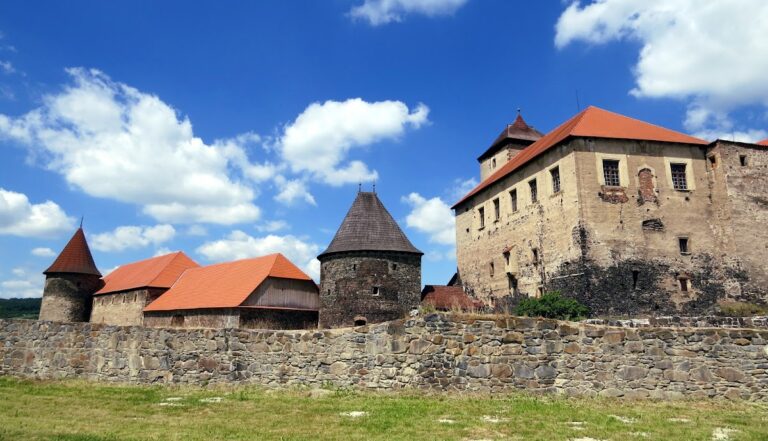
At the end of the fifteenth century, the Švihovský of Riesenberg family acquired the Pušperk estate and its ruined castle and incorporated them into the Švihov lordship. The estate was later separated from Švihov and sold to Albrecht Nebilovsky of Drahobuz. The castle remained abandoned while Nebilovsky built a new fortified seat at Poleň after 1550.
A chapel dedicated to Saint Wenceslas, the national saint of Bohemia, was built among the castle ruins at the end of the sixteenth century. The chapel was suppressed during the Josephinian reforms at the end of the eighteenth century. These were ecclesiastical measures associated with Emperor Joseph II that closed religious institutions considered nonessential, and the chapel later collapsed. Local legends maintain that an underground passage once connected Pušperk Castle with Ruchomperk Castle.
Remains
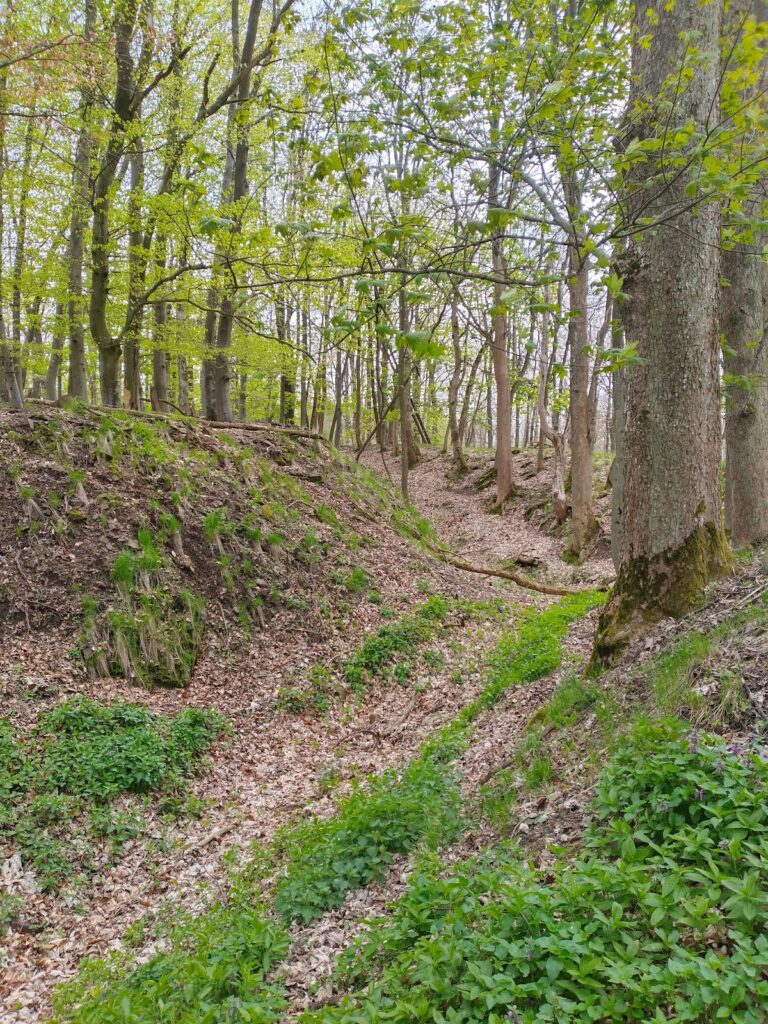
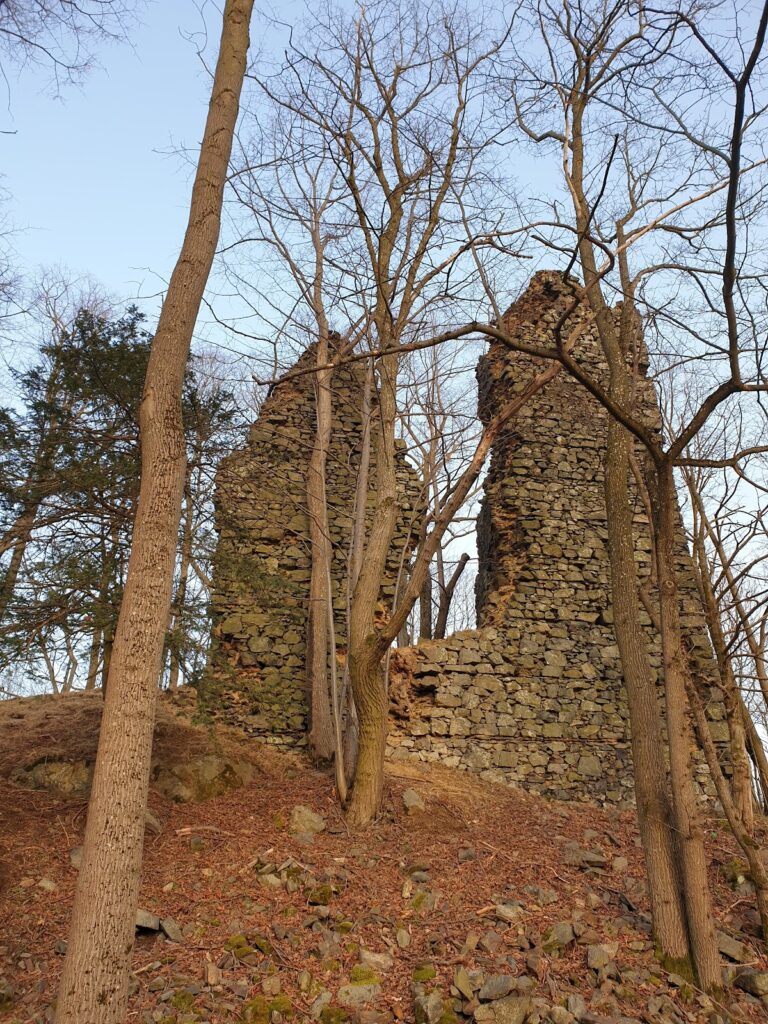
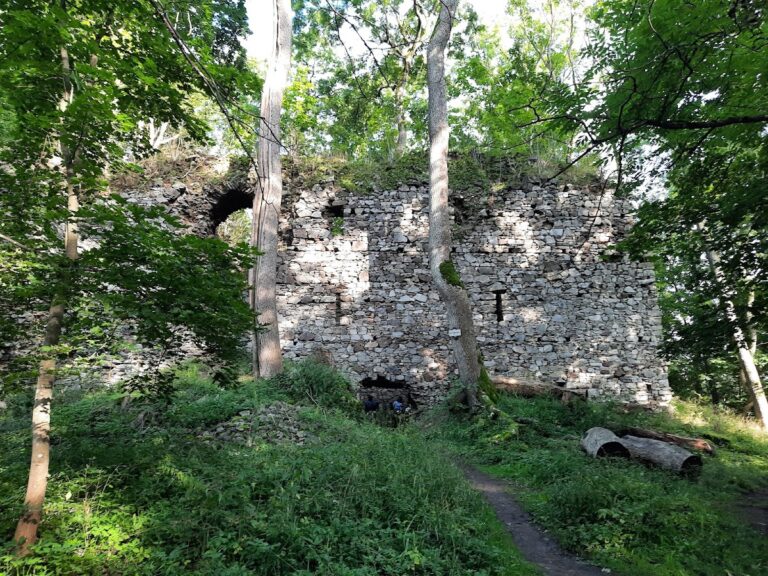
Pušperk stands on the wooded hill Na Pušperské skále, west above the village of Pušperk, now a locality within the municipality of Poleň in the Klatovy District. The hill lies at about 582 metres above sea level in the Chudenitz Highlands, while the castle is listed at approximately 580 metres. The surviving fabric consists of a fragment of the castle gate and remnants of the wall adjoining it, preserving a small part of the former hilltop enclosure in its ruined state.
Nearby sites