Rønnebæksholm: A Historic Manor Estate and Cultural Centre in Denmark


Site at a Glance
- Rating
- 4.3
- Popularity
- Low
- Country
- Denmark
- Primary era
- Early Modern
- External website
- Open
- Eras represented
- Early Modern, Modern
- Civilizations
- Danish
- Site type
- Domestic
- Remains
- Manor House
On this page8 sections
History
Medieval Estate and Royal Possession
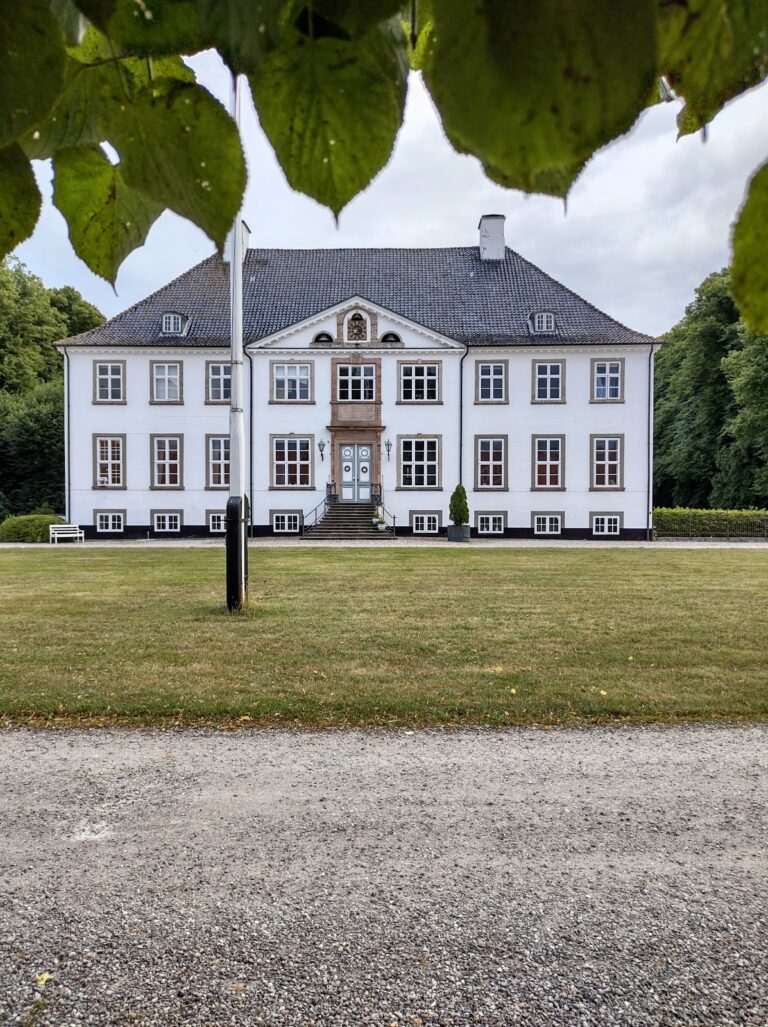
Rønnebæksholm is a former manor estate in Denmark outside Næstved, first mentioned in written sources in 1321 and now centred on a main building first constructed in 1734. Its history includes noble ownership, royal administration, industrial production, and later cultural use. The estate was previously owned by the Due family, while members of the Moltke family held it from 1321 to 1399.
In 1399, Fikke Moltke ceded Rønnebæksholm to Margaret I, the medieval monarch who brought Denmark, Norway, and Sweden together under the Kalmar Union. The estate then remained in royal possession until the sixteenth century. In 1513, Christian II commissioned Gert Bøsseskytte to establish Denmark’s first gunpowder factory on the estate’s land. A gunpowder factory was an industrial installation for making explosive powder for firearms and artillery.
Noble and Private Ownership, 1571–1840
Rønnebæksholm left crown ownership in 1571, when Frederick II granted it to Caspar Paslick, a diplomat and nobleman. The estate remained with the Paslick family for three generations. Knud Paslick sold it to Edel Urne in 1646, after which it descended through Edel Urne and her husband Pros Mund’s descendants. Financial difficulties forced the family to auction the estate in 1727.
Johan Rantzau Mund acquired Rønnebæksholm, followed by Christoffer Tage, the first owner who was not a member of the nobility. During Tage’s ownership, parts of the main building were renovated and adjoining properties were acquired. Jens Müller purchased the estate in 1750 and owned it until his death in 1753. His widow, Barbara Marie Munthe, transferred it to her second husband, Christian Walterstorff. Carl Juel then held it briefly before Peder Collet bought it in 1761.
After Peder Collet died in a fall from his horse in 1763, his brother Johan Collet inherited the estate. Johan sold it to Magnus Beringskjold in 1777. Beringskjold was accused of high treason and arrested in 1781, spending the remainder of his life imprisoned at Bergenhus Fortress. His wife, Marie Christine von Cappelen, took possession and formally sold Rønnebæksholm to their son Ditlev Beringskiold in 1782.
In 1783, Ditlev Beringskiold was ennobled as Ditlev Wedelsparre for faithful service to the crown and abandoned his father’s surname. He sold the estate to Joachim Moltke in 1798. After Moltke’s death in 1820, his widow Ellen Brun de Neergaard inherited Rønnebæksholm. She lived there for ten years before selling it.
The Toft and Grundtvig Period
Harald Toft acquired Rønnebæksholm in 1840 and remodelled the main building in a neo-Gothic style, using forms and motifs inspired by medieval Gothic architecture. He died the following year, and his widow, Marie Toft, assumed responsibility for the estate.
Marie Toft met N. F. S. Grundtvig around 1845, and they married on 25 October 1851, less than a year after the death of Grundtvig’s first wife. Grundtvig was a Danish theologian, pastor, historian, and influential nineteenth-century religious and educational thinker. Marie commissioned a pavilion for him in the southeastern corner of the estate, but died before it was completed.
Before her marriage to Grundtvig, Marie Toft had bequeathed Rønnebæksholm to her daughter Haralda. After Marie’s death, following the birth of her and Grundtvig’s only child, Frederik Lange Grundtvig, on 15 May 1854, Haralda became the owner. Grundtvig moved out of the manor. The estate subsequently passed through the descendants of Haralda Toft and her husband, Peter Ferdinand Collet, until it became public property.
Municipal Ownership and Cultural Use
By the end of the nineteenth century, Rønnebæksholm owned most of the village of Rønnebæk, apart from a few ecclesiastical buildings. The ownership of the estate later became divided between its buildings and lands. Director Keld Riff Andersen acquired the main building and stables in 1966. Næstved Municipality acquired the surrounding land in 1994 and bought the main building and stables from Andersen in 1998.
Næstved Municipality now owns the entire estate, which covers 230.5 hectares. Rønnebæksholm is operated as a self-owning arts and culture centre, an independently administered legal entity typically governed by its own board. Its programme includes exhibitions, concerts, talks, theatrical performances, and other indoor and outdoor cultural events, with an emphasis on modern and contemporary visual art.
Remains
Main Building and Estate Grounds
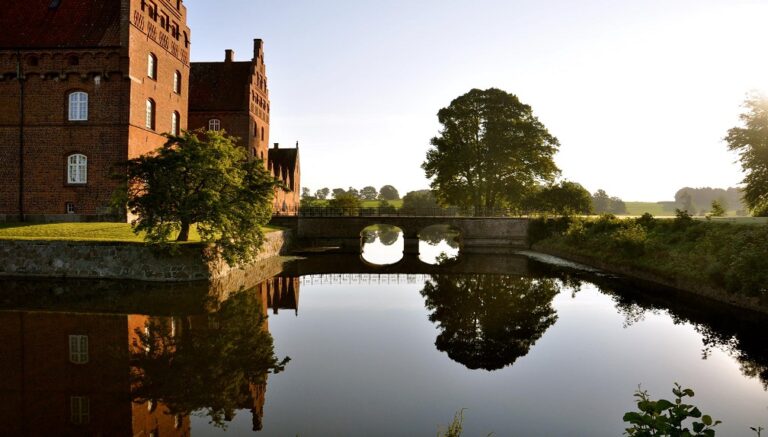
Rønnebæksholm’s surviving estate consists of the main building and stables set within grounds covering 230.5 hectares. The present main building is a three-winged structure originally constructed in 1734. Its appearance and fabric were altered during major remodelling in 1840–1841 and again in 1889–1890, including the neo-Gothic treatment associated with the nineteenth-century phase.
The main building now accommodates four to six exhibitions, primarily devoted to modern and contemporary visual art. Its continuing use as the principal cultural building preserves the estate’s role as an organized public complex while retaining the form of a historic manor house and its associated stables.
Grundtvig Pavilion
The Grundtvig Pavilion stands in the southeastern corner of the estate. Marie Toft commissioned it shortly after her marriage to N. F. S. Grundtvig, and the building was designed by Johan Daniel Herholdt. Grundtvig gave the pavilion the name Venligheden, meaning “The Kindness.”
The pavilion’s design drew on English Renaissance garden houses, an unusual source of inspiration in Danish architecture at the time. Marie Toft died before the pavilion was finished, leaving the structure physically connected with the brief period of her marriage to Grundtvig and with the estate’s nineteenth-century history.
Nearby sites