Qala-i-Jangi: A Fortress Near Mazar-i-Sharif
Site at a Glance
- Country
- Afghanistan
- Primary era
- Modern
- Eras represented
- Modern
- Civilizations
- Unclassified
- Site type
- Military
- Remains
- Fort
On this page9 sections
History
Foundation and early conflicts
Qala-i-Jangi is a fortress near Mazar-i-Sharif in northern Afghanistan, built by Afghan ruler Abdur Rahman in 1889. Known as the Iron Amir, Abdur Rahman intended the fort to defend against a Russian invasion and quell revolts by Uzbek tribes. British funding supported the project, which employed 18,000 workers and took 12 years. The fortress was then called Dehdadi, after a nearby village; the name Qala-i-Jangi was probably not applied until the 1940s.
In 1929, about 300 Russian troops were besieged inside the fort by 20,000 Turkmen.
Soviet and Taliban periods
After the 1979 Soviet invasion of Afghanistan, Soviet forces occupied the fort again with support from Abdul Rashid Dostum, an Afghan military commander and political leader. In 1981, Mujahideen fighters, a term used for Islamic armed groups opposing Soviet forces and the Soviet-backed government, attacked the fort. The attack resulted in the removal of 170 pro-Soviet Afghan soldiers.
The Taliban, an Islamist political and military movement, occupied the fort for most of the period from 1994 to 2001. In 1997, Dostum briefly held it with 20,000 militia as part of the Northern Alliance, a coalition of Afghan forces opposed to the Taliban.
The 2001 battle
During the opening stages of the 2001 war in Afghanistan, the fort served as a military headquarters and garrison for Dostum’s Northern Alliance forces. A Taliban uprising there became known as the Battle of Qala-i-Jangi. At least 470 people were killed, including CIA agent Johnny “Mike” Spann. On November 26, an errant American bomb guided by JDAM, a system that converts unguided bombs into precision-guided weapons, destroyed the fort’s northeastern tower.
Remains
Fort plan and buildings
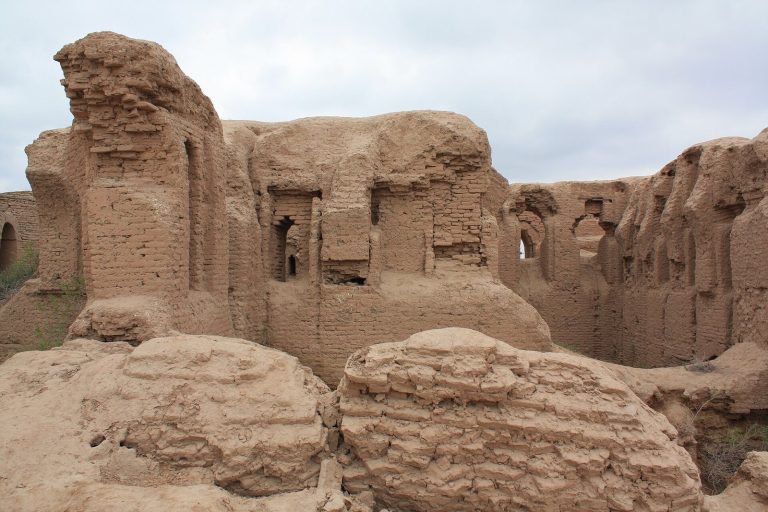
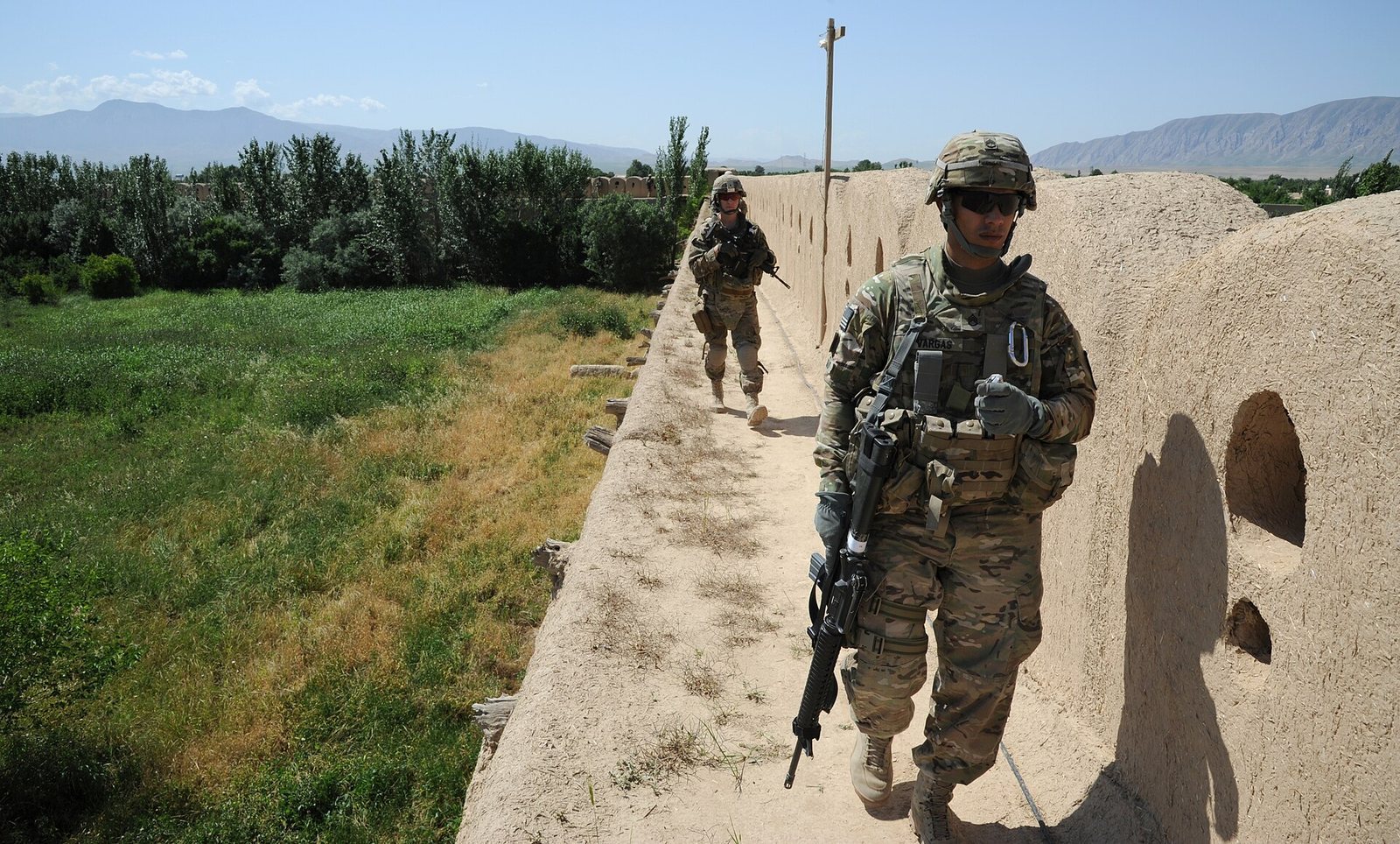
In 2001, the fort formed a walled enclosure about 550 m long and 270 m wide, with the character of a walled city. Its earthen construction used mud and straw reinforced with wooden beams. Average annual rainfall of about 100 mm helped limit soil liquefaction, in which saturated earth loses strength.
Walls and corner towers
A tower of mud stood at each corner of the fort. Each was about 24 m high and 46 m across; the northeastern tower is no longer extant. A wall about 24 m high divided the enclosure into equal northern and southern courtyards.
Courtyards and mosque
The internal wall defined the fort’s two courtyards. A mosque with a gold dome also stood within the enclosure.
Pink House
Soviet forces built the Pink House inside the fort during their occupation in the 1980s, using it as a medical facility. The square building measured about 23 m on each side.