Ruchomperk: A Transitional Hill Castle in Czechia


Site at a Glance
- Rating
- 4.7
- Popularity
- Very Low
- Country
- Czechia
- Primary era
- Medieval
- Eras represented
- Medieval
- Civilizations
- Holy Roman Empire, Kingdom of Bohemia
- Site type
- Military
- Remains
- Castle
On this page5 sections
History
Ruchomperk is an abandoned hill castle site in Czechia, near Černíkov, probably founded during the transition from the twelfth to the thirteenth century. Built as a transitional form between an early medieval fortified site and a medieval castle, it may have served as a territorial-defense point for the Kingdom of Bohemia or as the seat of the royal courtier Černín of Drslavice.
Foundation and early use
The castle probably arose during the reign of King Ottokar I Přemysl, a ruler of the medieval Přemyslid dynasty. Its position on the summit of Velký Kouřim, in what was otherwise an uninhabited forest, supports the possibility that it was established for territorial defense. Černín of Drslavice, a member of the royal household and service elite, may have founded or administered it on royal commission. The 1989 excavations placed the castle’s occupation in this early period and showed that it lasted only about fifty years.
The circumstances of Ruchomperk’s abandonment are uncertain. It occurred during a period when the knights of Czernin von Drslawitz were in exile, raising the possibility that they had previously seized the castle, although this cannot be established. Very little else is known about its owners or downfall.
Later references and changing interpretations
Ruchomperk appears in writing only once before its remains entered later historical discussion. In 1404, it was mentioned in connection with Marusch Czernik von Rauchenberg, a medieval nobleman. Until the end of the twentieth century, the noble designation Czernin von Rauchenberg, used from the second half of the fourteenth to the beginning of the fifteenth century, encouraged the belief that the castle had survived into the fifteenth century and that Marusch Czernik von Rauchenberg had been its last lord. More recent research no longer connects the family with Ruchomperk.
When the Puschberg lordship returned from Ernst von Hirschstein to the Bohemian Crown in 1457, the record referred to its forests and Kuřím Mountain but not to the castle. A document from 1462, concerning the sale of half of the lordship by Johann Zajíc von Hasenburg to Jiřík von Říčany, named the Kouřim forest together with Ruchomperk as an abandoned castle. František Teplý later incorrectly identified the Čirnperk fortress with Ruchomperk in his 1927 work Kniha o Švihově a okolí. A description from 1830 noted surviving wall remains and a well, while local tradition held that an underground passage connected Ruchomperk with Pušperk Castle.
Remains
Hilltop layout and earthworks
Ruchomperk occupies the summit of Velký Kouřim at an elevation of 641 metres, about 1.5 kilometres northwest of Černíkov in the Chudenická vrchovina. The castle formed a two-part complex with an oval ground plan. The larger upper section probably contained the main stronghold, while the smaller lower section probably functioned as an outer bailey, the secondary enclosed part of a castle complex. The surviving site is a Burgstall, an archaeological term for a castle site that no longer retains standing buildings.
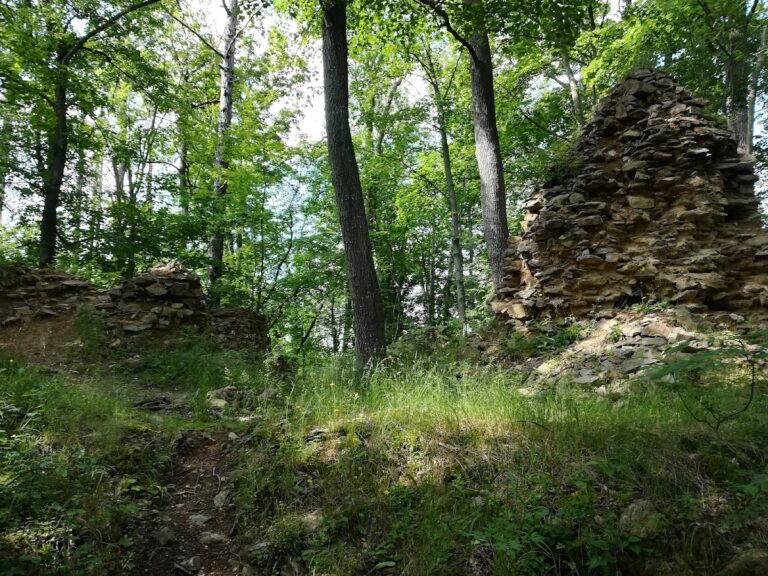
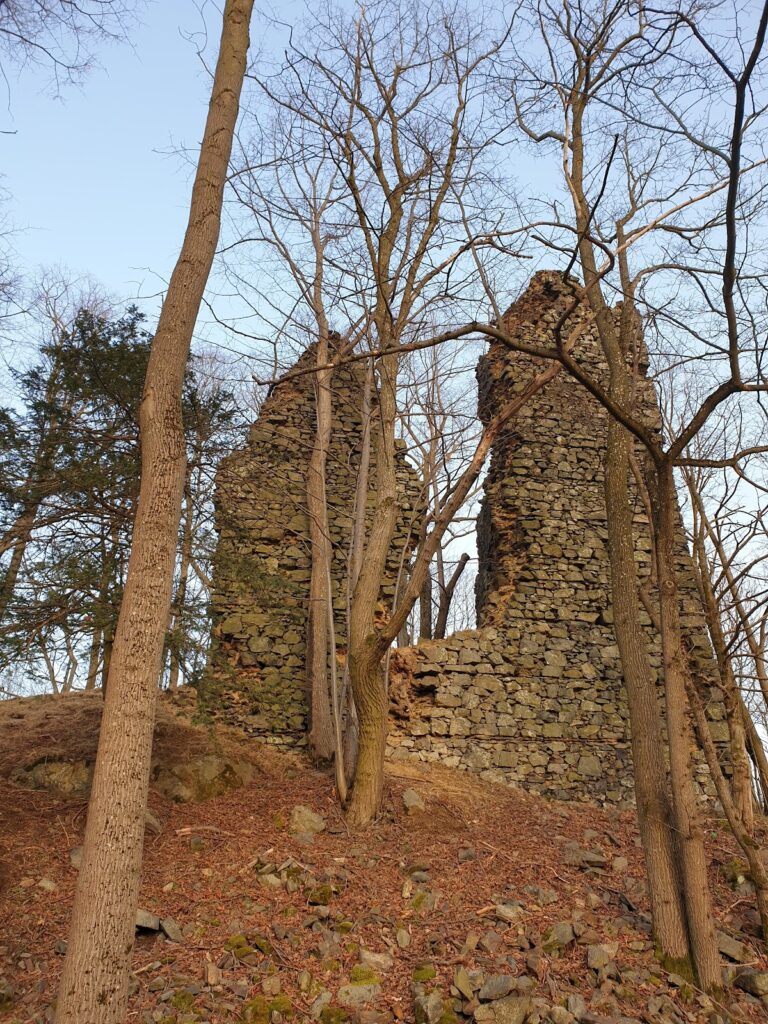
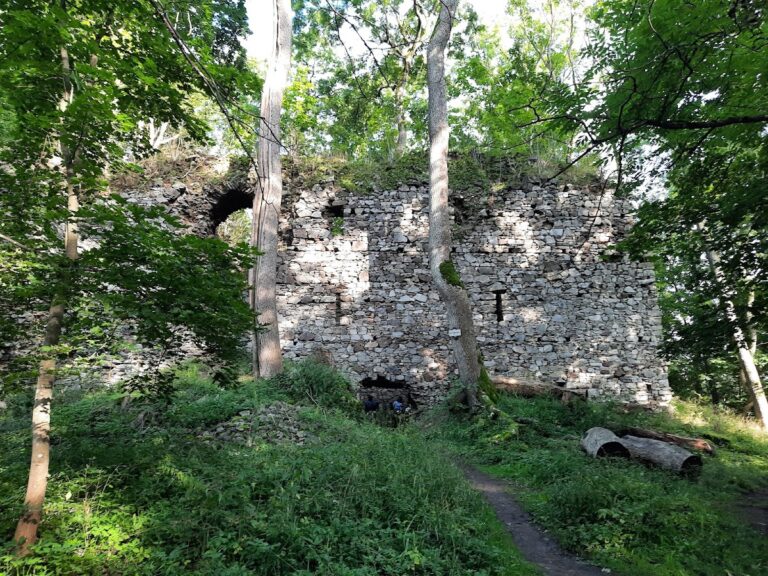
The castle was probably constructed largely of wood. Today, its physical remains consist of ditches and ramparts, which preserve the outline and division of the former hilltop complex. The wall fragments and well described in 1830 belong to the historical appearance recorded at that time, rather than to the standing remains visible at the present site.