Purgatorio ad Arco: A Baroque Church and Burial Complex in Naples
Site at a Glance
- Popularity
- High
- Country
- Italy
- Primary era
- Early Modern
- Eras represented
- Early Modern
- Civilizations
- Habsburg, Kingdom of Naples, Spanish
- Site type
- Religious
- Remains
- Church
On this page16 sections
History
The former tower and the name
The name Purgatorio ad Arco is generally linked to Torre d’Arco, a tower once located where Naples’s principal east–west street met Via Nilo and Via Atri. The tower gave its name to an early medieval district called regio de arcu cabredato. The tower was demolished on 6 April 1564, after the death of Don Pedro de Toledo, the Spanish nobleman who served as Naples’s viceroy. Its removal was intended to bring more light and air to the nearby palace of the Marchioness of the Vasto.
The Neapolitan historian Giulio Cesare Capaccio offered a different explanation for the name. He connected it to a supposed meeting place of Greek city magistrates, or archons, based on a mistaken reading of a Latin inscription. Capaccio also attributed the tower’s demolition to a belief that spirits lived there.
Charity and the church
The Opera Pia del Purgatorio ad Arco was established in 1605 by members of Naples’s nobility. Burial for poor and destitute people was one of its central aims. The institution also assisted people imprisoned over unpaid rent and provided clothing to those in need. The Mastrillo brothers, Geronimo and Francesco, were leading contributors; other benefactors included members of the Muscettola family, Alfonso Brancaccio, Fabrizio Caracciolo di Brienza, Diomede and Marcantonio Carafa, and Antonio Carmignano.
In 1616 the institution commissioned a church for the burial of poor people without family or homes. Giovan Cola di Franco designed it, and Giovan Giacomo Di Conforto later directed the building work. The upper church was consecrated and opened for worship in 1638, while the lower church was completed around the eighteenth century. The church was attached to the Congregation of the Purgatorio ad Arco, whose members prayed for souls in purgatory, the state in Catholic teaching where souls undergo purification after death before entering heaven. It remains a Roman Catholic church in the Archdiocese of Naples.
Devotion to abandoned souls
In 1742 Isabella Mastrilli established burial rights in the church for the poor or abandoned souls known as the anime pezzentelle. Devotees developed a practice of adopting a skull as the representative of a particular soul and praying for it. They also sought the souls’ intercession and help. One skull became popularly known as Lucia and was associated with prayers for brides.
Lucia’s identity is uncertain. One tradition describes her as a seventeen-year-old noblewoman who died of illness soon after her marriage. Her father, Don Domenico d’Amore, Prince of Ruffano, was said to have arranged her burial in the complex’s sacred earth. Other versions tell of a noblewoman who died for love of a commoner, or a commoner who died for a fisherman. In 1969 Cardinal Corrado Ursi, archbishop of Naples, prohibited the cult, objecting to appeals to anonymous dead rather than to the Church’s saints. The practice continued despite the prohibition.
Earthquake and restoration
The 1980 Irpinia earthquake weakened the lower church and led to the closure of both churches. Restoration work followed, and worship resumed in 1992.
Remains
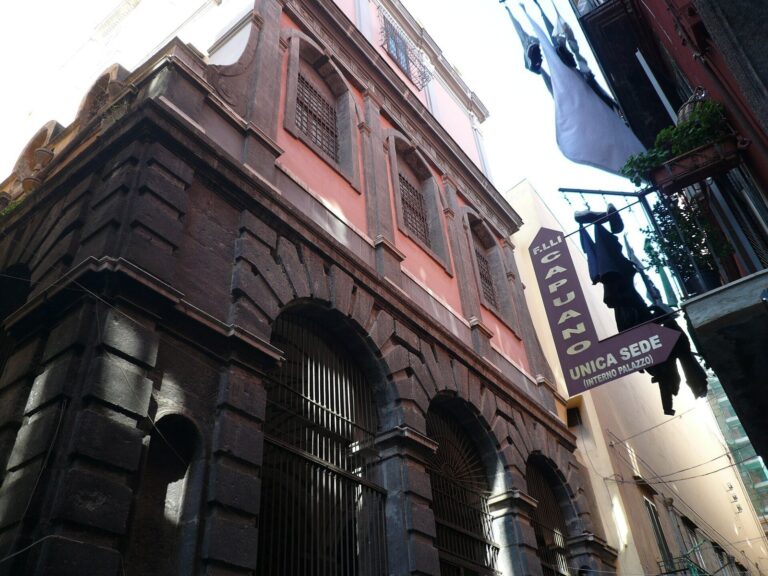
The complex is arranged across several levels. The upper church stands on Via dei Tribunali, with the lower church directly beneath it and an adjoining hypogeum, an underground burial complex. Rooms behind the apse form part of the museum. The Baroque church combines stonework with extensive stucco, marble and painted decoration.
The upper church
Façade and entrance
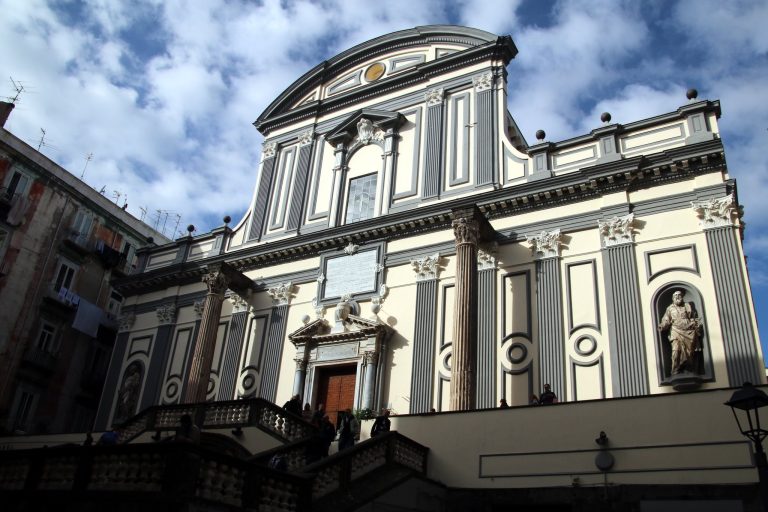
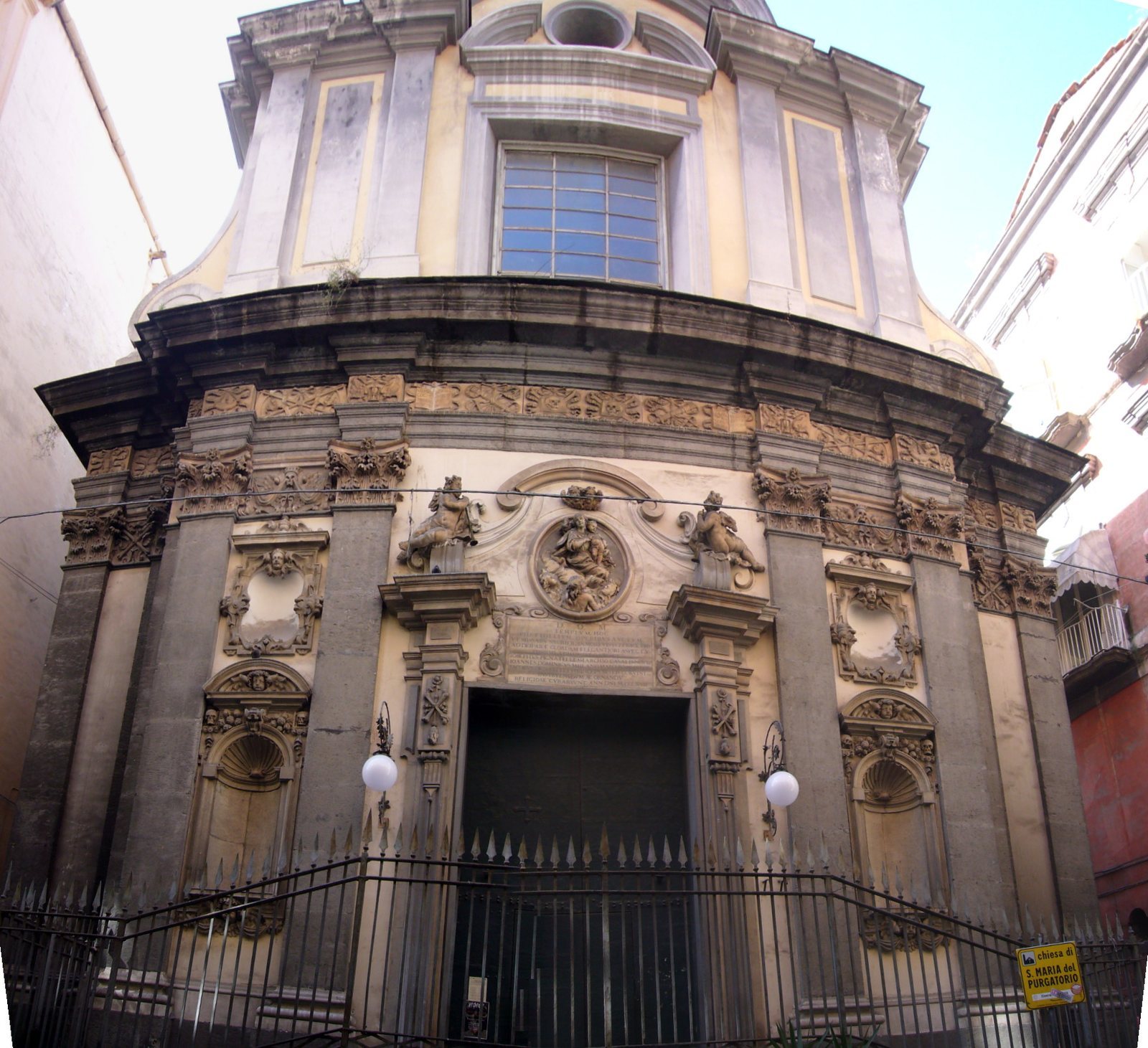
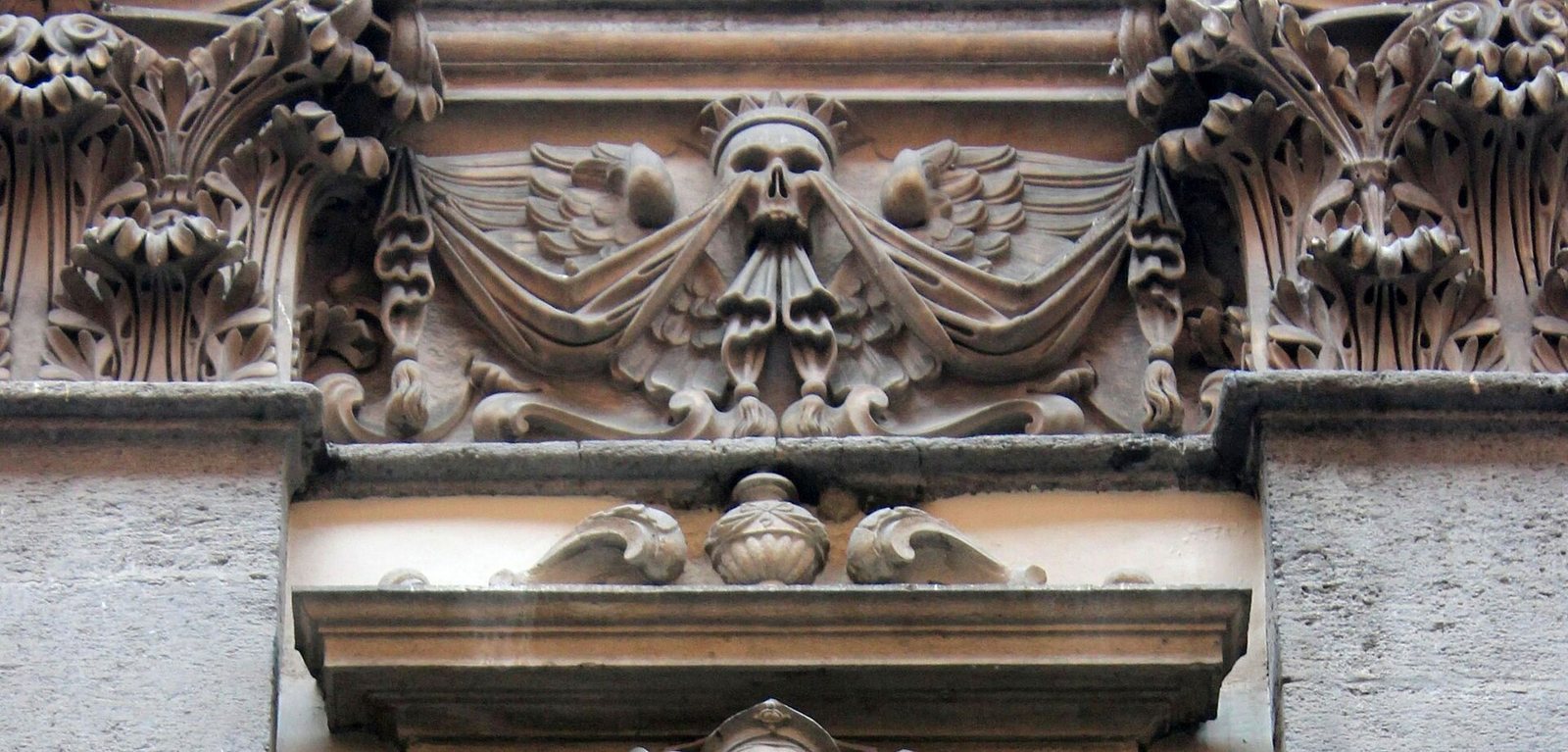
The façade has dark-grey piperno, a volcanic building stone used around Naples, shaped into pilasters, or flat, pillar-like wall strips, among elaborate Baroque stucco. Skulls and crossed bones appear on the entrance, decorative bands and side niches. Winged, crowned skulls sit between the decorated tops of Corinthian columns, while a red stucco band runs below the cornice. The entrance and the circular relief above it date to 1716 and are attributed to Cosimo Fanzago. The relief shows the Madonna with souls in purgatory.
Altar and apse
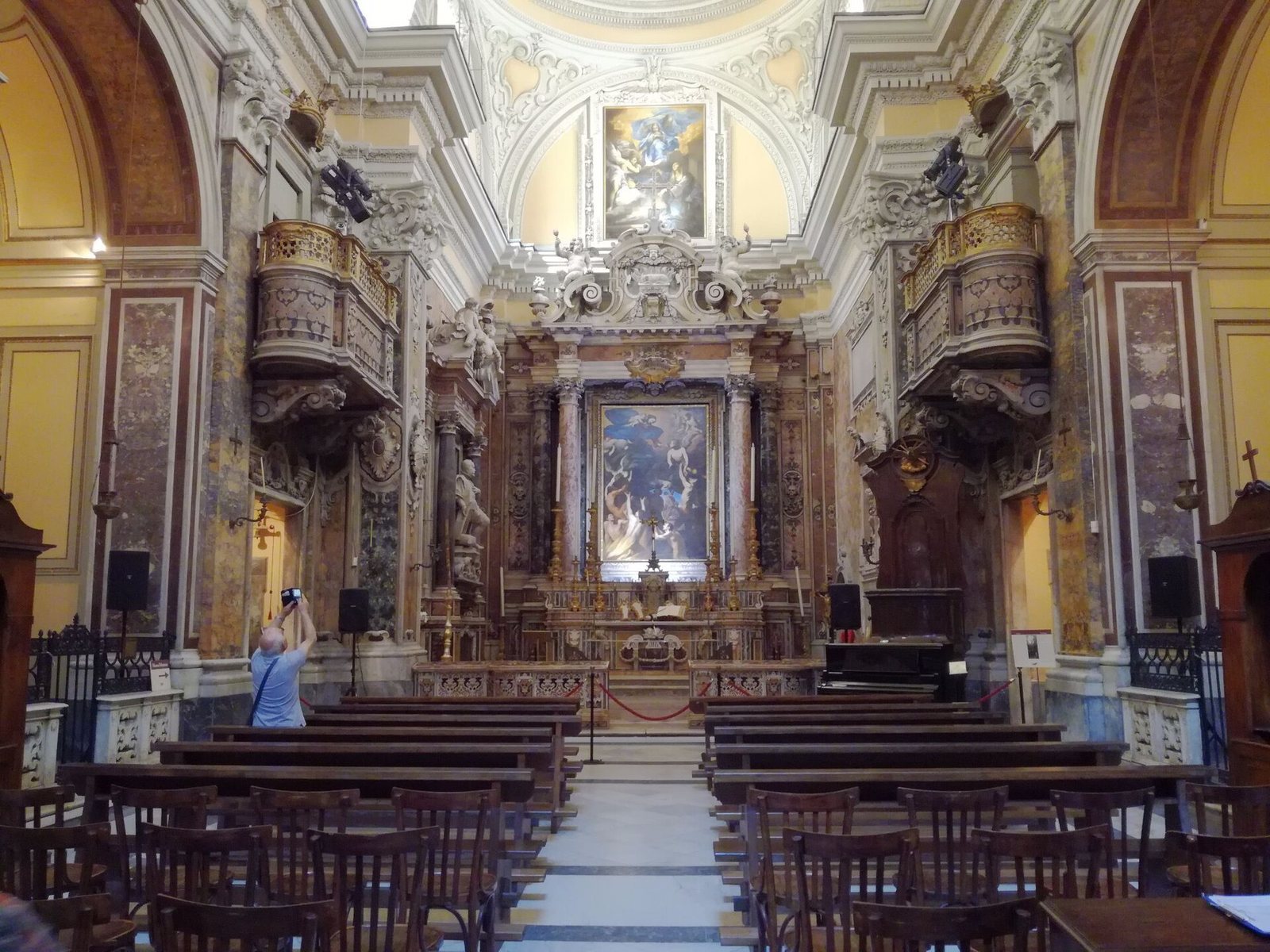
The interior has a single nave, the church’s main space, a reduced transept, or crosswise section, and three side chapels on each side. The presbytery, the area around the altar reserved for clergy, and the apse, the church’s end behind the altar, were decorated to designs by Dionisio Lazzari in 1669. Rose, grey and black marble and stucco are combined there, while gold-yellow marble veined like clouds faces the choir’s side walls.
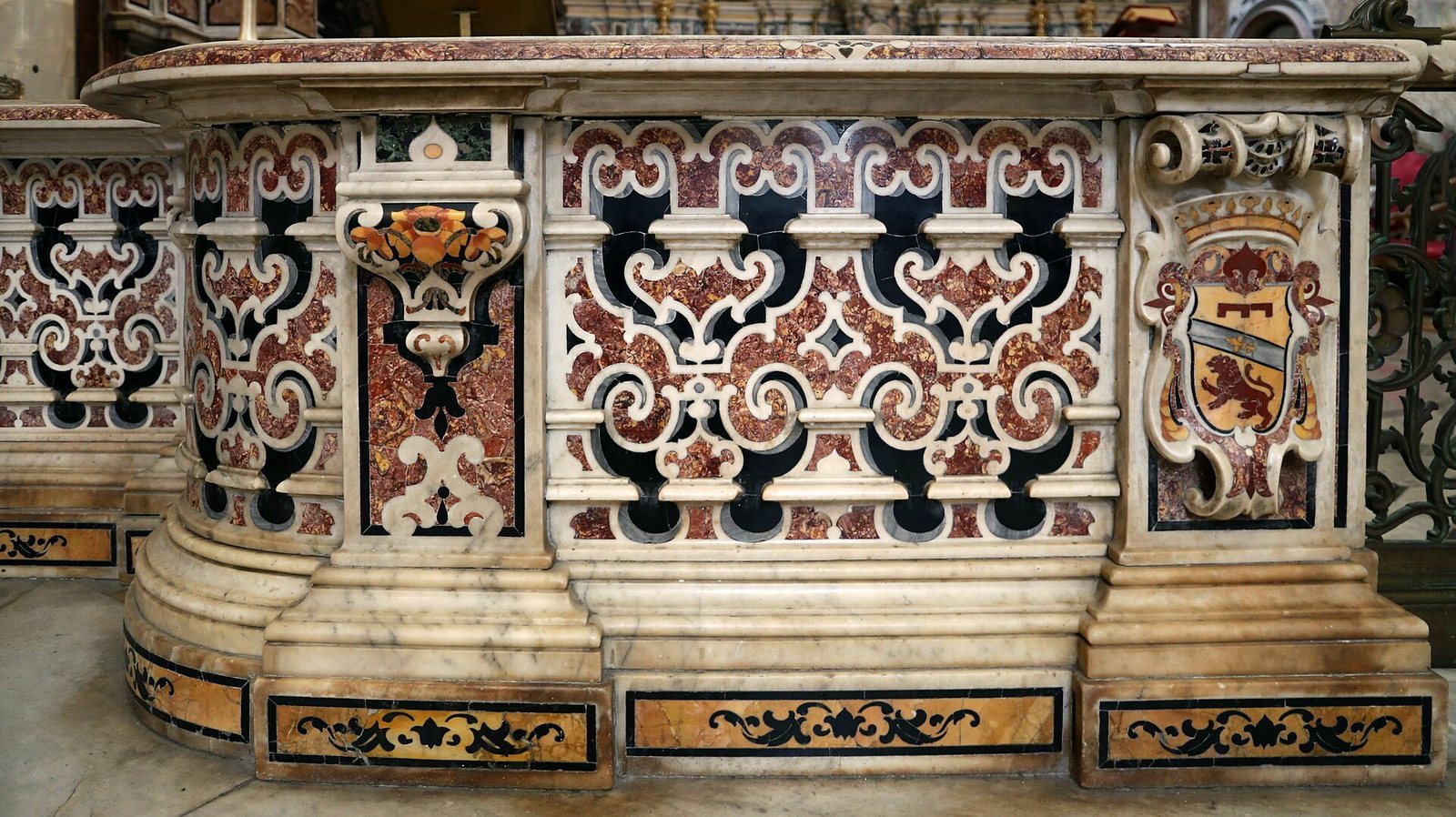
Neapolitan craftsmen made the main altar in the eighteenth century. A coloured-marble balustrade by Lazzari stands before it. Above the altar is Massimo Stanzione’s Madonna of the Souls in Purgatory, painted in 1638–1642. A large winged-skull sculpture by Lazzari sits beneath the painting, and two more winged skulls by him flank its marble frame. Above it, Giacomo Farelli’s 1670 painting depicts Saint Anne presenting the child Virgin Mary to God the Father. The church’s paintings and fittings, including those in the sacristy, repeatedly use imagery of death and purgatory.
Funerary monuments
On the left wall of the apse is Giulio Mastrillo’s monumental tomb, showing him kneeling. Lorenzo Vaccaro began the monument, and Andrea Falcone completed it in 1672. A monument to Pietro Antonio stands on the opposite wall.
Side chapels
The chapels contain wooden sculptures by unidentified makers and paintings by seventeenth-century Neapolitan artists. In the first chapel on the left, Girolamo De Magistro’s Saint Michael Defeats the Devil dates to 1650. The first chapel on the right contains a Holy Family by an unidentified seventeenth-century painter. Andrea Vaccaro’s Death of Saint Joseph, painted in 1650–1651, is in the third chapel on the left; Luca Giordano’s Death of Saint Alexis, from 1661, is in a chapel on the right.
The lower church and hypogeum
Lower church
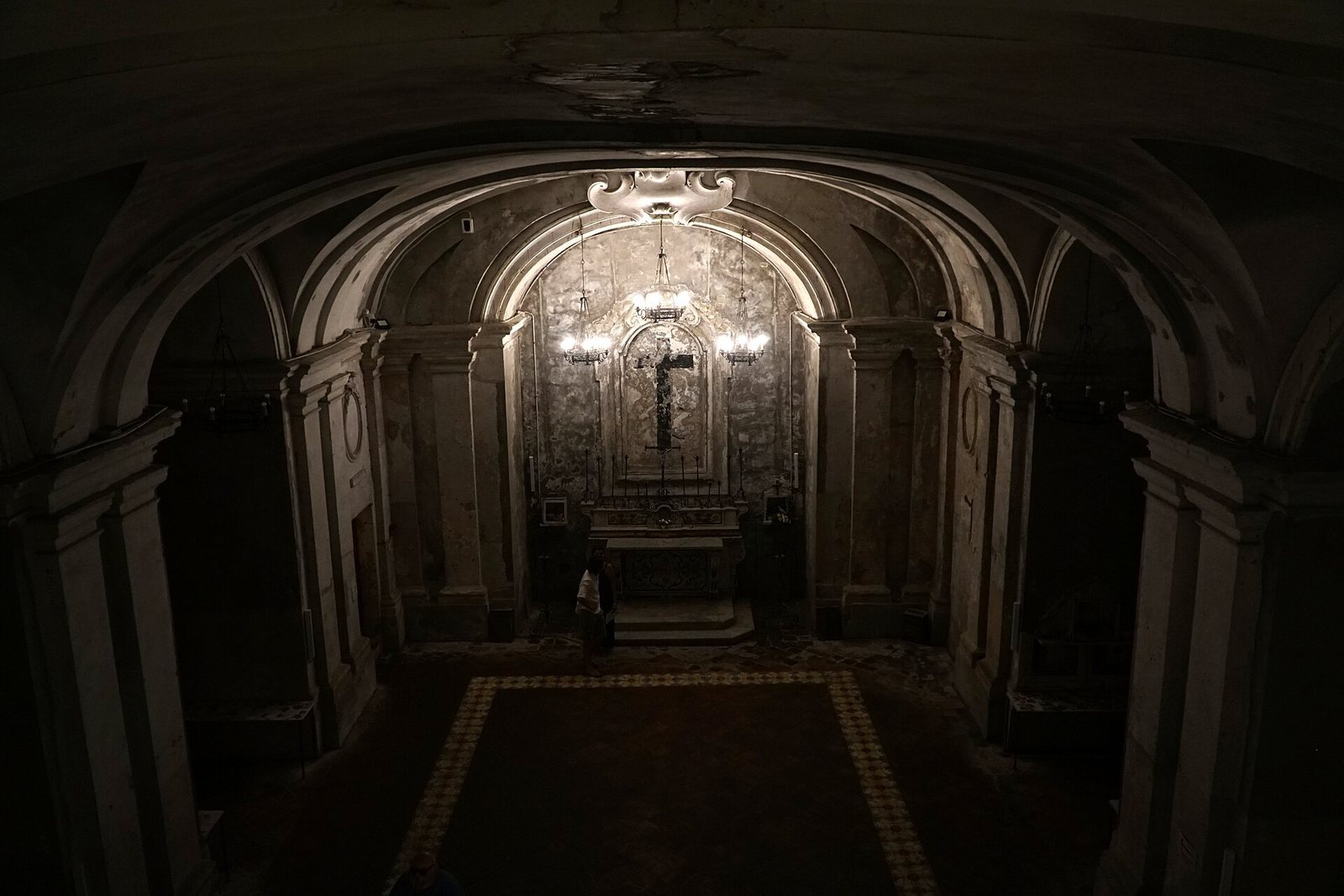
A staircase just inside the entrance descends to the lower church, which has the same dimensions as the upper church. Its deliberately plain interior evokes penitence and humility. A simple black cross is painted on the main altar. The floor is maiolica, tin-glazed pottery, made by Giuseppe and Donato Massa and decorated with skulls, bones and floral patterns. The piperno altar dates to the eighteenth century.
Burial chambers
The hypogeum has two side walls, each with two chapels containing burial niches, and a large anonymous tomb at the center. A decorated corridor in the church’s left corner leads to the tomb of Count Giulio Mastrillo and his wife, then to a second underground room used for burials. Skulls and sacred earth for members of the congregation and its benefactors are kept there, with a bone repository below.
Devotional niche
At the right end of the hypogeum, a small devotional niche displays the skull popularly called Lucia, dressed with a bridal veil and a small crown. Candles, silver offerings made in connection with prayers or gratitude for divine aid, and other gifts are placed around it. The hypogeum also contains an area of sacred earth reserved for members of the congregation.
Museum rooms and collection
The museum occupies the sacristy, a room used to prepare for worship, the Oratory of the Immaculate Conception, a room set aside for prayer, and other spaces behind the apse. The underground hypogeum is also part of the museum. Its collection includes paintings from the seventeenth to nineteenth centuries, church vestments, silver liturgical objects, chalices, books, manuscripts and furnishings used in religious celebrations. Among the paintings is a seventeenth-century copy of Luis de Morales’s Madonna of Purity. The original is at the convent of San Paolo Maggiore, belonging to the Theatines, a Catholic religious order.