Prečista Krajinska: A Medieval Serbian Orthodox Monastery in Montenegro
Site at a Glance
- Rating
- 5
- Popularity
- Very Low
- Country
- Montenegro
- Primary era
- Medieval
- Eras represented
- Medieval
- Civilizations
- Unclassified
- Site type
- Religious
- Remains
- Monastery
On this page12 sections
History
Prečista Krajinska is a medieval Serbian Orthodox monastery in Montenegro, near the southwestern shore of Lake Skadar. Dedicated to the Dormition of the Virgin Mary, the monastery belongs to the Serbian Orthodox Church’s Metropolitanate of Montenegro and the Littoral. Its church is first mentioned at the end of the tenth century, and the complex became closely associated with the rulers of medieval Duklja and with the religious history of the surrounding region.
The church of Krajina and Jovan Vladimir
At the end of the tenth century, Petrislav, the father of Jovan Vladimir, was buried at the church of Krajina. During the eleventh century, Krajina was described as the capital and court of Jovan Vladimir, who ruled Duklja, a medieval South Slavic principality centered in the western Balkans, from approximately 1000 to 1016.
Historical tradition connects the Church of Saint Mary with Kosara, Jovan Vladimir’s wife and the daughter of Emperor Samuel, ruler of the First Bulgarian Empire. According to that tradition, Kosara renewed the church. In 1016, Jovan Vladimir’s body was transferred from Prespa to Krajina. His relics drew devotees, turning the church into a pilgrimage center. Kosara was later buried there at her husband’s feet, according to her request.
Medieval transfers and ecclesiastical importance
Around 1215, while Krajina was under the rule of Serbian Grand Prince Stefan Nemanjić, Jovan Vladimir’s relics were presumably taken from the church by troops of Michael I, Despot of Epirus. Michael I briefly captured Skadar from Serbia, and the relics were transported to Dyrrhachium, the medieval name for the city now called Durrës in Albania. They remained at Krajina until approximately this period.
The monastery was mentioned in 1417 in connection with the seat of the Zeta Metropolitanate, an Orthodox ecclesiastical jurisdiction serving the medieval Zeta region. Around the same time, Prince Balša III granted salt revenues to the monasteries of Vranjina and Moračnik on the condition that they provide one-tenth of the salt to the Monastery of the Virgin Mary at Krajina. This arrangement placed the monastery within the economic and ecclesiastical network of the medieval Zeta region.
Balšić reconstruction and later decline
The Balšić family, a medieval ruling dynasty that held power in Zeta and neighboring areas, reconstructed the monastery during the fifteenth century. Later, during Catholic-Venetian expansion, the monastery became the seat of a Catholic bishopric. Its presence met resistance from the Serbian Orthodox population of the region, reflecting the competing religious and political authorities active in Krajina.
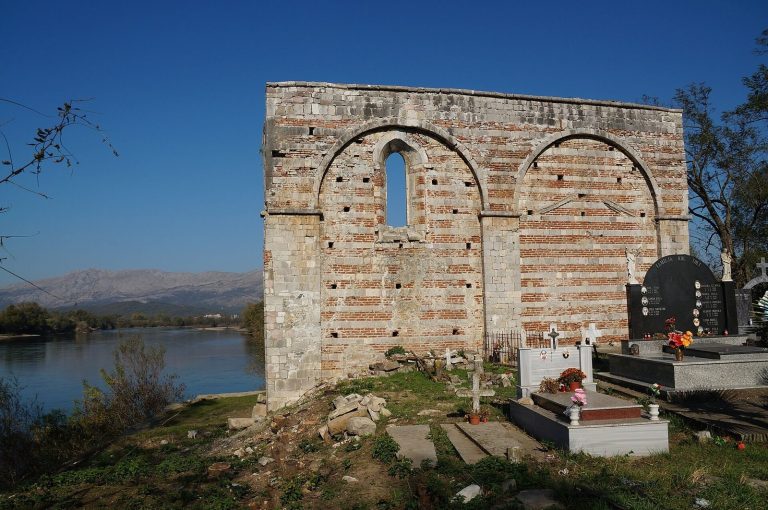
The monastery is presumed to have been destroyed and abandoned toward the end of the seventeenth century during the campaigns of Suleiman-Pasha Bushatli. By the beginning of the twentieth century, the population living around the church ruins was Muslim. The changing population and the destruction of the complex form part of the later history of a site whose earlier identity had been shaped by Orthodox worship, pilgrimage, and links to regional rulers.
The Mary Gospel
The Mary Gospel is traditionally associated with Prečista Krajinska. This eleventh-century manuscript was written in Glagolitic, the earliest known Slavic alphabet, and is regarded as one of the oldest surviving Old Church Slavonic manuscripts. Its association with the monastery connects Krajina with the early written culture of Slavic Christianity.
Remains
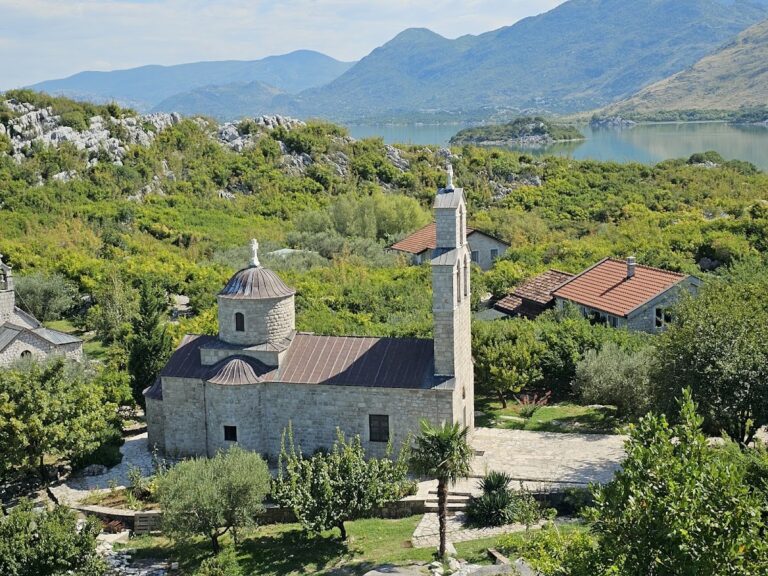
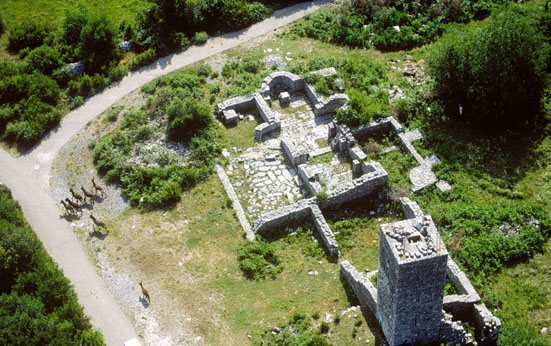
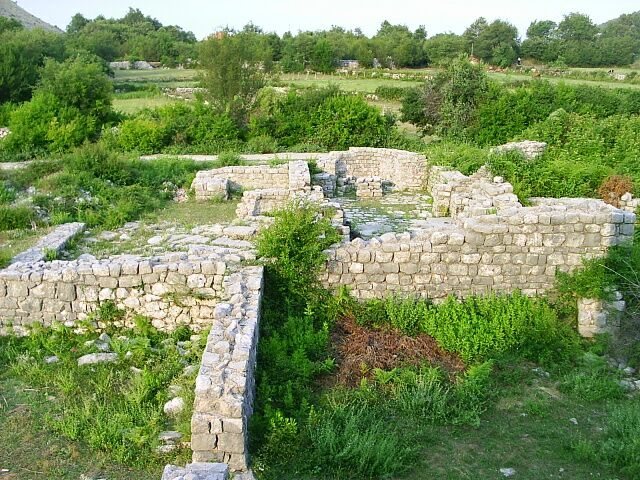
The surviving remains form a ruined monastery complex near the southwestern shore of Lake Skadar, close to the villages of Mali Ostros and Veliki Ostros. The church occupies the principal position within the complex. A larger room extended from its western end, while a five-storey bell tower stood at the western end of that adjoining space. Perimeter walls survive chiefly on the northern side, and additional walls beside the church may represent later additions.
Church and western structures
Church of the Dormition
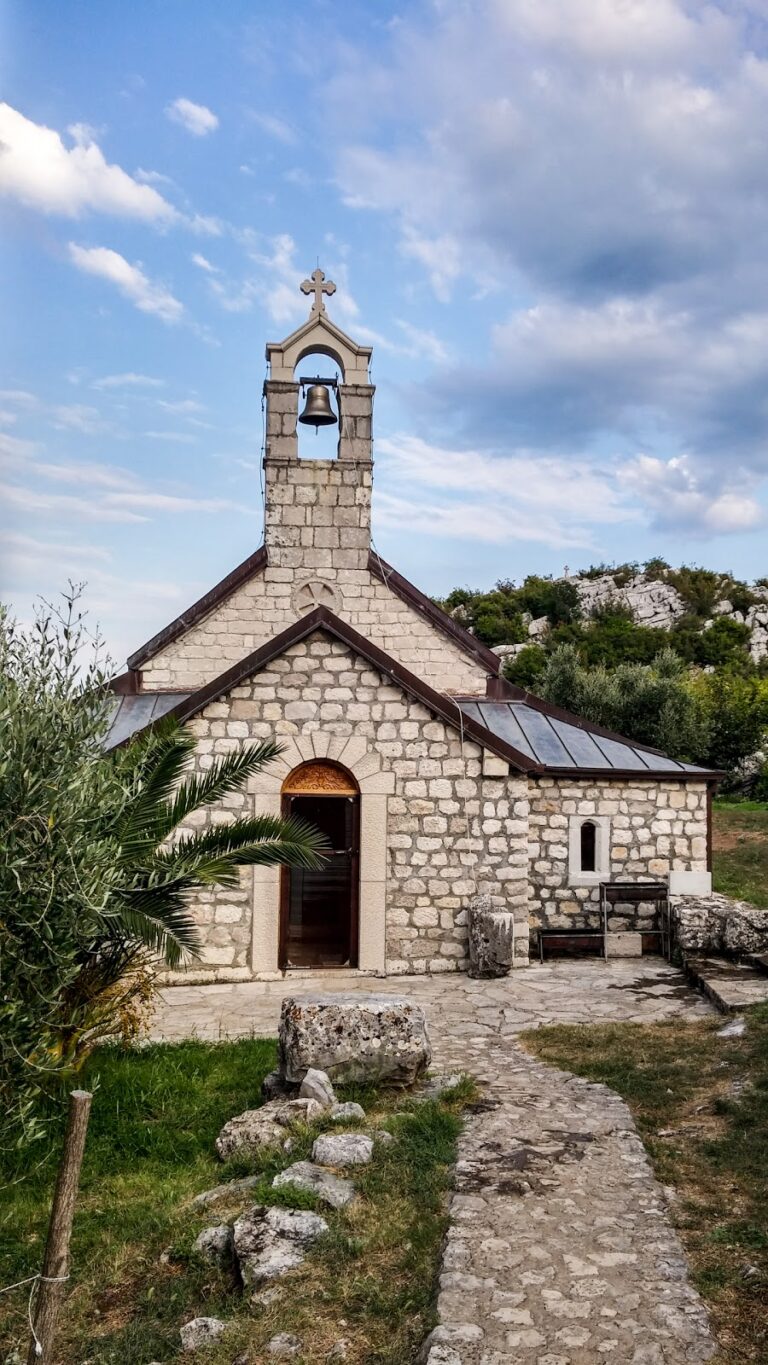
The principal church was dedicated to the Dormition of the Virgin Mary, a major Christian feast commemorating Mary’s death and entrance into heavenly glory. The church survives as part of the ruined complex and forms the architectural center of the remains. Its western side was joined to a larger room whose purpose remains uncertain. Residential use and use as a refectory, a communal dining room in a monastery, have both been proposed.
Bell tower and adjoining room
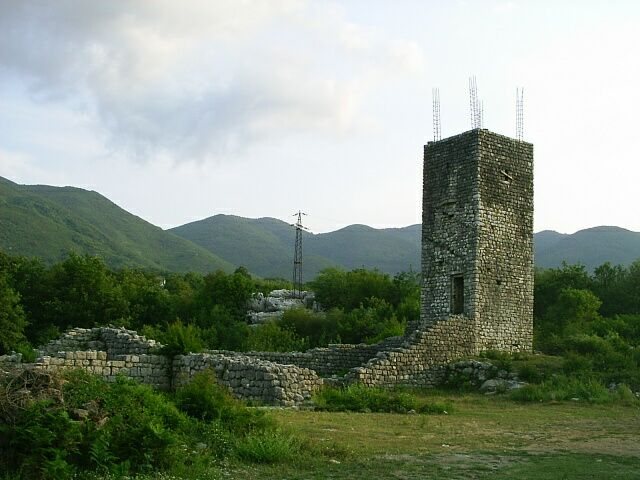
The five-storey bell tower stood at the western end of the adjoining room. Wooden intermediate ceilings separated its floors, and the fourth storey contained a small chapel with an apse, the rounded or polygonal end of a church or chapel. The tower has been partially restored, preserving a substantial element of the complex’s western group.
Walls and defensive setting
Perimeter walls
Visible sections of the monastery’s perimeter walls survive chiefly on the northern side. Further walls stand beside the church and are probably later additions. Their relationship to the main complex requires further investigation, but they form part of the surviving evidence for the monastery’s changing enclosure and layout.
Rocky ground around Krajina
The monastery’s immediate position was not especially suitable for defense. If the name Krajina refers to the area around Jovan Vladimir’s court, the rocky hillocks toward the lake may also have served defensive purposes. This interpretation remains conditional, linking the surrounding terrain to the possibility of a wider defensive setting rather than identifying the monastery itself as a strongly fortified site.