Fatih Sultan Mehmet Mosque: A Medieval Church and Ottoman Mosque in Shkodër


Site at a Glance
- Rating
- 4.7
- Popularity
- Very Low
- Country
- Albania
- Primary era
- Medieval
- Eras represented
- Medieval, Early Modern
- Civilizations
- Ottoman, Serbian, Venetian
- Site type
- Religious
- Remains
- Cathedral
On this page11 sections
History
Fatih Sultan Mehmet Mosque is a former medieval church and cathedral, later converted into an Ottoman mosque, within Rozafa Castle in Shkodër, Albania. Built as a Gothic Christian church, its completion is dated to 1251, while renovation work is recorded in 1319. The building later became a Catholic cathedral and was enlarged during the fourteenth and fifteenth centuries.
Medieval cathedral
The church was dedicated primarily to Saint Stephen, an early Christian martyr traditionally regarded as the first Christian martyr, although traditions also associate it with Saint Nicholas or Saint Lazarus. By the fifteenth century, when Shkodër was under Venetian rule, it served as the city’s Catholic cathedral, the principal church of the diocese and the seat of its bishop.
Its medieval development included several building campaigns. In 1319, Don Andrea of Shkodër, a Catholic cleric, brought carpenters from Ragusa, the historical name for Dubrovnik, to work on the choir. In 1403, the captain general of Shkodër, a senior military and administrative commander, arranged the importation of 5,000 roof tiles from Ragusa. After the 1478–1479 Siege of Shkodër, the bishop was no longer permitted to live inside the castle. A nearby bishop’s house was later apparently replaced by the Inn of Noka, which stood on its foundations until 1951.
Ottoman conversion and use
The building’s transformation followed Ottoman control of Rozafa Castle. A minaret may have been added around 1405, possibly when an Ottoman garrison was installed, but the church is explicitly recorded as having been converted into a mosque in 1685 after the Ottoman reconquest of Shkodër. It became known as the Sultan Mehmet Fatih Mosque, honoring Mehmet the Conqueror, also known as Mehmed II, the Ottoman sultan who captured Constantinople in 1453.
The mosque served Ottoman officials and the wider population while the governor’s offices remained inside the castle. It continued to function regularly until those offices moved into the city in 1865. Early nineteenth-century testimony describes Muslim prayer, sermons, and Mawlid, or Mevlud, recitations, a devotional observance commemorating the birth of the Prophet Muhammad. A report from 1685 also described an organ in the castle church as destroyed and retained as a reminder of Ottoman victories.
Destruction and protection
During the twentieth-century Communist dictatorship of Enver Hoxha, the mosque was partially destroyed, probably around 1967. It was the only one of Shkodër’s 36 mosques to survive that period in partial form. The castle became a cultural monument under Albanian state protection in 1948 and was redesignated in 1971.
Proposals to restore the building as a church were made by Giuseppe Valentini in 1939. A later plan, partly supported by the United States, sought to return the mosque to its original use, but Shkodër’s Muslim community opposed it, and U.S. Ambassador Marcy Ries promised to reassess the project’s funding. Until 2017, the parish of Saint Stephen’s Cathedral held an annual Mass at the site for twelve consecutive years in honor of Shkodër’s patron saint. Shkodër’s Mufti’s Office, a Muslim religious-administrative authority headed by a mufti, regarded the practice as infringing the boundaries of interfaith harmony and tolerance.
Remains
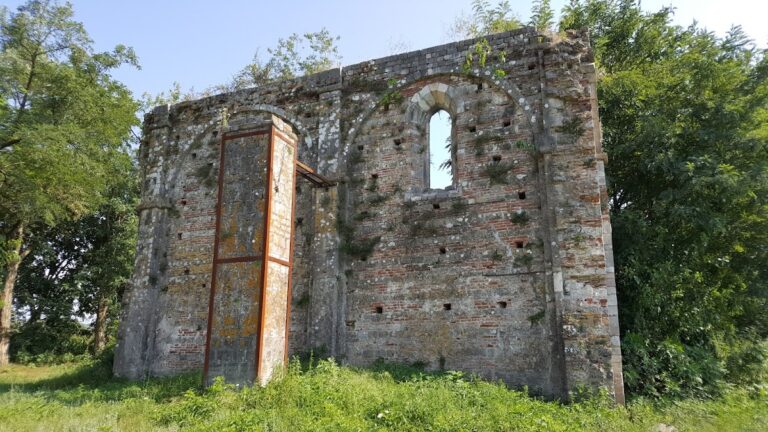
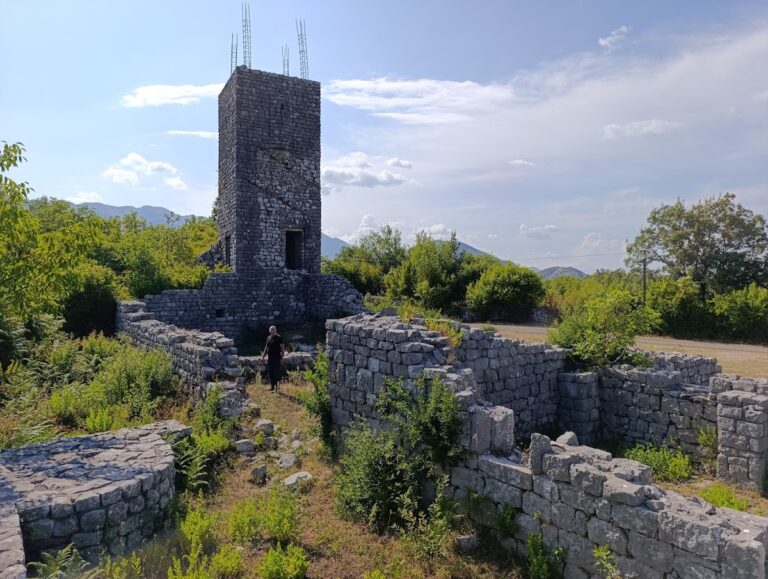
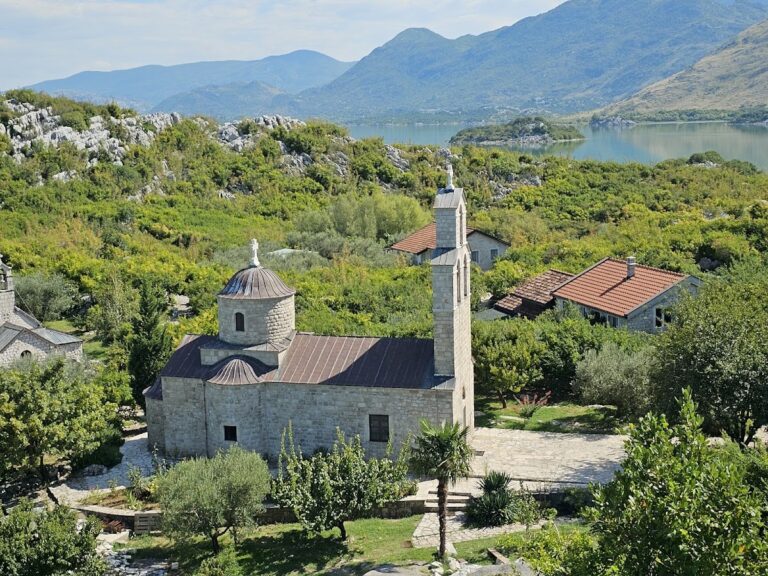
The surviving monument is a partially destroyed ruin within Rozafa Castle, the medieval fortress overlooking Shkodër. It retains elements of the former Gothic church and the later mosque, making its physical form a record of the building’s religious transformation. The medieval church followed a type comparable to Ratac Abbey in present-day Montenegro and a church at Šas, and its design included features associated with both the Dominican and Franciscan Catholic orders.
Former church structure
Gothic church interior
The church contained a roof-covered cella, the principal enclosed chamber of a temple or sanctuary, and an altar marked by crossed vaults. The altar had the church’s only window. Enlargement during the fourteenth and fifteenth centuries altered the medieval structure under Venetian rule. Later uncovered frescoes suggested that the building had originally been a church before its conversion into a mosque, although the documentary basis for that interpretation was once considered unestablished.
Bishop’s residence and Inn of Noka
A bishop’s house stood near the church after the bishop’s residence inside the castle was no longer permitted. The Inn of Noka was apparently built on the foundations of that residence and remained in place until 1951. Its history forms part of the physical development around the former cathedral.
Mosque remains
Minaret and prayer features
The mosque phase added a large minaret on the southern side of the former church. Its placement at the end of the building, rather than to the right of the entrance, and its Seljuk-style form have been regarded as unusual in relation to fifteenth-century Ottoman mosque design. Seljuk traditions came from a medieval Turkic ruling dynasty whose architectural influence extended across parts of the Islamic world.
The former altar apse, the usually semicircular or polygonal end of a church, was aligned with the direction of the qibla, the direction of prayer toward Mecca, and adapted as the mosque’s mihrab, the niche indicating that direction. The ruins also preserve a dikka, a raised platform traditionally used for recitation or the repetition of an imam’s prayers, together with the remains of the minaret.
Objects and surviving condition
Most objects from the former church were removed during its conversion into a mosque. An old organ remained associated with commemorations of Ottoman victories. The structure now survives in a ruinous and partially destroyed condition, but its church fabric, prayer features, fresco fragments, and minaret remains make it one of the few surviving medieval buildings in Shkodër.
Nearby sites