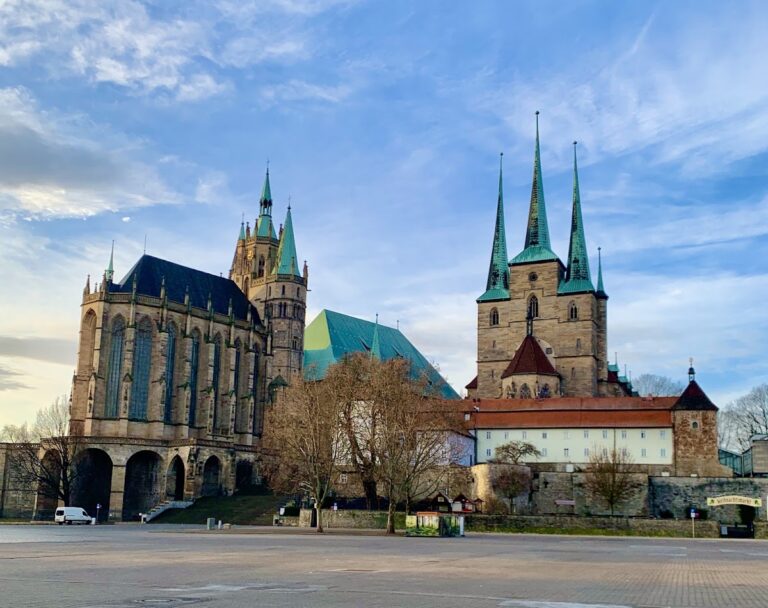
Preacher’s Church: A Dominican Gothic Church in Erfurt, Germany


Site at a Glance
- Rating
- 4.5
- Popularity
- Low
- Country
- Germany
- Primary era
- Medieval
- External website
- Open
- Eras represented
- Medieval, Early Modern, Modern
- Civilizations
- Holy Roman Empire
- Site type
- Religious
- Remains
- Church
On this page17 sections
History
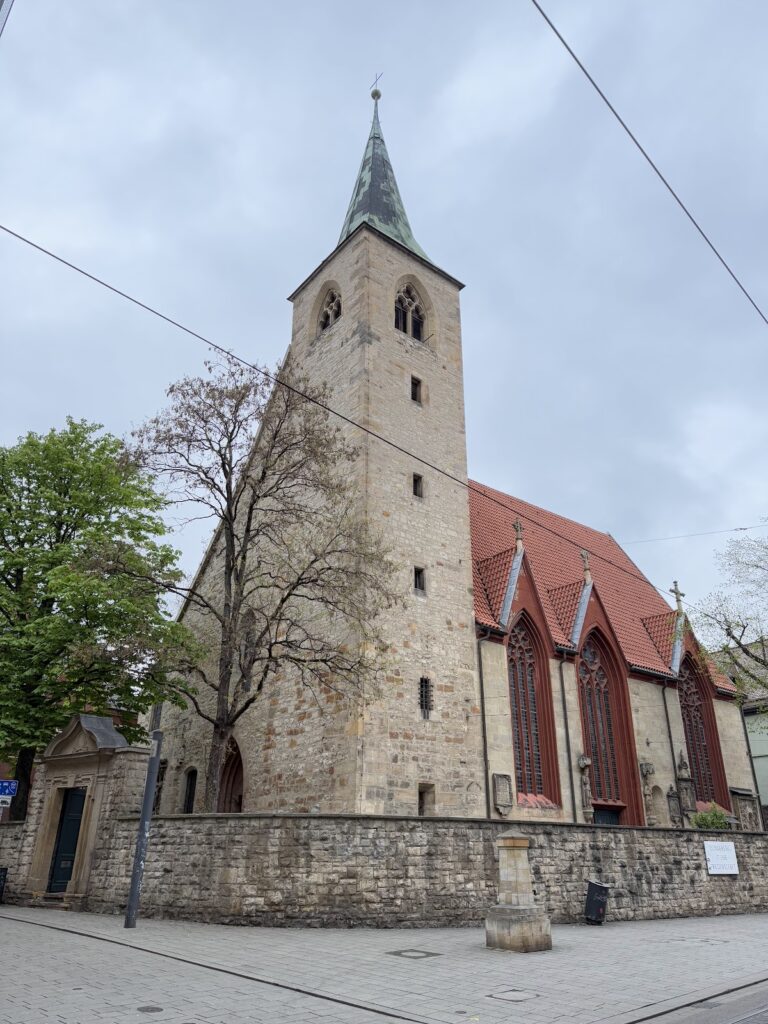
Preacher’s Church is a Lutheran parish church in Erfurt, Germany, built by the Dominican Order during the thirteenth century and later transformed by the Reformation. It stands beside the Gera in the old town and is regarded as a high point of Gothic architecture associated with the mendicant orders, religious communities that depended traditionally on charitable support while emphasizing preaching and pastoral work.
Dominican foundation
In the early thirteenth century, the building site belonged to Vitzthum von Rustenberg, an archiepiscopal administrator from Eichsfeld. Archbishop Siegfried II of Mainz approved the construction of a Dominican foundation near the existing Paulskirche. The first Dominican friars arrived in Erfurt from the Paris convent in 1229. Members of the Order of Preachers, founded by Dominic de Guzmán, they emphasized preaching, theological study, confession, and pastoral work. Before their church was provisionally complete, they preached in public squares and other churches.
Papal privileges allowed the friars to hear confessions, grant indulgences, and bury the dead. These rights helped the community gain influence among Erfurt’s inhabitants and nobility. Archbishop Siegfried II consecrated the first convent buildings, including the oratory and communal residence, in 1230. Bishop Engelhard of Naumburg consecrated the first church in 1238. The later name Preacher’s Church refers to the Dominicans’ formal designation as the Order of Preachers.
An anonymous friar at Erfurt composed the Dominican Annals of Erfurt between the 1230s and 1250s. The friary was also associated with Meister Eckhart, a German Dominican theologian and mystic whose writings made him an influential figure in German Christian mysticism. He was probably admitted as a novice at the Erfurt friary in 1274, when he was about fourteen. He later became prior there and, from 1303 to 1311, served as provincial, the head of the order’s regional Saxonia province, with his office at Erfurt.
Gothic rebuilding
The original church was demolished between 1340 and 1350. A new nave then rose as a continuation of the existing choir. The west facade was completed between 1370 and 1380, while the vaulting was finished by 1445. Although construction extended over more than a century, the building retained a unified appearance. The bell tower was added between 1447 and 1488.
Reformation and civic use
Magister Georg Forchheim preached the first Protestant sermon in the church in 1521. The Reformation, a sixteenth-century movement that challenged established Western Catholic institutions and led to Protestant churches such as the Lutheran churches, altered Erfurt’s parish boundaries because some believers continued Roman Catholic worship. The church’s fifteen altars were removed in an effort to suppress Catholic imagery and the former doctrine.
In 1559, Erfurt’s city council designated Preacher’s Church as its principal church. Ceremonies accompanying the annual change of council were held there and ended with a solemn service. In 1574, a wealthy council master paid for the repainting of the nave and interior. The adjoining friary remained Dominican property until 1588. After its sale to the city council, it became a secular educational institution that continued the tradition of Erfurt’s monastic schools and served as a precursor to an urban civic university. Dominican efforts to recover the former friary buildings in the early seventeenth century failed.
War, fire, and threatened demolition
During the Thirty Years’ War, the conflict that divided much of Europe between 1618 and 1648, Swedish forces under Gustavus Adolphus II occupied Erfurt and the Cyriaksberg in 1631. While in the city, the king used Preacher’s Church as his court church. This further weakened the position of the Dominican clergy.
Parts of the friary complex probably collapsed before the remaining buildings were presumably destroyed in Erfurt’s city fire of 1737. The church itself suffered only minor damage to its tower, while most adjoining buildings and neighboring churches burned. French forces later used the church during the Napoleonic Wars. In 1806 it served as a prisoner-of-war camp and hay store, a use that damaged the building, caused losses to its inventory, and devastated furnishings including sculptures and paintings. Regular services resumed in 1808.
Napoleon Bonaparte ordered the church offered for sale for demolition in 1811, but no buyer came forward. The Prussian architect Karl Friedrich Schinkel later advocated preserving it. The building was repaired around 1826, followed by a comprehensive interior and exterior renovation between 1874 and 1908. In 1850, it was considered as a meeting place for the Erfurt Union Parliament, although the assembly ultimately met at the Augustinian Monastery. In January 1919, Erfurt and the church were also considered as an alternative venue for the German National Assembly when revolution forced it to leave Berlin.
Twentieth-century preservation and public life
During the Nazi period, the congregation took part in the German church struggle. This was the conflict over whether Protestant teaching and church organization would be subordinated to National Socialist ideology. Gerhard Gloege, a leading member of the Confessing Church, served as pastor from 1938 to 1945.
Air raids on Erfurt in 1944 and 1945 destroyed the church windows and removed much of the roof. The building remained exposed to the weather until emergency protection began. Between 1946 and 1950, Pastor Benckert initiated the creation of four colored rubble windows by the Erfurt craftsman Heinz Hajna. They incorporated shards recovered from German Protestant churches destroyed during the war.
A comprehensive reconstruction from 1960 to 1964, directed by restorer Käthe Menzel-Jordan, revealed more than 150 large sandstone grave slabs beneath the floor. The slabs dated from the fourteenth to the eighteenth centuries, and 80 were in good condition. Several intact burials contained partially mummified bodies. The stones had been laid in three layers as a substructure when the floor was renewed around 1900. Many showed signs of reuse and bore images and inscriptions connected mainly with Erfurt patrician families.
During the Peaceful Revolution of 1989 and 1990, Erfurt residents gathered in the church before forming demonstrations through the city. In October, two plenary meetings of the New Forum were held there, attended by 1,750 and 4,000 people. After the political change, efforts to secure and restore the church fabric were intensified. Preacher’s Church is a protected cultural monument in Thuringia.
Remains
The east-west-oriented church has an elongated Gothic plan without buttresses. It measures 76 metres in length and about 19 metres in width. The nave is approximately 8.2 metres wide, while each side aisle is about 4 metres wide. The nave walls average 1 metre in thickness. The main entrance is on the west side, and the tower and former monastery chapter house occupy the south-east corner.
Choir and nave
Vaults and supports
Thirty octagonal pillars support the high nave walls and the cross-ribbed vault, a Gothic system in which intersecting stone ribs carry the masonry surfaces. Twenty-eight of the pillars stand free. Their capitals have carefully carved, shallow leaf sculpture, with related forms appearing on corresponding capitals to the north and south. The surviving choir roof structure dates from 1272 and 1273 according to tree-ring dating, which compares timber growth patterns with established chronological records. It is among the oldest surviving roof structures in Germany.
Choir screens and stalls
The accessible rood screen, a substantial division between the monastic choir and the nave, dates from the middle of the fifteenth century. Older choir screens between the choir and rood screen, and between the choir and side aisles, date from around 1275. The wooden choir stalls are arranged in two rows and date from around 1280.
Altars, paintings, and sculpture
Winged altar
The Gothic winged altar was made around 1492 by Linhart Könbergk of the neighboring Pauls Quarter for the opposite Paulskirche. It was moved to Preacher’s Church after the Reformation. The central shrine contains a Lamentation of Christ, inserted after the Reformation in place of a Coronation of Mary, and is flanked by the apostles Peter and Paul. The wings show the Nativity, the Adoration of the Magi, the Resurrection, and the outpouring of the Holy Spirit.
When opened to its Sunday face, the five-part folding altar presents eight scenes: the Last Supper, the Garden of Gethsemane, the Scourging, the Mocking of Christ, the Descent from the Cross, the Entombment, the Ascension of Christ, and the Assumption of Mary. Its weekday face shows the apostles Peter and Paul. Restoration revealed the signature of an Erfurt carving master on the central shrine.
Wall paintings and devotional works
A fragmentary wall painting of Mary and John dates from around 1460. Another painting, showing the Death of Mary and dating from around 1320, is the oldest known representation of that subject in Erfurt. A sedilia niche, a recessed seat for clergy, depicts the Death of Mary with Saints Thomas and Dominic. The southern choir screen holds the Schmedestedt Madonna, a Madonna and Child made before 1352, together with wall paintings of the Schwanring family from around 1370.
The rood screen includes parts of an Annunciation from around 1360, including representations of Gabriel and Mary. A Calvary group at the northern choir screen dates from 1350 and is accompanied by a depiction of its donor, Hugo Longus, from the same year. The church also contains a Gustavus Adolphus chandelier in the high choir, dating from 1647, and a baptismal font with a wrought-iron enclosure from 1640 to 1646.
Windows and memorials
Stained glass
The high choir contains stained-glass windows made in 1897 and 1898 by the Frankfurt glass painter Alexander Linnemann. Four colored rubble windows made between 1946 and 1950 use shards from Protestant churches destroyed during the Second World War. An additional rubble window is positioned above the northern side entrance.
Grave monuments
The choir and nave contain numerous medieval and early-modern grave monuments. Choir memorials commemorate members of families including the Arnoldi, Aurifaber, Besolt, Brun, Fratscher, Gleytzmann, Gromann, Hallenhorst, Herse, Juch, Kerlinger, Legat, Nacke, Perthes, Rosenzweig, Roth von Schreckenstein, von der Sachsen, Schwanring, Vitzthum, and Wydemann families. They also include monuments to Hugo Longus and Hugo Longus the Younger, Dietrich von Lichtenhain, Melchior Rost, Günther XVI von Schwarzburg-Blankenburg, and other members of Erfurt’s civic and noble communities.
Nave memorials include epitaphs and slabs for Petrus and Christina Avianus, Johannes Bock, Regina Stotternheim, Hermann Paul Juch, Anna Juliana Burchard, Daniel Burchard, Hiob Ludolf and his children, Petrus von Kassel, Eberhard Markmeister, Isentrud Vitzthum, Veronika Martini, Johannes Mech, Paul Mues the Elder and the Younger, Hans Rottendorfer, Henning von Schwerin, Jeremias Seltzer, Abraham Steiner, Heinrich von der Weser, Johannes Wydemann, Heinrich Ziegler, and many others. Together with the grave slabs uncovered beneath the floor, these monuments preserve an extensive record of Erfurt’s patrician, clerical, and civic families.
Organ and musical history
A new organ gallery was built in 1579, and Heinrich Compenius the Elder installed an organ there. In 1648, his grandson Ludwig Compenius constructed a Baroque organ that was played, among others, by Johannes Bach. After several alterations, E. F. Walcker & Cie. built a new instrument in 1898 as opus 800. It had 60 stops and pneumatic action, a system that uses air pressure to transmit the movement of the keys to the valves. That instrument was worn out by the 1950s.
In 1977, the Potsdam firm Alexander Schuke installed a new organ behind the surviving Baroque case of 1648. The present instrument has 56 stops, 4,302 pipes, three manuals, and pedal. Its key action is mechanical and its stop action is electric; an electronic combination system was added around 2000. Its couplers are II/I, III/I, I/P, II/P, and III/P.
The church’s organists have included Johannes Bach from 1636 to 1673, Johann Effler from 1673 to 1678, Johann Pachelbel from 1678 to 1690, Nicolaus Vetter from 1690 to 1691, Johann Heinrich Buttstett from 1691 to 1727, Jakob Adlung from 1727 to 1762, Johann Christian Kittel from 1762 to 1809, Michael Gottard Fischer from 1809 to 1820, and Matthias Dreißig from 1994 onward.
Nearby sites