Barfüßerkirche: A Franciscan Monastery Church in Erfurt


Site at a Glance
- Rating
- 4.7
- Popularity
- Low
- Country
- Germany
- Primary era
- Medieval
- External website
- Open
- Eras represented
- Medieval
- Civilizations
- Holy Roman Empire
- Site type
- Religious
- Remains
- Church
On this page11 sections
History
Barfüßerkirche in Erfurt, Germany, is a former Franciscan monastery church dedicated to John the Baptist. The present church is a High Gothic building whose construction began after 1291 and continued into the early fifteenth century. Until its extensive destruction in 1944, it was regarded as one of Erfurt’s most important churches and as one of Germany’s most elaborate mendicant churches.
The Franciscan foundation
Franciscan friars, members of a Catholic mendicant order associated with Francis of Assisi, settled outside Erfurt on 11 November 1224. They were the city’s first mendicant order. At first, they took over the abandoned Church of the Holy Spirit, which had formerly belonged to an Augustinian nunnery. At the instigation of the Archbishop of Mainz, they began building a church and monastery in 1229 and 1230, and they probably also cared for sick people.
In 1231, the friars moved into convent buildings beside the Gera on land provided by Gunther, the vicedominus, or senior representative, of the archiepiscopal administration at Apolda. Archbishop Gerhard I of Mainz was buried in the church on 25 September 1259. The monastery later suffered several fires, and numerous Franciscans died during the plague that struck in 1463.
A centre of Franciscan learning
During the thirteenth century, the Erfurt convent became one of the central institutions of the Franciscan province of Saxonia, which covered Saxon and neighbouring German territories. Most medieval provincial chapters were held there, indicating the considerable scale and institutional importance of the convent.
A Franciscan school probably existed soon after the friars arrived. By the early 1230s, Erfurt had a house of studies for young friars in the Custody of Thuringia, an administrative subdivision of Saxonia. The institution grew in both size and intellectual level, and a second theology teacher, or lector, is recorded from 1371.
In 1392, the Franciscan studies were incorporated into the theological faculty of the newly founded University of Erfurt, together with the studies of the Augustinian Hermits and Dominicans. Erfurt also became a studium generale, an advanced Franciscan centre of learning that attracted friars from several provinces. In 1467, students came from fourteen provinces, including Argentina, Sicilia, and Burgundia. The convent served as Saxonia’s training centre for future provincial leaders, and six of the twelve provincial ministers before 1517 had earned doctorates in Erfurt.
The provincial minister Johannes von Chemnitz entered the university in 1395. His successor, Johannes von Minden, matriculated in 1396, became head of the Franciscan studies from 1400, and held a university chair. Franciscans subsequently formed an almost continuous part of the university teaching staff. Their theology was influenced by Bonaventure and Johannes Duns Scotus, two major Franciscan thinkers.
Reformation and changing use
The Erfurt Franciscans opposed the Observance movement, a reform current within the order, and from 1518 belonged to the Saxon Province of the Order of Saint John the Baptist. They resisted the Reformation, the sixteenth-century movement that challenged Catholic doctrine and institutions in western and central Europe. Conrad Clinge, guardian of the convent and Erfurt cathedral preacher from 1530, strongly defended Catholic teaching.
Despite this resistance, the church became the parish church of the Protestant Barfüßer congregation in 1525. Martin Luther preached there on 11 October 1529. Since new friars could no longer be admitted, the monastery gradually died out and was dissolved in 1594 after the death of its last Franciscan. The convent buildings were then used as a school. Franciscan Minorites from Cologne briefly occupied the buildings again from 1628, but left in 1637 when Swedish forces returned to Erfurt.
Construction, restoration, and wartime destruction
After the city fire of 1291, construction of a new monastery church began. The choir was consecrated in 1316, work on the nave continued until the beginning of the fifteenth century, and the tower was completed around 1400. The church became one of Erfurt’s largest buildings and remained a prominent feature of the cityscape.
The convent buildings north of the church were demolished between 1641 and 1648 during the Swedish period. Their materials were reused in a bastion, a projecting gun platform, within the city fortifications. A lightning strike damaged the nave in 1838, prompting extensive restoration between 1842 and 1852. The restored church then served as Erfurt’s Protestant garrison church. From 24 August 1874, plaques commemorated soldiers from Erfurt regiments who had died in the German Unification Wars, the nineteenth-century conflicts that contributed to Germany’s political unification.
From 1943, movable and transportable artworks and the valuable early stained glass were removed for safekeeping. The glass was stored in cellar vaults beneath the cathedral crypt, while the winged altar received makeshift protection inside the church. On 27 November 1944, during an attack on Erfurt by several British Mosquito bombers, an aerial mine struck the church, the neighbouring residential area, and the vicarage. The nave was destroyed and the high choir was severely damaged. Debris clearance and the recovery of architectural elements continued through difficult wartime and post-war conditions. During the winter of 1945, part of the damaged seating was burned as fuel by the freezing population.
Post-war preservation
Restoration of the choir began in 1950. On Ascension Day 1957, a service was held there for the first time since the destruction, in a space separated from the ruined nave by a wall. The remains of the nave could be secured only through structural stabilization.
Declining membership led the Barfüßer and Prediger congregations to merge in 1977, after which the church was transferred to the city. Following further choir renovations, the building became a branch of the Angermuseum for medieval art in 1983. Conservation and stabilization measures have continued since 1989, including work through 2015 on structural security, stone restoration, and monument preservation. In 2011, the city received federal support through the Nationally Valuable Cultural Monuments programme. Barfüßerkirche is protected as a cultural monument in Thuringia and has also been treated as a monument of national importance in conservation efforts.
A commemorative plaque from the German Democratic Republic period was removed from the street-facing outer wall after 1990. Since about 2000, the war ruin has also been used for theatre performances, particularly comedies. A working group formed in 2007 to promote awareness of the monument and its long-term preservation became the independent twelve-member Initiativkreis Barfüßerkirche in 2009. At the end of November 2012, the group installed a newly cast bronze relief, Dance of the Dead, by Hans Walther on the outer wall in front of the ruins. A programme connected with the 2017 Luther Year was planned to strengthen the museum use of the church and present the history of Erfurt’s mendicant orders.
Remains
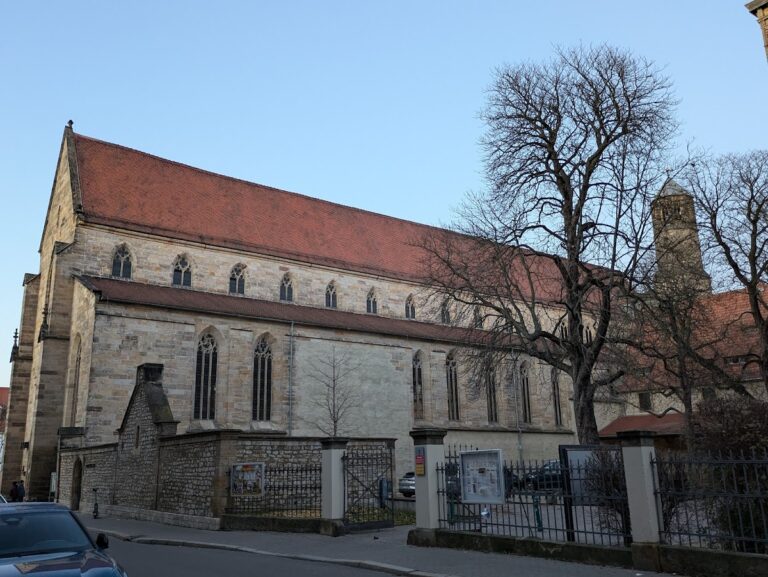
Barfüßerkirche survives as a High Gothic, three-aisled pillar basilica, a church with a higher central nave and lower side aisles, arranged on an elongated plan beneath a long continuous gable roof. The nave remains a war ruin, while the restored choir is enclosed separately by a wall. Together, these surviving parts show the scale of the medieval church and the division between its preserved eastern end and damaged western body.
The choir
The choir dates from around 1300 and was consecrated in 1316. It is polygonal and longer than the choir of the neighbouring Predigerkirche. Its steeply proportioned lancet windows contain simple tracery, the patterned stonework that divides Gothic window openings. Thirteen tall windows illuminate the choir. Some retain coloured glass panes dating from 1230 to 1240, which had already belonged to the Franciscan monastery. The scenes represent episodes from the Passion of Christ and the life of Francis of Assisi, including some of the oldest surviving representations of Francis in the territory of the former Holy Roman Empire.
After the war, the early stained glass was reinstalled in reduced form. Fragments from six windows were fitted into the tracery of three windows over a smaller surface area. Their imagery points to a close relationship between Barfüßerkirche and the Franciscan mother monastery in Assisi.
A slender, finely articulated tower was added to the north side of the choir in the fifteenth century. A low chapel was built on the south side. Its vault incorporates shield-shaped vault bosses, decorative projections at the intersections of vault ribs, taken from the nave and dating from around 1400. An eastern vault member rests on a figurative wall console showing a hand above an upside-down demon’s head.
The ruined nave
The nave was laid out as two transverse rectangular vaulted bays above each arcade arch. Its surviving fabric was left as a war ruin and could be made secure only through structural stabilization. The nave’s condition reflects the destruction of 27 November 1944, when the aerial mine destroyed this part of the church while severely damaging the choir.
The winged retable
The five-part winged retable, an altarpiece behind the altar with hinged panels, dates from 1446 and is one of Erfurt’s important carved altars. It was moved to Barfüßerkirche after 1594 from the abandoned Bartholomew’s Church. Major alterations in 1829 changed its appearance, and after 1945 it was restored as far as possible to its original state. The high altar, dated 1445, was freed from its protective enclosure, restored, and returned to use.
When fully open, the retable’s central shrine shows the Coronation of Mary by Christ. It is surrounded by scenes of Christ’s birth, the Presentation in the Temple, the Resurrection, and the outpouring of the Holy Spirit. The inner sides of the wings contain eight standing saints in two rows beneath canopies, carved by Master Jakob of Leipzig. In its half-open position, the Sunday side displays six male and six female saints beneath canopies on each side. Four painted scenes on the outer wings, formerly visible on weekdays, survive only in fragments.
Original invoices connect the retable with Master Carver Hans von Schmalkalden, paintings by Michael Wiespach, gilding by Master Jakob, punched decoration by Master Matthias, and a painter from Göttingen.
Burials and later artistic works
The church contains the 1370 gravestone of Cinna von Vargula, with a strongly stylized portrait of the deceased, and the 1371 gravestone of Auxiliary Bishop Albert von Beichlingen. An auxiliary bishop assists the diocesan bishop rather than governing a diocese independently.
Around 1925, Lyonel Feininger painted several views of the church. One is preserved in the Angermuseum in Erfurt and another in the Staatsgalerie Stuttgart. The choir glazing arranged by Theo Kellner, Hermann Giesau, and the Erfurt city councillor Halfmann during the 1938 renovation was made by Charles Crodel, but it was destroyed in 1944. The later bronze Dance of the Dead relief by Hans Walther remains mounted on the outer wall in front of the ruin, accompanied by an explanatory plaque.