Prang of Wat Arun: A Thai Religious Tower in Bangkok
Site at a Glance
- Rating
- 4.8
- Popularity
- Low
- Country
- Thailand
- Primary era
- Modern
- External website
- Open
- Eras represented
- Medieval, Early Modern, Modern
- Civilizations
- Unclassified
- Site type
- Religious
- Remains
- Temple
On this page9 sections
History
Prang of Wat Arun is a Thai religious tower complex at Wat Arun in Bangkok, Thailand. Its original tower probably dates from the Ayutthaya period, although its exact construction date is unknown, and the present monument was completed in 1851 after a major nineteenth-century rebuilding.
Ayutthaya origins and royal expansion
The first prang stood approximately 16 metres high, or 8 wa. In 1820, King Rama II, one of the Chakri dynasty kings of Siam, planned to enlarge it into a great relic monument for the capital. The new structure was intended to enclose the older Ayutthaya-period tower and preserve its established role as a focus of religious devotion. Only the foundation excavation had begun when Rama II died.
King Rama III continued the project and laid the auspicious foundation stone on 2 September 1842. Construction lasted more than nine years and was completed in 1851. The enlarged prang became one of Bangkok’s prominent tall structures, reaching 81.85 metres.
Restoration and heritage status
The monument underwent repeated restoration. A major intervention during the reign of King Rama V produced the form visible today. Thailand’s Fine Arts Department registered the Prang of Wat Arun as a historic monument on 22 November 1949.
In 2025, the monument was placed on UNESCO’s World Heritage Tentative List. The Ministry of Culture planned for the Fine Arts Department to prepare a nomination dossier while conservation, restoration, and site management continued according to international principles.
Remains
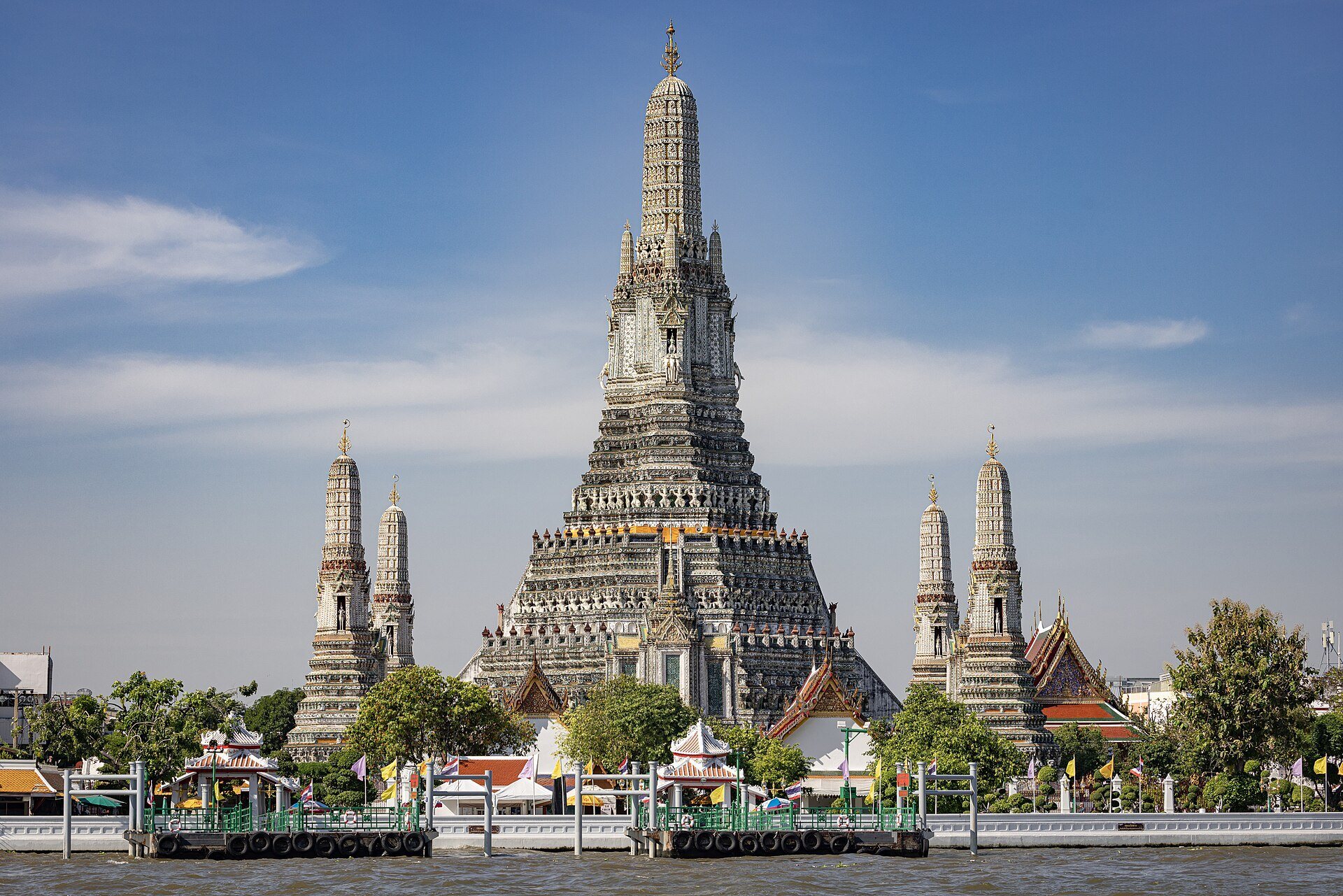
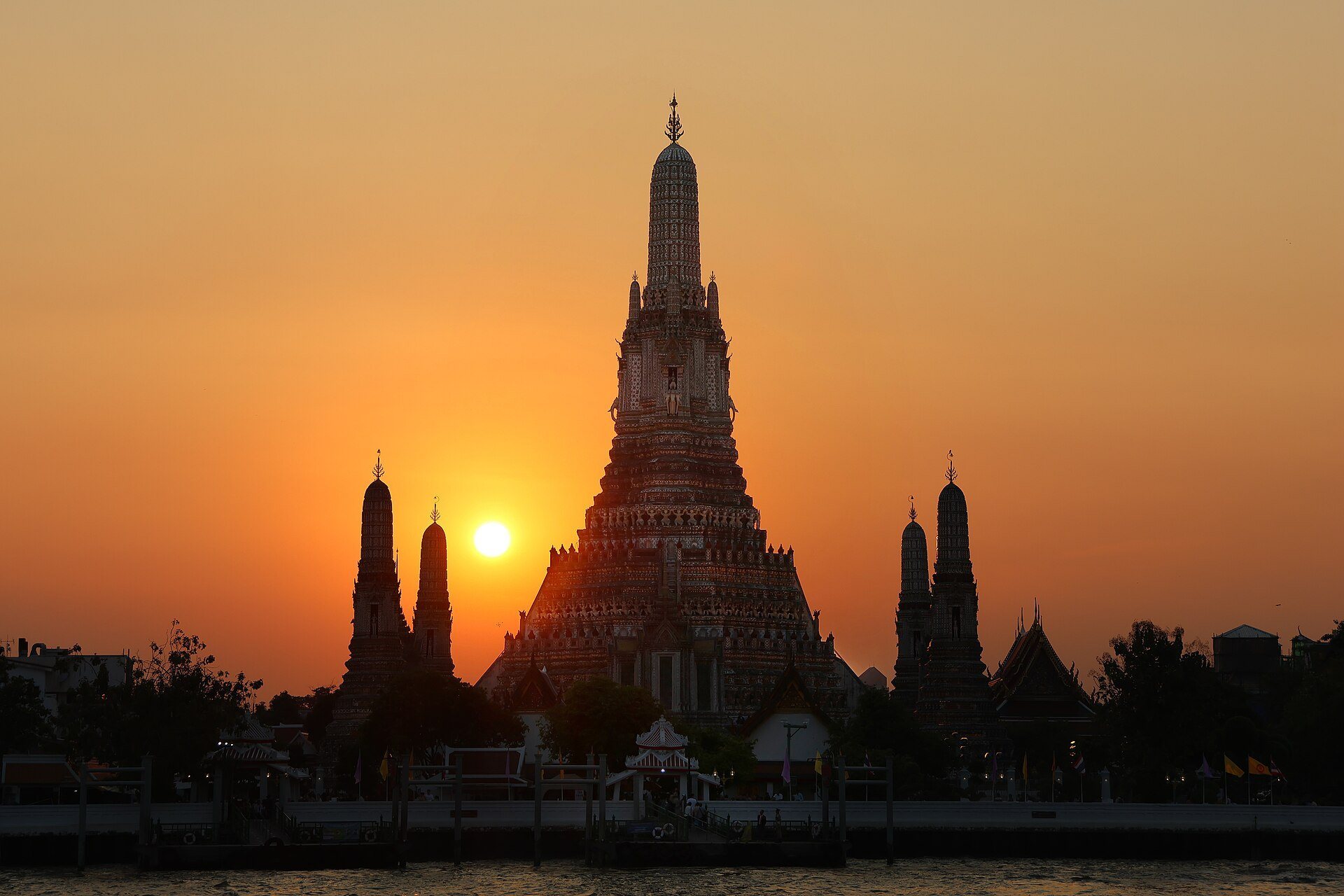
The Prang of Wat Arun is a large Thai-style complex facing east. It consists of one principal prang surrounded by four smaller directional towers. The complex has a base, a central body, and a tiered upper section, while its overall form represents Mount Meru, the cosmic mountain at the centre of Hindu and Buddhist cosmology. The base measures approximately 234 metres.
Principal tower
Structure and ornament
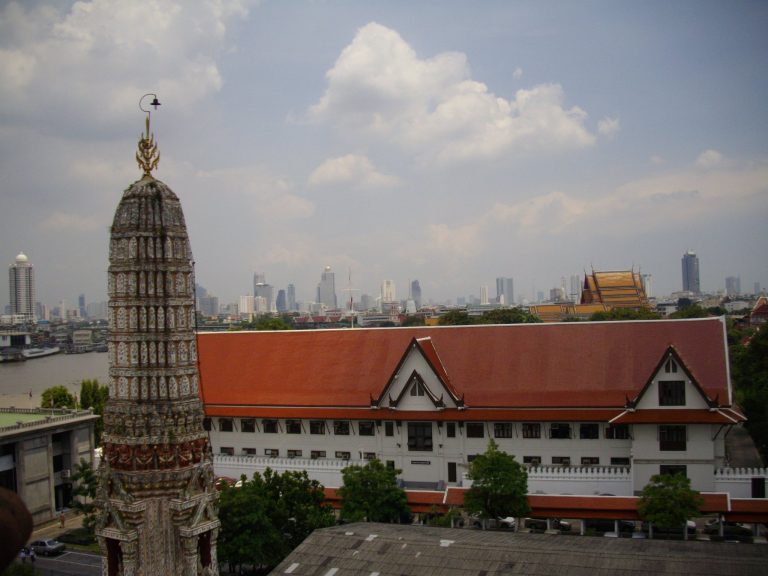
The principal prang has a central height of 67 metres and reaches 81.85 metres from its base to its summit. Brick covered with plaster forms the structure. Its surfaces are decorated with shell fragments, glazed ceramics, and multicoloured Bencharong plates and bowls, a Thai tradition of enamelled ceramic decoration. Much of the ceramic material came from China and was arranged into floral, foliate, and other patterns.
Figures and upper tiers
The lower body narrows through recessed corners, while the upper body rises in successive tiers. Niches in the tiers contain kinnara and kinnari, mythical half-human, half-bird beings. Alternating demons carrying swords support the bowl-shaped ledges above the niches. Higher shrine-like recesses contain Phra Phai, the wind deity, riding horses. Figures of Garuda grasping nagas, together with kneeling deities, appear above the recesses, and a gilded naphasul, the finial at the summit of a prang, crowns the tower.
Directional towers
Four surrounding prangs
Four smaller prangs occupy the northeast, southeast, northwest, and southwest corners of the lower circumambulatory terrace around the principal tower. Each is built of brick and plaster and decorated with coloured glazed glass in a manner similar to the main prang. Their arrangement establishes the four directional points around the central tower.