Taq-e Bostan: A Sasanian Rock-Relief Complex in Iran
Site at a Glance
- Rating
- 4.6
- Popularity
- Medium
- Country
- Iran
- Primary era
- Medieval
- External website
- Open
- Eras represented
- Classical, Medieval, Modern
- Civilizations
- Qajar, Sassanid
- Site type
- Civic
- Remains
- Monument
On this page14 sections
History
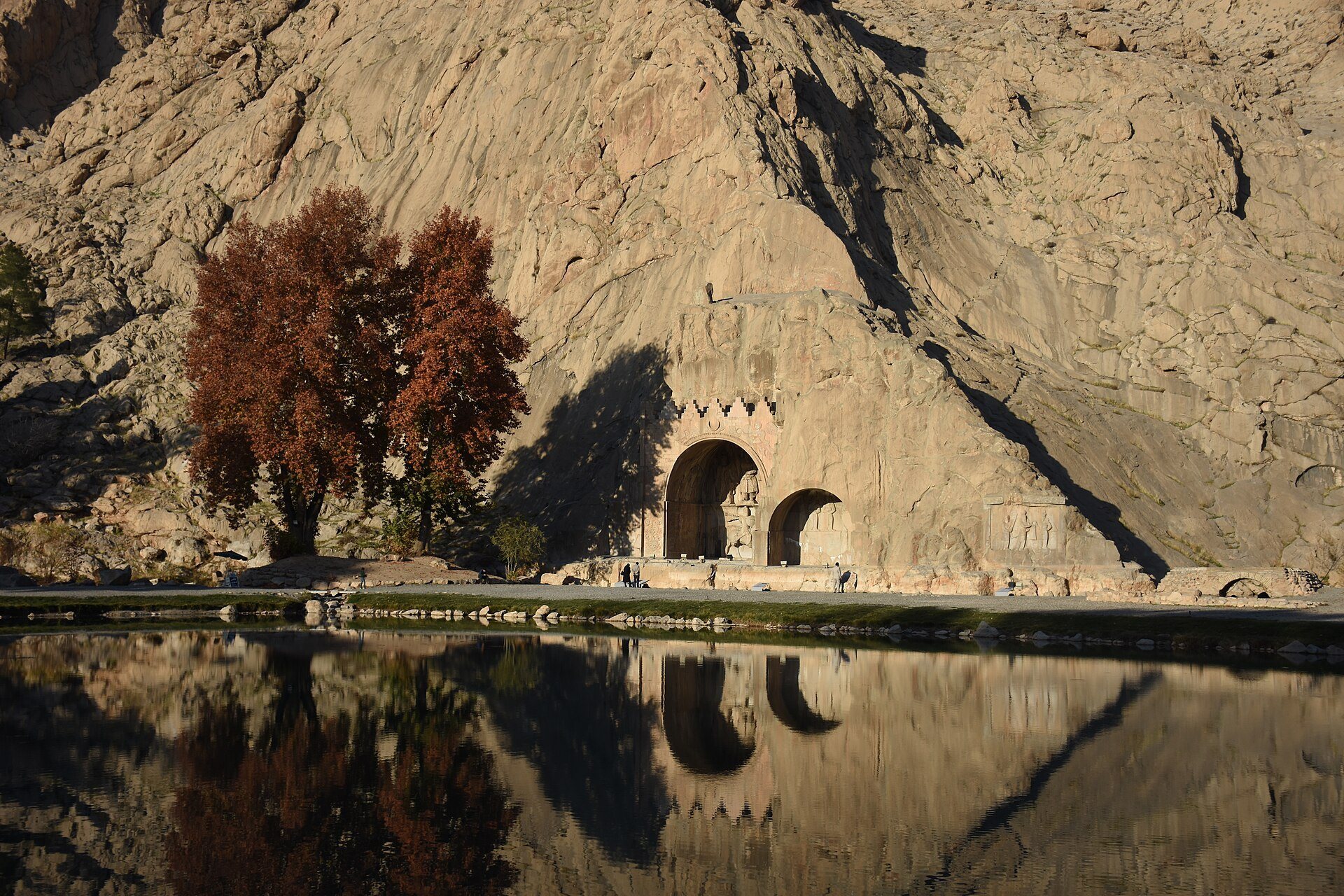
Taq-e Bostan is a Sasanian rock-relief complex in northeastern Kermanshah, Iran, at the foot of the Zagros Mountains. Developed in successive phases from the late fourth century into the late Sasanian period, the approximately 1,700-year-old site preserves royal sculpture associated with kingship, hunting, ceremony, and religious belief.
Setting and early development
Taq-e Bostan stands beside a historic route associated with the Silk Road, near springs regarded as sacred by Zoroastrians. The combination of mountain, water, and vegetation appears to have supported the site’s long religious and ceremonial importance. Prehistoric cemeteries occupy a nearby hill, while the summit of the Taq-e Bostan hill was used during the Parthian period.
The complex may have served more than one purpose. A partly visible ancient enclosure and the hunting scenes have encouraged its interpretation as a royal hunting park, or paradeisos. The spring and the presence of Anahita, a Zoroastrian goddess associated with water, fertility, prosperity, and vegetation, have led other interpretations to emphasize a religious function. Its exact original role remains uncertain.
Sasanian royal phases
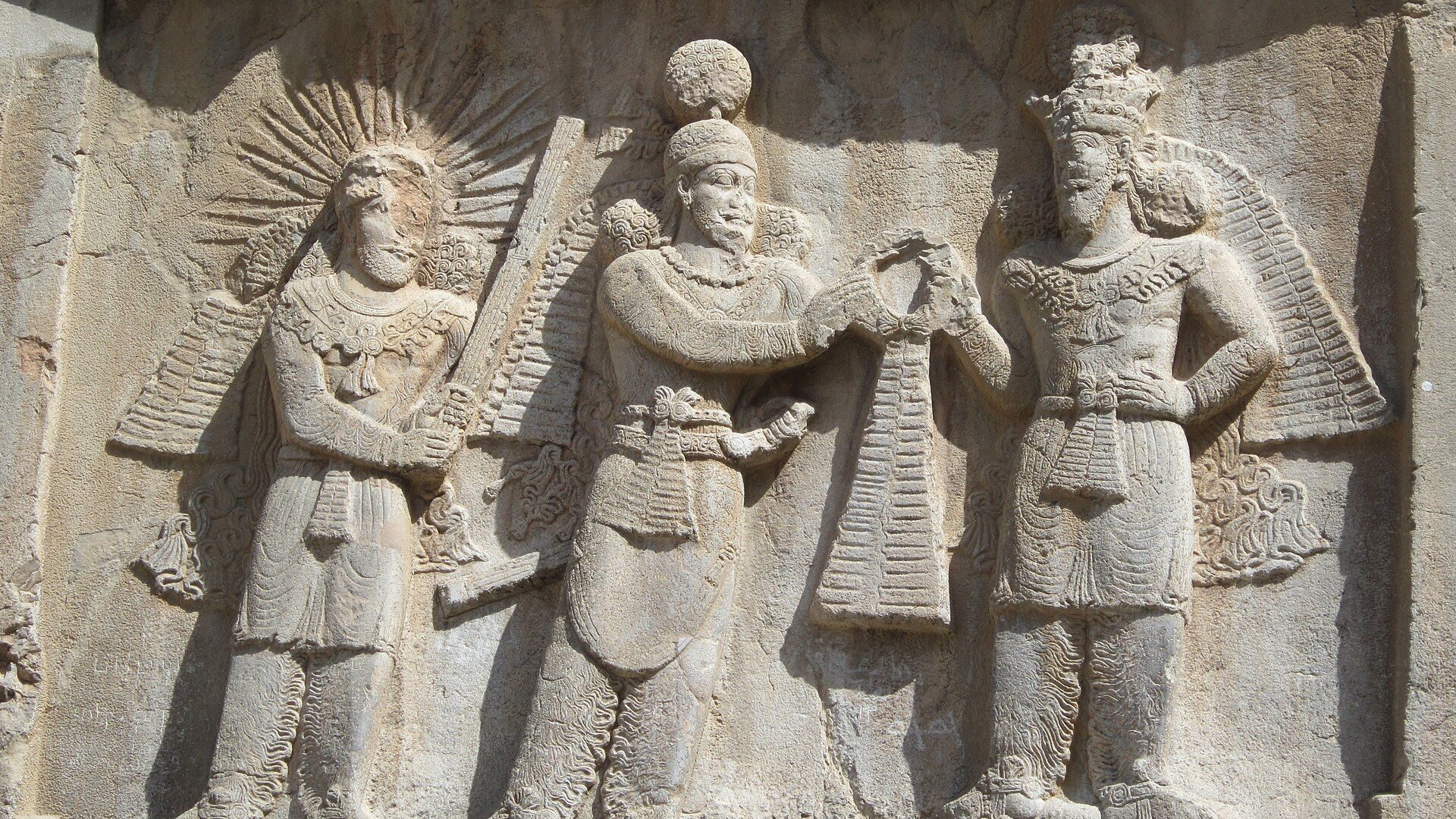
The earliest relief is the investiture scene of Ardashir II, created during his reign from AD 379 to 383. In Sasanian ideology, Ahura Mazda, the supreme deity of Zoroastrianism, was the divine source of legitimate kingship. The relief presents royal authority through a ceremonial transfer of the investiture ring, while also connecting the ruler with divine and military power.
The smaller grotto was constructed under Ardashir II’s successor, Shapur III, who ruled from AD 383 to 388. Its inscriptions identify Shapur II and Shapur III as divinely descended, Mazda-worshipping kings of Iran and non-Iran, and set out their royal parentage. The large grotto belongs to the late Sasanian period and is generally associated with Khosrow II, although some interpretations identify the principal king as Peroz I.
The reliefs represent Shapur II, Ardashir II, Shapur III, and Khosrow II through royal investitures, hunting, music, and military imagery. They form an important surviving group of Sasanian sculpture in the Zagros region and express several aspects of royal identity, including divine legitimacy, court ceremony, military strength, and aristocratic sport.
Later history and protection
After the Arab conquest, royal relief sculpture was not continued in Iran until the Qajar period. In the nineteenth century, Mohammad-Ali Mirza Dowlatshah, the Qajar governor of Kermanshah and son of Fath-Ali Shah, ordered a relief of himself above the Sasanian hunting panel in the large grotto. The addition damaged the earlier work.
During the same century, Emam-Qoli Mirza Emad al-Dowleh, governor of Kermanshah, built the Masudieh Mansion near the complex. The building was demolished in the twentieth century to expose the antiquities and clear the spring identified as the Spring of Anahita. The work was associated with an archaeological interpretation later attributed to Roman Ghirshman and his team.
Taq-e Bostan was registered as a national monument in the twentieth century. Its scenic protection zone was also established during that period. A later protection plan covered approximately 1,170 hectares, including a 145-hectare core area, the surrounding park, Taq-e Bostan village, the hunting ground associated with Khosrow II, Muradhasel Hill, and the boulevard extending toward the water. Proposals in the twenty-first century included adding the site to a UNESCO World Heritage nomination for the Sasanian Axis and creating a Sasanian-period research institute.
Earth movement has caused cracks in both grottoes. Moss and water entering the cracks have progressively obscured parts of the reliefs and created continuing conservation concerns. The entrance of the large grotto was restored in the twentieth century, when the grounds were also landscaped with a basin and a garden displaying architectural fragments.
Remains
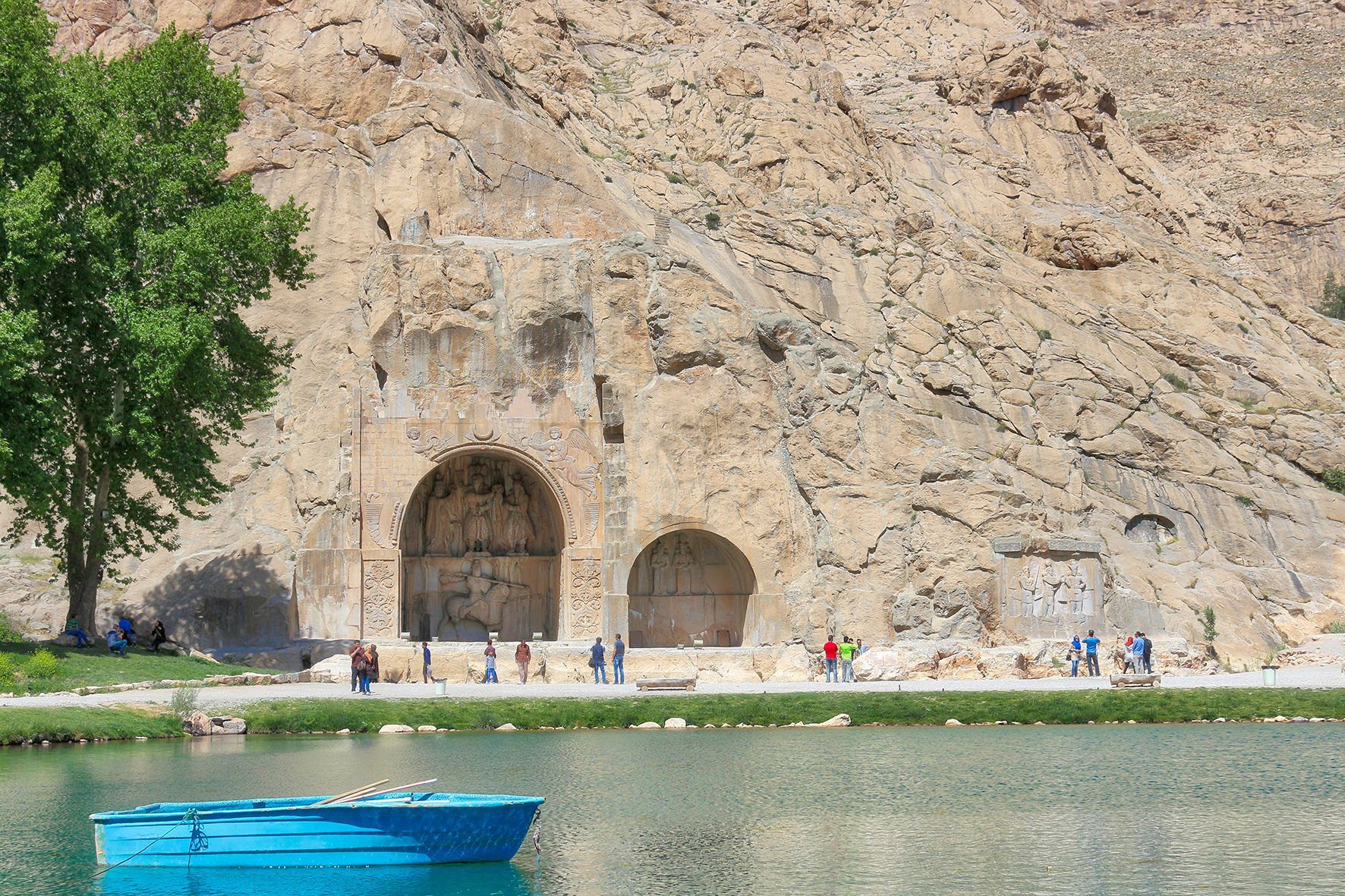
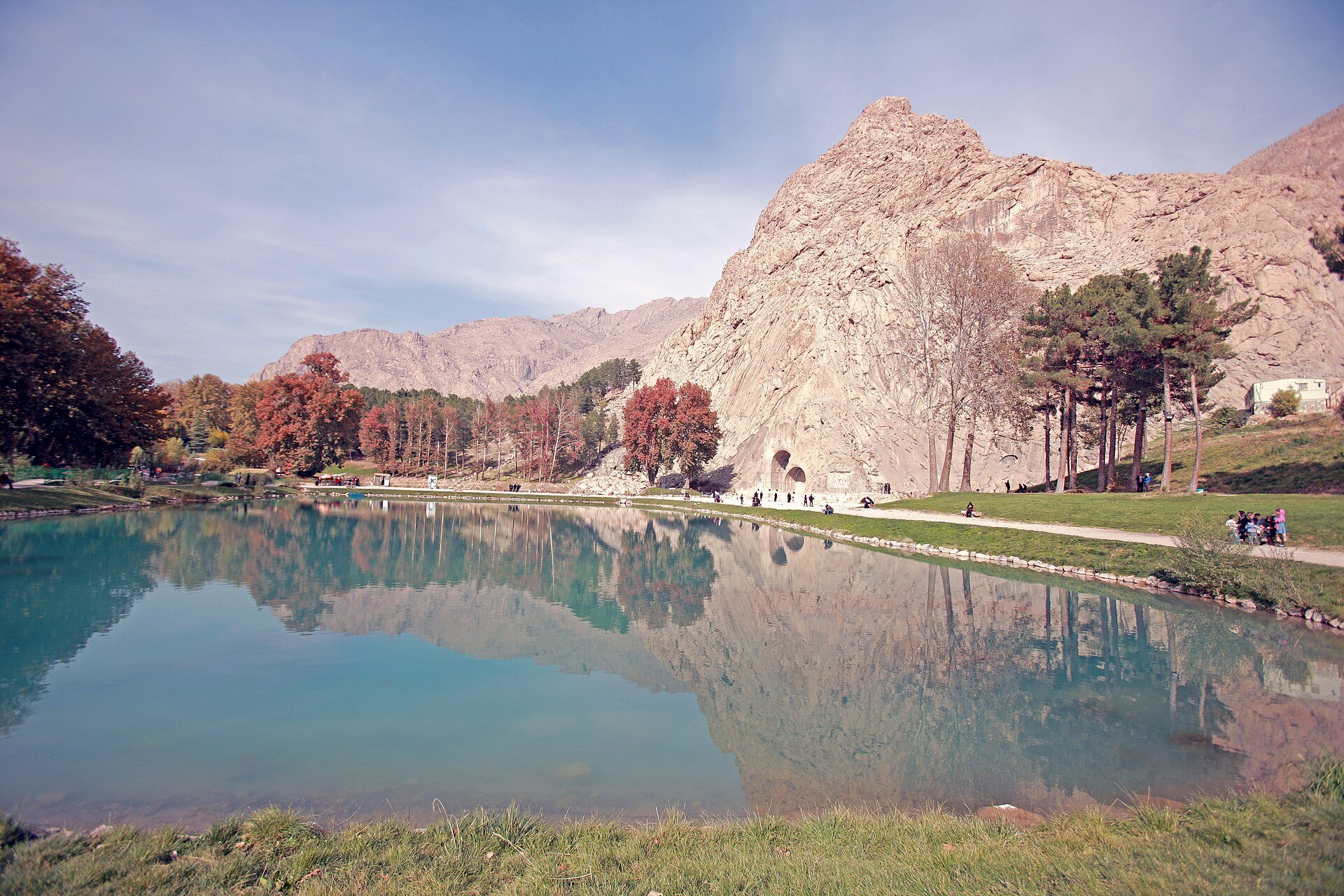
Taq-e Bostan consists of a freestanding investiture relief and two rock-cut grottoes, or iwans, beside a spring, a lake or reflecting basin, and the mountain slope. An iwan is a vaulted space open on one side. The smaller grotto lies between the Ardashir II relief and the larger grotto, while the larger chamber contains the most extensive scenes of royal ceremony and hunting.
Investiture relief and small grotto
Ardashir II relief
The freestanding investiture relief beside the small grotto measures approximately 4.07 metres across and 3.9 metres high. Ardashir II receives a ribboned investiture ring from Shapur II, while Mithra stands behind him and the defeated Roman emperor Julian lies beneath the figures. Another interpretation identifies the crowning figure as Ahura Mazda.
Ardashir stands facing forward, with one hand on his sword and the other accepting the ring. His costume includes earrings, a pearl necklace, bracelets, elaborate decoration, and a large curled beard. Mithra stands on a lotus flower beneath a halo. The relief’s arrangement connects royal authority with divine sanction and victory over a defeated enemy.
Small grotto
The rectangular small grotto is approximately 5.8 metres wide and 5.3 metres high. A separate description gives its vestibule as about 6 metres by 5 metres by 3.6 metres. Two high-relief royal figures stand on the rear wall facing one another, each resting both hands on a long sword. Pahlavi inscriptions, written in the Middle Persian language and script used for official and religious texts during the Sasanian period, identify them as Shapur II and Shapur III. Each figure is about 3 metres high.
The grotto contains two inscriptions, one of nine lines for Shapur II and another of thirteen lines for Shapur III. Both describe the rulers as divinely descended, Mazda-worshipping kings of Iran and non-Iran and name their royal ancestry.
Large grotto
Investiture and mounted warrior
The large grotto forms an approximately rectangular chamber 7.85 metres wide, 11.9 metres high, and 7.65 metres deep. Three large figures occupy its rear wall and are usually understood as Khosrow II receiving investiture from Anahita and Ahura Mazda. Other interpretations identify the flanking figures as a priest and priestess. The sculpture approaches three-dimensional form, an unusual technique in Sasanian art, and the king rises more than five metres, larger than the divine figures.
In the upper scene, the king receives a diadem or ring of power. The carving carefully renders embroidered garments, belts, sword scabbards, trousers, jewellery, and details resembling precious stones. The figures do not follow a strict arrangement with all heads at the same level, allowing them to follow the curve of the vaulted ceiling.
Below the investiture scene is an armoured mounted warrior, generally identified as Khosrow II riding his celebrated horse Shabdiz. Another interpretation identifies the king as Peroz I. The rider and horse wear complete armour, including a helmet, mail, and a richly decorated covering. The detailed mail leaves only the king’s eyes visible.
Entrance decoration
Two winged female figures frame the entrance and hold the ring of power and royal diadem. Trees of life flank the opening, their acanthus-like foliage combining Greco-Roman and Indian elements. Above the arch, a crescent releases another diadem that descends on both sides of the entrance. These carvings join royal insignia with vegetal and symbolic imagery.
Boar-hunt panel
The left wall contains a detailed royal boar hunt set within an enclosed marsh. Reeds surround a central lake, while barriers made from branches, stakes, and rope define the hunting ground. Elephants drive boars toward the water. The king hunts from a boat with a bow, while other boats carry female musicians and singers.
The composition brings several moments together. The king aims at a boar, shoots it, and returns to the shore. Both the king and the boar appear twice, and a halo surrounds the king in his second appearance. One interpretation identifies this haloed figure as the king’s fravashi, a protective spiritual being in Zoroastrian belief, rather than as a second depiction of the ruler.
Deer-hunt panel
The right wall presents a more complex but less finely finished deer hunt. Elephants drive the animals, and deer are released from cages into an enclosure. The king approaches on horseback beneath a parasol with his court, then joins the pursuit. The scene continues with the butchering of the deer and camels carrying away the hunting spoils.
Musicians playing harps and wind instruments appear among the hunting scenes, together with boats, elephants, horses, reeds, fish, birds, and other details. Riders’ clothes display gold-thread weaving and geometric diamond patterns. The king’s hunting garment bears repeated Simurgh designs in circular panels, while boatmen, attendants, and elephant riders wear clothing decorated with vegetal and bird motifs. The boar hunt is especially notable for its accomplished stone composition and a visual treatment close to wall painting.
Spring, hillside features, and archaeological park
The springs originally emerged through several channels beneath and beside the reliefs. A smaller lake or basin survives around the complex, and the springs continue to feed a large basin in front of the cliff. On the eastern side of the spring, a stone staircase cut into the mountain has 78 steps. A stone niche higher on the slope may also have been cut into the rock.
A newly discovered relief was reported in the niche in the late twentieth century. It shows a human-like figure with raised arms holding an object, accompanied by several characters resembling Latin letters that remain illegible. Its date is uncertain. Another relief beside the staircase and spring resembles this image.
The archaeological park contains Sasanian and late Sasanian or Islamic column capitals and other material brought from Taq-e Bostan, Mount Behistun, and elsewhere in Kermanshah. Some capitals carry geometric designs, while others have figural decoration. Together with the grottoes and open-air reliefs, these remains preserve evidence of stone carving, high relief, near-round sculpture, armour and textile detail, geometric ornament, vegetal forms, birds, musical instruments, and royal insignia.