Pointe du Souc’h Necropolis: A Neolithic Burial Complex in Brittany
Site at a Glance
- Rating
- 4.5
- Popularity
- Medium
- Country
- France
- Primary era
- Stone Age
- Eras represented
- Stone Age
- Civilizations
- Unclassified
- Site type
- Burial
- Remains
- Necropolis
On this page17 sections
History
The Pointe du Souc’h necropolis is a Neolithic burial complex at Menez Dregan, in Plouhinec, Finistère, Brittany, France. Its earliest burial dates to 4530–4360 BC, and the site developed through successive phases of tomb construction. The pit grave is regarded as the best-preserved Middle Neolithic I burial in Lower Brittany.
Neolithic construction and use
The pit grave was followed by a first dolmen, built around 4000–3500 BC. Its construction damaged the northern part of the grave’s mound. A partitioned dolmen dates to about 3310–2910 BC. The latest dolmen belongs to the Final Neolithic, broadly dated to about 3500–2200 BC, and remained in use into the Chalcolithic, or Copper Age, which followed the Neolithic.
The burial mound developed through six construction phases and contained six chambers. At a later stage, construction covered the oldest chamber.
Antiquarian accounts and archaeological work
In 1844, Chevalier de Fréminville described the necropolis as a Druid sanctuary, a mistaken interpretation of the prehistoric site. Alexis Grenot carried out the first excavations in 1870–71, uncovering a compartmented structure and grave goods. The finds passed to Paul du Châtellier and are now held at the National Archaeological Museum at Saint-Germain-en-Laye.
The site continued to be quarried for stone until the 1970s. It received France’s Historic Monument heritage-protection designation in 1979. Excavation campaigns led by Michel Le Goffic began in 2000 and continued for seven years. Four installations were excavated, while other parts of the necropolis remained poorly preserved. The latest dolmen, which nineteenth-century excavators had avoided because they feared its covering slab might collapse, was examined in the later campaigns.
Remains
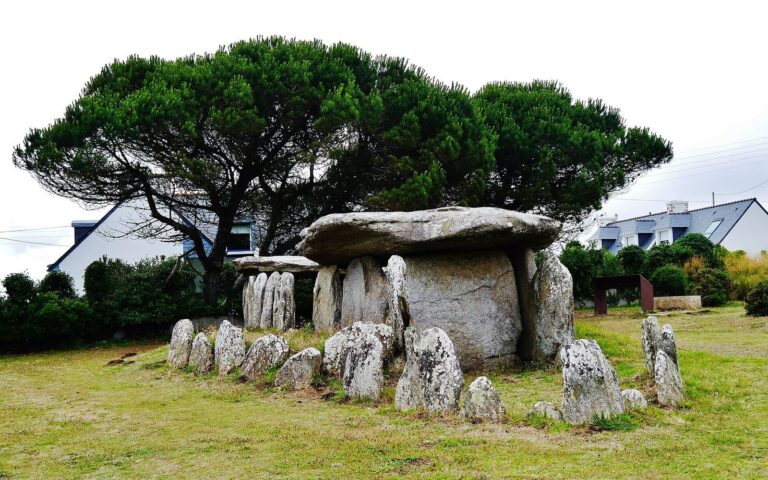
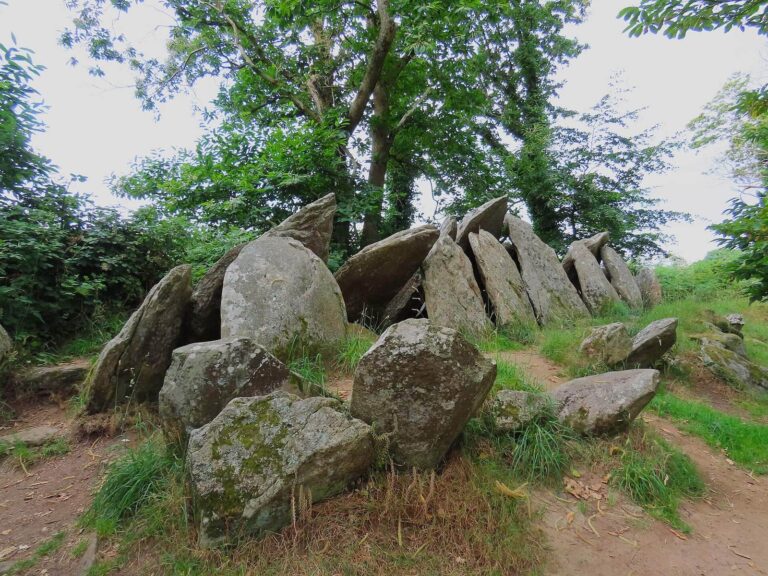
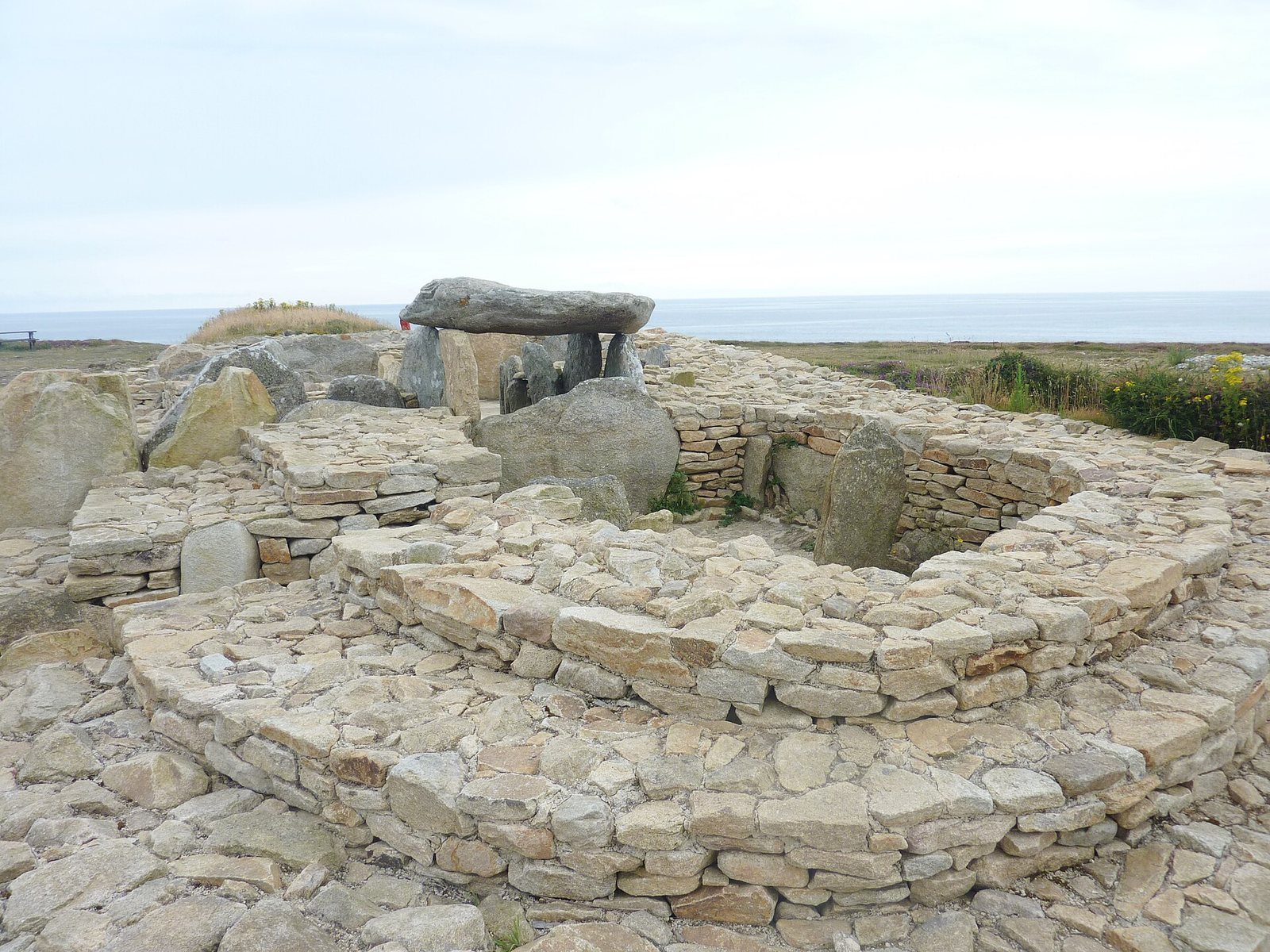
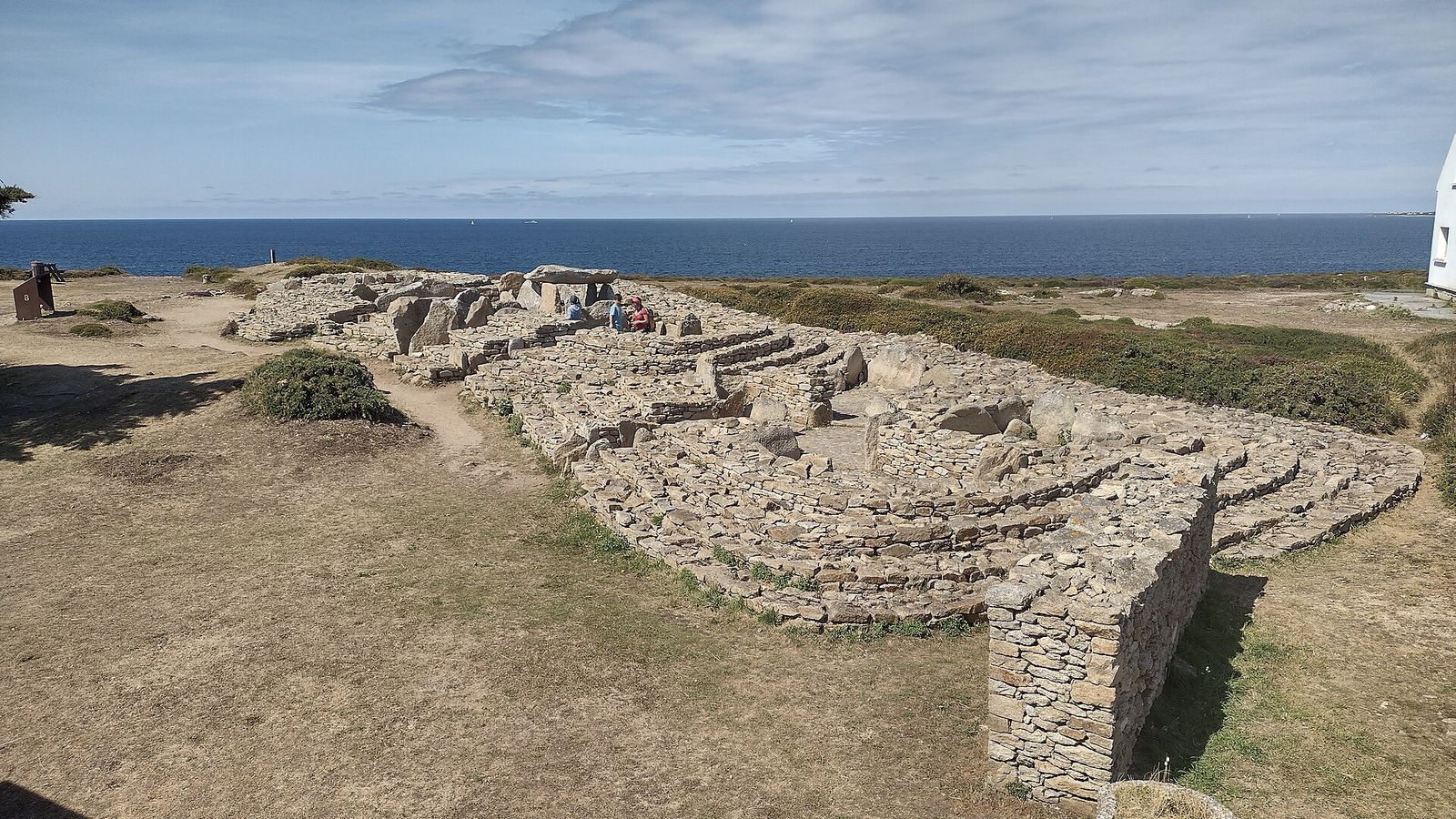
The cemetery is organized around a stone mound, or cairn, about 42 m long and 11 m wide, containing several burial structures. The building stones came from two quarries west of the necropolis. Builders worked the local orthogneiss, a metamorphic rock formed from an igneous precursor, along its natural fractures, using large coastal pebbles as hammers and mauls. Some of these tools weighed as much as 50 kg. The site lies about 100 m above Menez Dregan cave, which contained Paleolithic finds; its outlook extends from Pointe de Penmarc’h to Île de Sein.
The pit grave
The grave was cut 20–30 cm into the ground, down to the underlying gneiss. It measures 2.15 m by 1.20 m and is oriented east-northwest to southwest. Flat stones lined its edges. Silt covered the burial, with gneiss slabs above it forming a mound about 8 m by at least 26 m. Finds associated with the grave include two vessels of the Cerny culture, a Neolithic archaeological culture: one has a large oval opening and the other is bottle-shaped. Other objects include five transverse arrowheads, a flint fire-making tool with a piece of pyrite still attached, and a polished axe made of dense metamorphic rock called eclogite.
Dolmens within the cairn
First dolmen
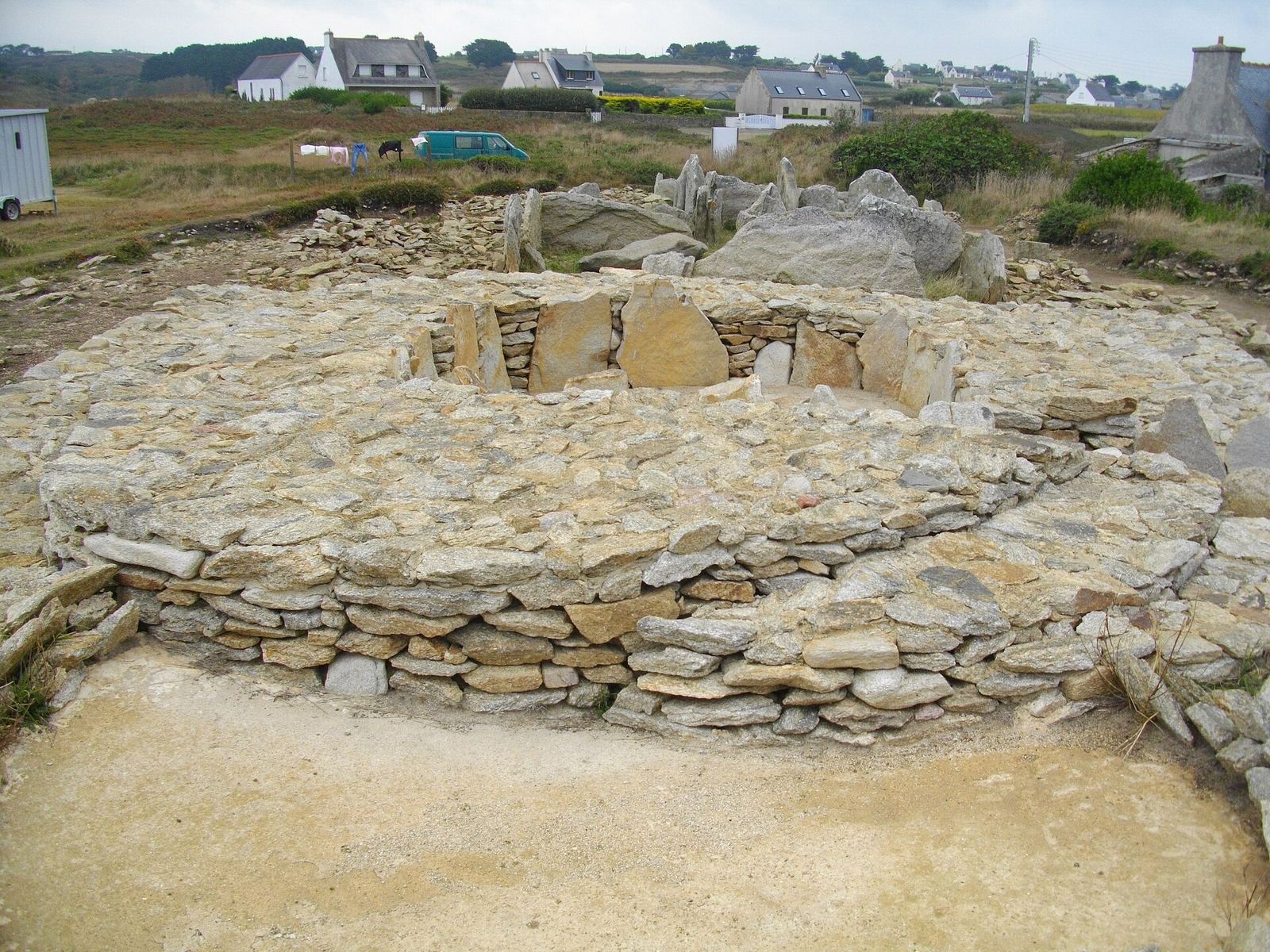
Near the pit grave, the first dolmen had a four-sided plan defined by small upright stones and dry-stone walls, built without mortar. Several layers of facing stones enclosed it. Its corridor opened to the southeast and was later blocked with piled stones. A ladle-like vessel found among them has a lug pierced by four holes, probably so a handle could be attached.
Second and third dolmens
The second dolmen stood about 6 m north of the first. Two side chambers, each 2.8 m by 1.8 m, flanked a central corridor formed by small upright stones and dry-stone walls. Its cairn had several nested layers of facing stones. A third dolmen adjoins it to the north and has four compartments arranged around a central corridor.
Fourth dolmen
A fourth dolmen, with a partitioned chamber, occupied the space between the first dolmen and the group formed by the second and third.
Fifth dolmen
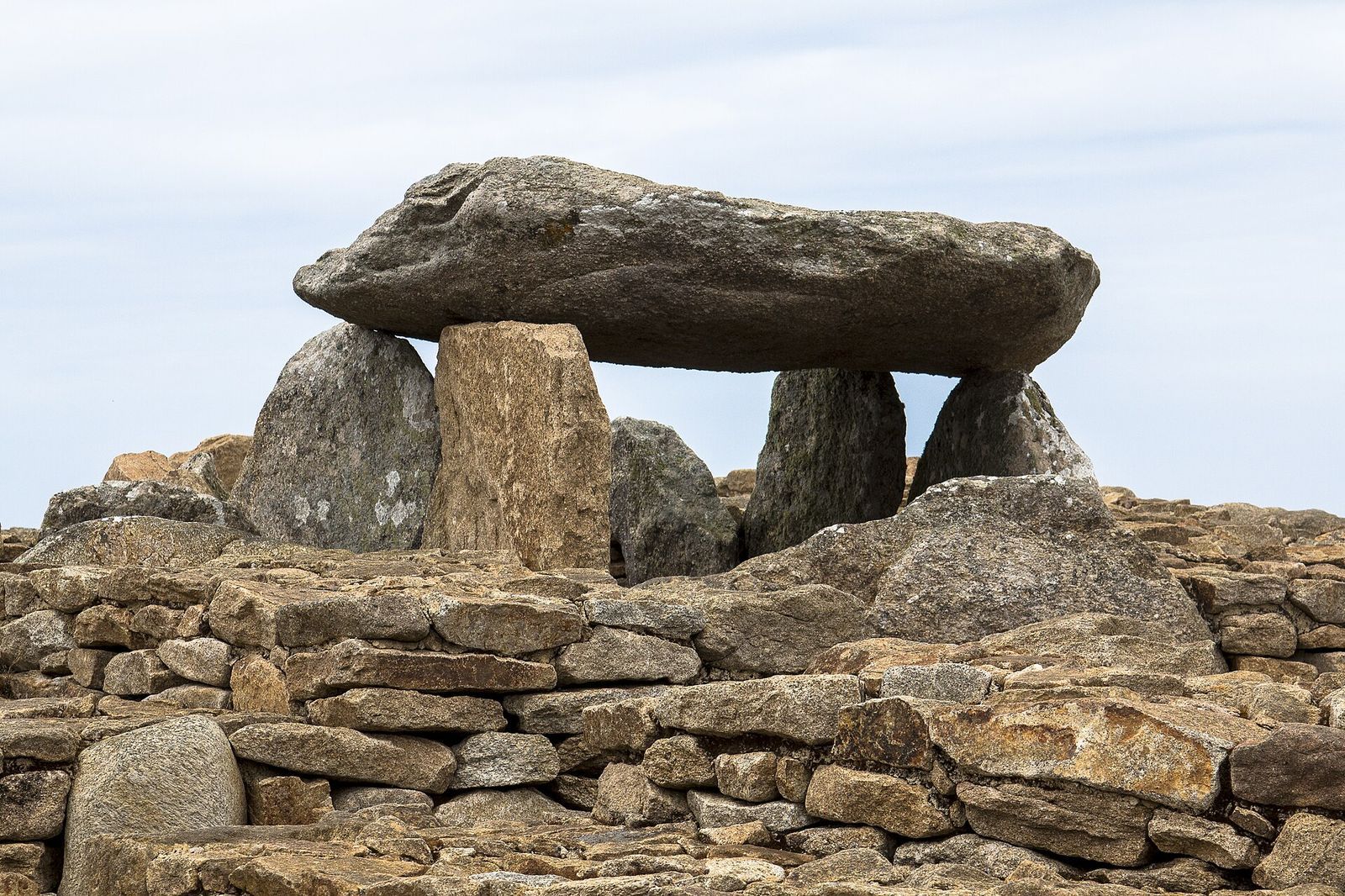
The fifth dolmen stands near the centre of the existing cairn, which was already partly ruined when it was built. It is a side-entry passage tomb, a burial chamber reached through a passage. Two notched slabs and a sill form a low entrance from the corridor into the end chamber, which remained under its capstone. Finds include 104 beads smaller than 5 mm, of which 78 are slate and 26 are clinochlore, a mineral. Pottery sherds include Kerugou type, a prehistoric pottery tradition, and Bell Beaker type, associated with a wider prehistoric culture.
Passage-tomb plans
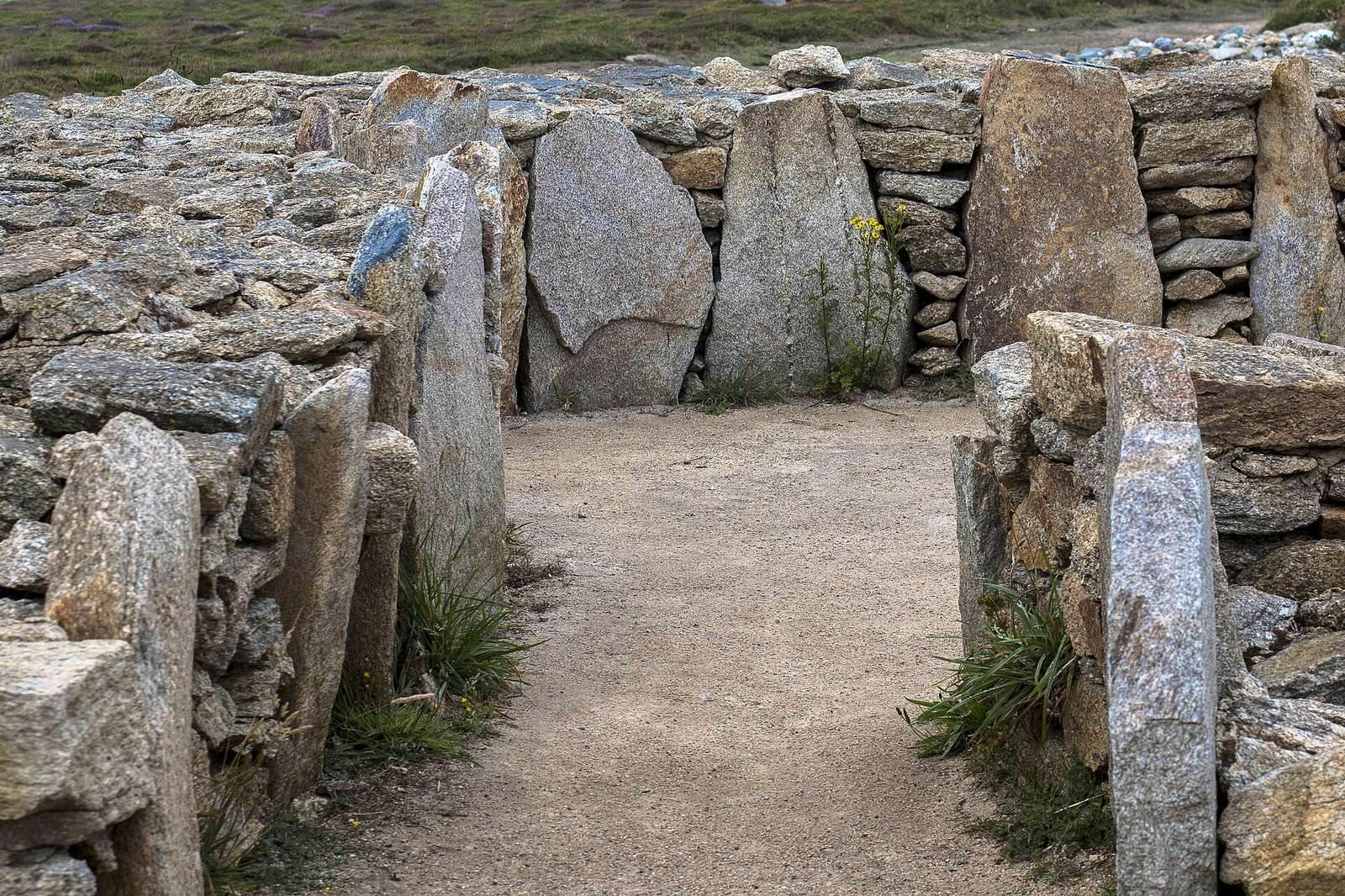
Excavation and partial restoration clarified the plan of one cairn, with a nearly square chamber measuring 3.8 m by 3.6 m and a straight corridor joining it from the side to create a P-shaped passage tomb. A second structure of the same type is larger, measuring 6.2 m by 4.8 m, and has a corridor 3.75 m long.
Excavated objects and pottery
Stone and personal objects
Grenot’s excavations yielded two flint axes, one complete and two truncated spearheads, arrowheads, and more than 2,000 flakes. More than 200 flakes, which Grenot called “knife flakes,” were noted for their workmanship. Other finds include pebbles of quartz, sandstone, and schist; a red-quartz necklace bead; two polished, perforated pebbles for suspension; two flint pendants; a bracelet; a child’s ring; and assorted metal fragments.
Pottery
The excavations produced about 30 pottery sherds and two complete vessels. One is spherical and known as the Vase du Souc’h. The pottery includes a coarse fabric with large inclusions and a finer fabric with a rounded base, finely everted rim, and perforated lugs for handling. This finer type is called Souc’h pottery after the site.
Enclosure and nearby dolmens
Rectangular enclosure
In 1844, de Fréminville described upright, rough stones arranged as a rectangle measuring 78.4 m by 39.2 m. He said the stones were set in a dry-stone masonry base about 65 cm wide. Near one corner, he noted a dolmen that he thought might belong to the enclosure.
Dolmens near the guard post
De Fréminville also described two dolmens near a customs officers’ guard post. Their capstones were somewhat displaced.